

The country has lost its memory; they no longer remember the horror of 24,000 families that were part of the [radio] show. Around 20,000 victims of kidnapping returned to freedom, and 4,000 never came back. They disappeared. Neither the government nor the Guerrillas wanted to talk about the kidnapped; they became a nuisance. Only with the [radio] show were we able to break the wall of indifference. Footnote 1
Again, radio is constantly figured there as a ‘vehicle’, ‘used’ to ‘transmit’, ‘convey’, ‘spread’, and ‘disseminate’ ‘messages’, ‘ideology’, and ‘views’: a technique, in other words, for the expression and distribution of intentional thought as manifested in the technologized voice. To ‘disseminate’, after all, from the Latin seminare, to sow, means to scatter one's seed widely. The roots of the word ‘broadcast’ are similarly agricultural.Footnote 2
1. The humanitarian adventure: By way of introduction
Perched on a hill, overlooking the United Nations Office in Geneva, one can find the towering headquarters of the International Committee of the Red Cross (ICRC). Its current building, originally erected in the late nineteenth century in a neoclassical style to host the Institut International d'Education la Châtelaine, had a long history of entanglements with international law and its struggle to tame the ravages of war through humanitarian aspirations and international norms and institutions. Indeed, it was in the basement of La Châtelaine – often named the Thudichum School, after its owner – that the International Labour Organization (ILO) found its first base of operations.Footnote 3 Immediately before that, during the last two years of the First World War, it had served as a makeshift hospital for French and Belgian prisoners of war (POWs) captured by the German Empire.Footnote 4 After the ILO left for a new lakeside venue in 1926,Footnote 5 the Thudichum was reconverted into the privately owned Hôtel Carlton, servicing some of the high-profile visitors who came to the many meetings held at the League of Nations during the interwar period. When war again broke out in 1939, the Carlton was reconverted into a humanitarian site (endroit): an orphanage for displaced Francophone children aptly named after the founder of the ICRC, the Centre Henri Dunant.Footnote 6
For that reason, it was unsurprising that the Genevese cantonal and Swiss federal authorities sought to endow the ICRC permanently with this venue in the wake of the Second World War.Footnote 7 Since then, the ICRC has slowly but surely expanded its spatial hold over the hill, providing a lighthouse for Red Cross, Red Crescent, and other national humanitarian societies – such as the Magen David Adom – across the world. In 1988, it even expanded its operations deep within the hill itself, with the creation of the International Red Cross and Red Crescent Museum. While, by 1993, this museum was still not seen as a fully developed ‘peace museum’, it truly came into its own after a major renovation from 2011 to 2013.Footnote 8 The current permanent exhibition, named ‘the Humanitarian Adventure’, has been read in museum studies as an attempt to go beyond the typical narrative produced by institutional archives to instead encompass a ‘vast and growing collection into an emotionally touching and engaging story about compassion and timely help to those in need’.Footnote 9 The exhibition, not unlike the International Red Cross and Red Crescent Movement itself (to which the ICRC belongs), is divided into three main areas: ‘Defending human dignity’, ‘Restoring family links’, and ‘Reducing natural risks’. Each area is curated by a different architect or designer, who was given the enormous task of melding a vast array of materials and documents from different crises into a coherent narrative about universal suffering and humanitarian relief.Footnote 10 Each architect or designer, perhaps to highlight the cosmopolitan aspirations of this international institution, hails from a different continent – adding a non-western perspective to an institution long haunted by its ties to a deeply parochial Calvinist tradition.Footnote 11
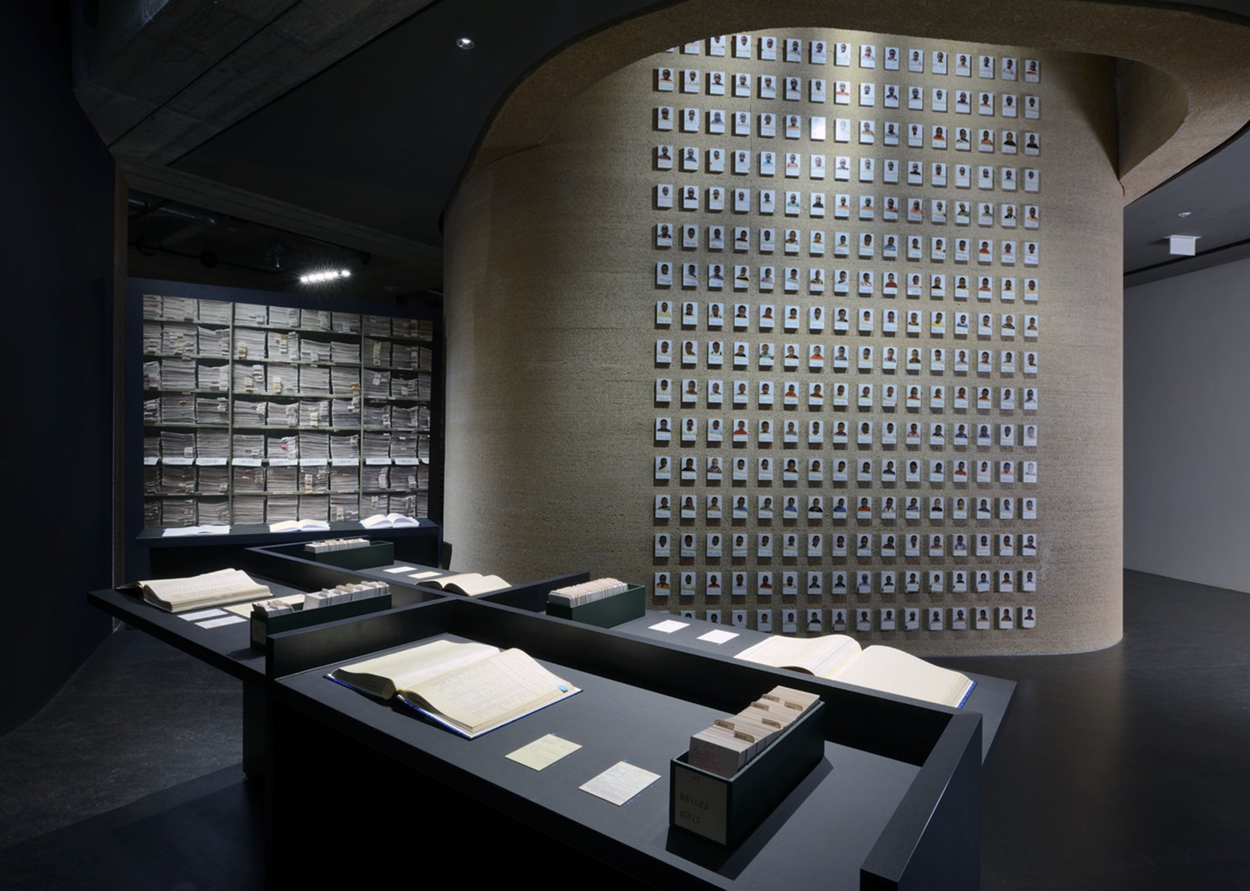
Deep inside the museum, in its area on ‘Restoring family links’, I was confronted with a memento from my youth. Nestled deep within the exhibition, one can find a relatively small but still sizeable collection modestly named ‘Colombia Radio’. Designed by the award-winning Burkinabé architect Francis Kéré,Footnote 12 the whole subsection on broken family ties brings together a panoply of different contexts to create a common horizon of experiences of forcible family separation (see Figure 1). This is, in fact, a quite a literal experience for the museum visitor, who must traverse a curtain of steel chains to enter the sub-exhibition itself. From then on, one is confronted with the name cards of many POWs from the First World War – documents that bear witness to the long history of the ICRC in the protection of those hors de combat. Very quickly, the visitor then moves through time and space, reaching other exhibits related to the terrible violence that erupted in Rwanda and the former Yugoslavia at the end of the previous century. Along the way, the spectator is forced to behold the many ways in which armed strife curtails communication and family ties, in tandem with the tireless efforts of humanitarian actors – the ICRC, chief among them – to keep channels of supply and information open, even in the most dire of times.Footnote 13 In his choice of exhibits, materials and installations, Kéré deliberately wanted to emphasize the ‘intrinsic link between the family, roots[,] and natural elements … as a way to symbolize people's return to their roots and to nature in times of turmoil and tragedy’.Footnote 14 In his view, the ‘simplicity of the materials and the way they are put together spares visitors from heartless materialism during the difficult search for the missing’.Footnote 15
A subsection of the ‘Restoring family ties’ sub-exhibition
Source: Kéré Architecture 2012 ©
Note: I thank the team at Kéré Architecture for their permission to reproduce this image.
I, for one, was brought back to my roots by ‘Colombia Radio’. Basically, this section contains many audio excerpts from a 2010 radio recording with a small ‘historical bookmark’ card titled ‘Hostage-taking in Colombia’ (in French, Arrêt sur histoire, sequestrations en Colombie). The source was the famous radio show Las Voces del Secuestro (roughly translated, The Kidnapped Voices), created by the war reporter Herbin Hoyos. After a brief period as a hostage of the Fuerzas Armadas Revolucionarias de Colombia – Ejército del Pueblo (FARC-EP) guerrilla group, Hoyos ran the radio show from 1994 until 2018. During this 24-year period the families of those abducted sent out public messages of love and remembrance each morning, hoping that their loved ones – deep in the jungles and mountains of Colombia – would be able to hear the broadcasts from their radios. While I was fortunate not to have any close family or friends among those detained by the war, I – like two or three generations of Colombians – still have vivid memories of the many ways in which the radio show served as a background for everyday life during the last 30 years of internal armed conflict. For better or worse, the Voces curated
a national bank of emotions, an oral history of violence and anguish, a discography of voices that resonated through the jungle, an encyclopaedia of cultural memory whose entries range from prayers, diary entries[,] and news items to even salacious gossip about who was having an affair with whom.Footnote 16
2. ‘A national bank of emotions’: The Voces and the Colombian armed conflict
The Colombian war, to be sure, has continued and mutated in various ways since the radio show first started in the 1990s or when the particular session cited in the epigraph was recorded in 2010. That fact, however, is not entirely apparent to the museum visitor in Geneva. Indeed, by including these recordings in the exhibition, they are taken from the specific time and place in which they were produced. While the humanitarian framing of the museum allows the Colombian experience to abstract itself into a wider horizon of tales of abuse and suffering, it also detaches these recordings from the particular political struggles and contexts that animated their emergence.Footnote 17 In this article, drawing from and aiming to contribute to the bourgeoning literature on the political economy of the humanitarian imaginaries and practices (which highlights relatively unexplored questions related to the institutional channels for the creation and circulation of knowledge),Footnote 18 I examine this radio show as a dispositif of power and knowledge, which (re)produced a particular understanding of memory, suffering and injustice. By dispostif, following the Foucauldian tradition, I refer to an assemblage of heterogeneous elements (both concrete and intangible) that enable and constrain human practices and imaginaries.Footnote 19 For example, in his work on the birth of the clinic or of the prison, Foucault highlighted the interconnection between ‘discourses and architectures, coercive regulations and scientific propositions, real social effects[,] and invincible utopias’ which underpinned what he called the ‘medical-hospital’ or the ‘juridico-political’ complexes in modern western societies.Footnote 20 In this same vein, I am interested in exploring how the materiality of this radio show enabled the dissemination of particular legal discourses about violence and victimhood – with important consequences for Colombia's contemporary transitional justice process. Indeed, given that these processes of circulating legal knowledge promoted a particular reading of legal categories (such as victim, impunity or justice) for the Colombian non-international conflict, their operations should concern international legal scholarship. They offer, for better or worse, an example of how a ‘vernacular’ understanding of international law, human rights law and international humanitarian law came into being in a fraught political atmosphere.Footnote 21
With this in mind, I am particularly concerned in this article with how these radio emissions were used by far-right political actors (such as Hoyos himself) in Colombia to mobilise the anti-impunity principle against the recent (2016) peace process – and its crown jewel, the Special Jurisdiction for Peace (JEP).Footnote 22 After a long process of negotiation between the Colombian government and the aforementioned FARC-EP guerrilla group (which involved a failed referendum and the extensive involvement of international experts and funders), the country adopted a vanguardist transitional justice model. This system, the Comprehensive System of Truth, Justice, Reparation and Non-Repetition (in Spanish SIVJRNR) brings together different transitional justice mechanisms (such as a truth commission and an ambitious administrative reparation programme) to create the foundations for a lasting peace after decades of armed strife.Footnote 23 At the centre of this system sits the JEP, a special transitional tribunal with the task of adjudicating the most egregious violations of human rights law and international humanitarian law, on the basis of both Colombian domestic law and international law.Footnote 24 To fulfil this daunting task, the JEP needs to engage with the ‘national bank’ of collective memories produced by decades of violence – under the careful gaze of the International Criminal Court or the Inter-American Court of Human Rights, as a result of the highly ‘juridified’ and ‘judicialised’ nature of the Colombian transitional process.Footnote 25
This is especially true for the JEP's engagement with the thorny question of the FARC-EP's widespread practices of kidnapping. Even before the tribunal opened its investigation of these practices through its macro-case 01, the shadow of Hoyos’ Voces del Secuestro loomed large over Colombia's transitional justice process. For this reason the JEP will be obliged to engage with the thick layer of legal meaning that was created by this show in the Colombian collective imagination.Footnote 26 For, in a country deeply traumatised by the effects of these kidnappings, this radio show galvanised the claims of those who thought the JEP – and the peace process more broadly – was nothing but a sham that would guarantee the impunity of former guerrilla perpetrators to the detriment of victims. With this in mind, in this article I trace the ways in which this radio show engaged the anti-impunity principle in international law to agitate against the 2016 peace agreement. In other words, I argue that in the longest non-international armed conflict in Latin America, even radio waves served the continuation of war by other means. My aim, to be sure, is not to criticise the radio show or the Red Cross Museum as much as to politicise and contextualise them – to make concrete the rather abstract promises of their humanitarian adventures. In other words, I suggest that the content of the radio show cannot be placed above politics in the realm of humanitarian neutrality.Footnote 27 Instead, I foreground how this show has been actively used by political actors, especially those on the far right, in the battle for the ‘field of memory’.Footnote 28 The seemingly intangible nature of radio and the humanitarian aspirations of this particular show should not lead us mistakenly to take it as an instance of ‘heartless materialism’ – to paraphrase from Kéré's description of his exhibition. For, just as history is not an impartial umpire in human power struggles,Footnote 29 the Kidnapped Voices were also entangled in the strategies of the political far right in Colombia. As such, its humanitarian lens captured a partial and arguably narrow understanding of Colombia's internal armed conflict, which highlighted a series of practices (kidnapping or hostage taking) of a particular group (far-left guerrillas, like the FARC-EP) while disregarding or downplaying other forms of political violence – such as the forced displacements and massacres perpetrated by right-wing counterinsurgent or parastate groups.
To argue this, following the two introductory sections already offered to the reader, I provide an overview of the history of this radio show (Section 3). I then focus, in Section 4, on the ways in which the show engaged with the categories and institutions of ‘humanity's law’Footnote 30 – highlighting how the show was actively ‘translating’ these notions in the Colombian public sphere precisely at a time in which what Orozco called the ‘humanitarian consciousness’ increasingly gained salience in, and beyond, Colombia.Footnote 31 I highlight how humanitarian discourses have been used for illiberal purposes and objectives, which run against the lofty aspirations of Geneva's hilltop ICRC headquarters.Footnote 32 Finally, this allows me to conclude with some comments on materiality and the political economy of remembrance (Section 5).
3. ‘For freedom and against the atrocities of terrorism’: Hoyos in his political context
‘Wars are won in the field of information’, proudly declared Hoyos in a 2011 interview in a student newspaper edited by the Universidad Católica de Pereira.Footnote 33 He would know, as in this interview he claimed a long experience of war reporting not only in Colombia but also in the Balkans, Iraq and Chechnya. Hoyos also backs up his claim by referring to his expertise in questions related to human rights, international humanitarian law, conflict resolution and anti-terrorist strategies – subject areas which are allegedly covered by his personal library.Footnote 34 While all journalistic activity entails some degree of risk, Hoyos decided to embrace the extra challenges that arise in situations of war. He justifies this by his sense of duty and in the profound love for his values, which has pushed him to come to terms with the sacrifices that this task might entail.Footnote 35 The image of Hoyos that appears in this 2011 interview, just like that of his show that is curated in the humanitarian museum in Geneva, is that of an impartial and expert observer – untouched by the morass of factional political strife.
However, this image of Hoyos is tenable only if one divorces him from the concrete constellation of factors that led to the emergence of his show in the first place. Against this, I suggest we should understand his project in the context of the reorganisation of the media establishment that occurred during the rule of Álvaro Uribe Vélez (2002–2010) in the first decade or so of the millennium.Footnote 36 Rather than seeing Hoyos as a lone entrepreneur or a journalistic ‘great man’,Footnote 37 in what follows I reconstruct his project in the framework of a broader reconfiguration of the Colombian right and far right during a period marked by the anxieties of the rise of the left-leaning political parties in the rest of the continent (something that Latin American studies often call the ‘pink tide’ of the turn of the century)Footnote 38 and their disappointments with previous – and often ‘forgotten’– peace negotiations.Footnote 39 In that sense the Voces should be understood as part of a broader system that resonated with the Uribe government's strategy to remake the Colombian ‘social constitutional state’ (estado social de derecho) into a ‘State of Opinion’ (Estado de Opinión) in the pursuit of the doctrine of ‘democratic security’.Footnote 40
To be sure, Hoyos opened his programme well before the arrival of Uribe to power in 2002. As he himself narrates, the show came out of a promise he gave to other victims of the FARC kidnapping practice when he was also taken hostage back in 1994.Footnote 41 During his time in the jungles and mountains, he realised that the far-left guerrilla group gave each and every one of those it kidnapped a modest survival kit which included, at least, a radio, toothbrush and toothpaste, and a rain poncho.Footnote 42 When he was freed by the Colombian army, Hoyos fulfilled his oath to his fellow kidnappees and created the first radio show created specifically to raise consciousness in relation to the plight of those kidnapped. The allure of the show was nested in its capacity not only to engage with everyday Colombian civilians, but also in its ability to reach (through the radios of the personal kits given by the FARC) to those who were kidnapped – reaching, in a way, places in which the Colombian state and armed forces could not even dream of penetrating.Footnote 43
This focus on kidnapping, as opposed to a more holistic understanding of violence, is important because in the Colombian armed conflict certain types of violence have been employed with more salience by particular actors.Footnote 44 For instance, the 2013 report of the Colombian National Center for Historical Memory (CNMHFootnote 45), ‘Enough: Memories of War and Dignity in Colombia’, concludes that roughly 90.6 per cent of kidnapping operations were carried out by left-wing guerrillas, whereas only 9.4 per cent were carried out by right-wing paramilitary groups.Footnote 46 The same is true for attacks on civilian lives and property. Extrajudicial killings, on the other hand, were almost equally carried out by various armed actors, with around 33 per cent attributed to the paramilitaries, 19 per cent to the guerrillas and 16 per cent to state actors.Footnote 47 However, nearly 60 per cent of all massacres were committed by right-wing paramilitaries, with 17 per cent allocated to the guerrillas and 8 per cent to the Colombian security apparatus.Footnote 48 These forms of violence generally are also connected to particular sets of victims: while far-left kidnappers targeted mostly urban and rural elites to finance their activities,Footnote 49 far-right paramilitary massacres and extrajudicial killings were linked to practices of forced displacement and land grabbing.Footnote 50 These patterns of violence, by and large, have been ratified by the recent findings of the Colombian Commission for the Clarification of Truth, Coexistence and Non-Repetition (CEV). This institution, which – like the JEP – was created as part of the Havana Peace framework,Footnote 51 issued its final report in the summer of 2022.Footnote 52 For instance, the technical annex on the statistics of the conflict – commissioned by the JEP, the CEV and the civil society organisation Human Rights Data Analysis Group – concluded that ‘there is evidence that the paramilitaries were the main actors responsible for forced disappearances and homicides, while the FARC were the main culprits of kidnapping and the recruitment of boys, girls and teenagers’.Footnote 53 To be sure, while these exact figures are debatable – and indeed, are being debated right now by the Colombian transitional justice institutions – it is difficult to deny that by the 1990s the ‘war of massacres’ had been the preferred form of violence of the far-right paramilitariesFootnote 54 while the far-left guerrillas had opted for systematic practices of kidnapping.Footnote 55 This is especially true for the Marxist FARC-EP guerrilla group, which is estimated to have committed more kidnapping operations than those attributed to the paramilitaries and the Catholic-Marxist guerrilla ELN (National Liberation Army) together (see Figure 2).
Statistical estimates that correlate instances of violence with the groups that committed them
Note: Above: homicides; below: kidnappings (in Spanish).
Source: JEP-CEV-HRDAG 2022 ©. Extracted from JEP and others (n 53) 17.

Indeed, while the left-wing guerrillas had experimented with some high-profile cases of kidnapping in the 1970s, these practices only became widespread in the 1990s. Prieto even identifies a ‘massification’ of kidnapping between 1996 and 2010, drawing again on figures provided by the CNMH.Footnote 56 In fact, the emergence of the right-wing paramilitaries is often credited to the exasperation of elite families and rising drug traffickers with the kidnapping of their families, of which the group Death to Kidnappers (Muerte a Secuestradores – MAS) was the most salient perpetrator.Footnote 57 It was in this context that Gabriel García Márquez (the Nobel-winning author) penned his News of a Kidnapping, which Hoyos and González-Jácome have read as a reflection on legality, violence and hostage taking in this tense period of Colombian history.Footnote 58 However, the 1990s was a decade also marked by the exacerbation of other forms of violence. For that reason, a focus on kidnapping – rather than on the emergence of other forms of violence (such as massacres) or armed actors (such as drug traffickers or right-wing paramilitaries) – shows that the framing taken by the Voces highlighted certain aspects of the Colombian conflict, downplaying others.Footnote 59 Of course, my point here is not that Hoyos should have covered all human rights violations equally, which would have been truly impossible.Footnote 60 Nor am I arguing that any actor that agitated against kidnapping was necessarily pursuing a right-wing agenda – indeed, I cite Gabriel García Márquez (whose left-leaning politics pushed him towards a long exile in MexicoFootnote 61) as a good example of how different sectors of Colombian society came to rally against kidnapping during these turbulent years.Footnote 62 Rather, I highlight that claims of victimhood are never neutral, as every denunciation carries an implicit hierarchisation of the many ways in which violence is inflicted at the individual or structural level.Footnote 63
This exasperation with the far-left guerrillas (and with the FARC in particular) reached its highest mark in the wake of the failed peace process, which took place between 1999 and 2002 – colloquially known as the el Cagúan process.Footnote 64 Since the early 1980s, almost all of Colombia's presidents have attempted to negotiate peace with the left-wing guerrilla groups, with varying degrees of success. While the demobilisation of the left-leaning Movimiento 19 de April (M19), which occurred under President Virgilio Barco (1986–1990), gave the country high hopes for a political solution to armed strife, the failure of the Cagúan process left a profound sense of distrust of the guerrillas among the Colombian establishment. In this process, led by the administration of Andrés Pastrana (1998–2002), the FARC was allowed to roam freely within a demilitarised zone of 42,000 kilometres during almost three years while the negotiations unfolded.Footnote 65 The slow advance at the negotiation table and the extensive deployment of the FARC within the zone led many citizens to doubt the group's commitment to a political settlement. A highly symbolic instance of this for many Colombians is the so-called empty chair (silla vacía) incident of el Cagúan: as the highest guerrilla leader had opted not to go in person to the opening of the negotiations, President Pastrana was forced to sit awkwardly beside an empty chair.Footnote 66 After a series of disappointments, Pastrana declared the peace process a failure and ordered the armed forces to bomb the demilitarised zone in 2002. Shortly thereafter, the FARC kidnapped a right-wing presidential candidate, Ingrid Betancourt, who had ventured into the former demilitarised zone.Footnote 67 The image that emerged out of 2002 was that the FARC had tricked the Colombian establishment into giving it a three-year truce, which allowed it to prepare seriously for a military takeover of power, financed by the surpluses generated by kidnapping and drug trafficking. As the window for peace negotiations closed, Pastrana addressed the nation to tell all citizens that he wished ‘the Archangel Saint Michael [to] protect us’ from what would come next.Footnote 68
In lieu of divine intervention, Colombia got instead the landslide election of Álvaro Uribe Vélez, who would rule for two terms from 2002 to 2010 – overturning, along the way, the constitutional prohibition of presidential re-election.Footnote 69 While Uribe was formerly tied to the centre-right Liberal Party (Partido Liberal), his platform had effectively broken the hegemony of the traditional two-party Colombian system to create instead a broad consensus around his ‘neopopulist’ law-and-order approach.Footnote 70 A central part of this vision was that the only legitimate conclusion for Colombia's armed conflict was the military annihilation of the FARC in the battlefield – which was then known as the ‘military option’ (as opposed to a ‘political’ solution).Footnote 71 In this vein, the Uribe administration pursued a two-pronged strategy to end the armed conflict: on the one hand, it sought to negotiate a lenient demobilisation process with the right-wing paramilitaries through the so-called Justice and Peace Process, which was enacted via Law 975 of 2005.Footnote 72 At the same time the Uribe administration pursued a series of aggressive military operations against the left-wing guerrillas, which was accompanied by a series of media operations that sought to justify the legitimacy and legality of state violence against these groups. Marketing and mass media were crucial parts of this strategy – the Uribe administration and its allies actively deployed communication strategies to demobilise and demoralise far-left guerrillas into entrepreneurs and consumers, while at the same glorifying counterinsurgent ‘freedom fighters’.Footnote 73
While the creation of the Voces by Hoyos predated this strategy by some years (1994), it gained the salience it had in Colombian politics only during the Uribe era (2002–2010). In was part of a broader constellation through which journalists and media operators adjusted to the expectations of the Uribe war-related vision of ‘democratic security’.Footnote 74 In the same vein, the Uribe government mobilised the notion of ‘terrorism’ to brandish the guerrilla groups as actors who were beyond the pale of the law – as such, placing them outside the purview of the protection of the laws of war and international humanitarian law.Footnote 75 In this turn he found a key ally in Hoyos, who had been writing about ‘terrorism’ outside and within Colombia since the late 1990s.Footnote 76 Not in vain did Uribe explicitly cite the importance of this radio show in his 2012 memoirs, which sought to provide a retrospective justification for the increased militarisation of the armed conflict that occurred under his mandate.Footnote 77 A salient example of this was that the most spectacular military operation carried out to rescue kidnapped victims from the FARC (the so-called Operación Jaque) was made possible through the deliberate abuse of the emblems of the ICRC, in a case of ‘permissible perfidy’, which caused outrage in Geneva and beyond.Footnote 78 It is telling, for instance, that as soon as the aforementioned presidential candidate Ingrid Betancourt was liberated by Operación Jaque, she praised the important role that Hoyos and his show played during her time in the jungle.Footnote 79
For all the above, I argue that the Voces cannot be read only as a humanitarian platform which sought to raise consciousness of the plight of those kidnapped. It was certainly that, but it was also part of a wider system through which the Colombian state waged its war against the FARC: a strategy which combined military operations, legal justifications and mass media interventions. If law can sometimes serve the prolongation of war ‘by other means’, the same was true for its radio waves.Footnote 80 It was no coincidence that during the same years in which the radio show raised consciousness about the plight of those kidnapped, the government adopted a heavy-handed military strategy, which denied any sort of protection for FARC-EP ‘terrorists’. Indeed, during these years Uribe denied the existence of a non-international armed conflict.Footnote 81
In sum, Hoyos and his programme – not unlike Uribe (whose father had died in a botched kidnapping attempt in 1982Footnote 82) – was very much a product of the anxieties of a rising far right exasperated with far-left kidnappings in the 1990s. I am not suggesting that either of these figures are easily reducible into each other: Hoyos did not ‘create’ Uribe, but nor is the opposite true. My argument here is one that is analogous to that raised in the historiography with regard to the relation between Uribe and the paramilitaries.Footnote 83 Instead of asking whether Uribe created the paramilitaries or if the opposite is true, I think we should see this period as being marked by the creation of lasting far-right coalitions between armed actors, political figures, and media operators – without imputing a determinant role to either of these components. Hoyos was neither a ‘puppet’ of higher powers, but nor was he an unentangled lone rider. He acted within a particular political context of ‘structured contingency’Footnote 84 to pursue a political agenda which required him to mobilise his cultural capital in exchange for patronage or leverage.Footnote 85 Through its use of legal categories, this agenda was able to outlive Hoyos and his radio show – with important consequences for the Colombian transitional institutions entrusted with the implementation of humanity's law. I turn to this now.
4. ‘Whoever invokes humanity wants to cheat’:Footnote 86 On the political uses of the legal categories of ‘humanity's law’
Legal categories were actively mobilised by Hoyos and the Voces, especially as the Uribe administration found itself increasingly on the defensive in the last years of its regime. For instance, Hoyos was one of the central actors who called for the mass mobilisation of ‘a million voices against the FARC’ (un millón de voces contra las FARC) of 2008,Footnote 87 which sought to justify another constitutional reform to allow for Uribe's third re-election. The alternative, Uribe and his supporters claimed, was a constitutional catastrophe (hecatombe) which would result in the victory of the far-left guerrillas and the collapse of the institutional order. As mentioned above, while Uribe had been able to reform the Constitution once for his first re-election, now his camp wanted to pass a grass-roots referendum to allow a further constitutional reform that would allow ‘that who: has held the office of President for two-terms can be elected for a third’.Footnote 88 This process started in 2008 with a campaign of mass mobilisation (through the collection of signatures) in favour of the referendum and the elevation of this proposal into a law in 2009.Footnote 89 While this process was eventually cut short when the Colombian Constitutional Court ruled this whole ordeal to be unconstitutional in 2010,Footnote 90 for the purpose of this article's argument what matters is that Hoyos actively mobilised his radio show and political capital in favour of Uribe's agenda.Footnote 91 Moreover, his position was not shared by all victims of kidnapping associations. Some family members of those kidnapped and more left-leaning victim groups opposed the mobilisation, arguing that it was more invested in satanising the FARC than in negotiating the release of kidnapped victims. In fact, these mobilisations clashed with the efforts with other humanitarian actors which had sought to engage with the FARC's overtures for ‘humanitarian exchange’ – a euphemism which stood for a process through which the Colombian army released FARC combatants in exchange for the liberation of kidnapped actors.Footnote 92 Against this, Hoyos and the Uribe administration pushed for the military liberation of the victims – a strategy viewed with some scepticism by family members on the ground of the high risks these operations entailed for those who were kidnapped.Footnote 93
However, the real turning point for Hoyos and his programme in terms of usage of international legal categories – and of the Colombian right in general – came a couple of years later, once they found themselves out of power.Footnote 94 After the Colombian Constitutional Court blocked the third re-election of Uribe in 2010,Footnote 95 the Colombian far-right deposited its faith in Uribe's former Minister of Defence, Juan Manuel Santos. The latter was elected in 2010 with Uribe's backing and under the colours of his political party – named the U: Party of Unity, which in practice really stood for the ‘U’ in Uribe. However, Santos proved to be an unruly puppet, and slowly but surely came to be seen as a traitor to the hardliner Uribista tradition.Footnote 96 Indeed, in a couple of years, Santos surprised all political actors by turning from an exemplary Minister of Defence committed to ‘the military option’ and ‘democratic security’ to a President who reopened negotiations with the FARC in 2012.Footnote 97 As Hoyos himself admitted, while news of the peace process first seemed to offer hope for the liberation of those kidnapped, he and other actors of the far right increasingly started to see the Santos process as a capitulation to the FARC, which would guarantee the impunity of its kidnapping operations.Footnote 98 His radio show became an important tribune for this agenda – in which law played a central role. For instance, in 2016 he used his show to denounce the peace process as one in which ‘the government made humanitarian concessions without any guarantees’.Footnote 99 Furthermore, in 2020 he even denounced pro-peace lawyers as pro-FARC and pro-impunity puppets – an act for which he was challenged in a domestic defamation suit and for which he was ordered to issue a public retraction.Footnote 100
Anti-impunity, as Alviar García and Engle have argued, became – perhaps surprisingly so – a central banner in the agenda of Hoyos and other far-right actors as they became disgruntled with the Santos administration and its peace process.Footnote 101 I say ‘surprisingly’ because for a long period Uribe and his allies had been the accused in fostering impunity, rather than those who raised the accusations.Footnote 102 Indeed, concerns related to the promotion of impunity were long raised by human rights organisations and left-leaning grass roots activists against Uribe's process of ‘Justice and Peace’ with the right-wing paramilitaries in 2005.Footnote 103 In a game of ‘inverted mirrors,’ far-right actors now found themselves brandishing allegations of impunity against the Santos-FARC peace process.Footnote 104 As Hoyos himself noted in an interview, the peace process led to his ‘radicalisation’, as he became convinced that the process would ‘cover-up’ (tapar) the crimes of the FARC – and its heinous practices of kidnapping, in particular – to the detriment of the rights of victims.Footnote 105 At this point, Hoyos and his allies realised that they could use the categories of international humanitarian law for their own far-right political agenda, which were quite different from the seemingly progressive and liberal aims of the ‘humanitarian consciousness’.Footnote 106 If the new FARC peace process was one which was not only thoroughly ‘juridified’Footnote 107 but also ‘judicialised,’Footnote 108 then the far right stood much to gain if it managed to mobilise these concepts for its illiberal purposes.Footnote 109 It is important to note that ‘impunity’ is a legal category, and not merely of a moral nature. As Simpson noted, it is quite distinct to argue that a war or legal institution is immoral or inconvenient rather than to say that it is illegal under international law.Footnote 110 This entails a call not to politics as usual but mobilises a set of higher values rooted in a core of common commitments to ‘humanity's law’.Footnote 111 For this reason, I am not necessarily interested in providing a ‘right interpretation’ of the anti-impunity principle (nor of clarifying the circumstances under which FARC detention would be illegal or legal), but to examine the malleability of this legal doctrine for all kinds of political purpose.Footnote 112
This fact was not lost on Hoyos and the Voces, as they set their eyes on the Special Jurisdiction for Peace (JEPFootnote 113), the special transitory judicial mechanism created by the Santos-FARC peace process in Chapter 5 of the Havana Peace Agreement.Footnote 114 As I have explained in more detail elsewhere, in the 2012 Havana process – in contrast to the 2005 paramilitary demobilisation process – ‘compliance with international standards [on the rights of victims] took centre stage’.Footnote 115 For this reason, the Havana negotiators (with much advice from international experts) created an ‘integrated system of Truth, Justice, Reparation, and Non-Repetition’, of which the JEP was the crown jewel. This Special Jurisdiction was tasked with the implementation of a regime of alternative, non-prison-based punishments. Confident of the technical soundness of the agreement, the Santos administration decided to hold a nationwide plebiscite so that Colombians could ratify what was negotiated between the government and the FARC.Footnote 116
To everyone's surprise, the peace accord was rejected by a slim majority of voters in 2017 – no doubt in part because ‘Colombian citizens did not widely support the peace agreement, partly due to the influence of Uribe, who mobilised his Democratic Centre party against the agreement, ultimately quashing a referendum to ratify it’.Footnote 117 However, to those following the Voces this should not have been a surprise; in fact, Hoyos and the programme had long rallied against the JEP.Footnote 118 In particular, Hoyos raised claims of impunity and the rights of the victims (of the FARC) to argue that the JEP was incompatible with domestic and international law.Footnote 119 While the far right pursued a misinformation campaign, which used a variety of tropes (from anxieties related to gender and sexuality to concerns about economic redistribution),Footnote 120 the impunity of FARC kidnappings was a crucial element of its repertoire. Hoyos, in 2019, went as far as proposing a nationwide referendum to abolish the JEP – a measure that was ultimately unsuccessful but was widely supported by the Uribe camp.Footnote 121 In an interview Hoyos gave to another university newspaper, he declared that his proposal was being put forward by a ‘federation’ of ‘10 million victims’ who wished to prevent submission of the Colombian judiciary to ‘bandits’.Footnote 122 In his Twitter account, Hoyos denounced those who defended the JEP as motivated by their selfish self-interest: the defenders either had ‘their women working there [tiene la mujer allá metida]’, had ‘personal and political ties to the corrupt judiciary’, or were pro-FARC left-wingers [mamertos] who had no respect for the country [no le duele el país].Footnote 123
While this attempt to abolish the JEP was ultimately unsuccessful,Footnote 124 the crusade led by Hoyos and his followers outlived the end of the Voces show in 2019 – and even of Hoyos himself, who died of COVID-19-related complications in 2021. His death was promptly followed by a shower of obituaries from the Colombian establishment and those involved in the Uribe anti-FARC constellation – from the US Embassy in Colombia to Uribe himself and many of his followers.Footnote 125 However, not even Hoyos’ death prevented him from challenging the JEP one last time. The JEP, earlier that year, had issued an administrative writ (in Spanish, auto) which opened one of its landmark criminal investigations on the taking of hostages by the former FARC guerrilla.Footnote 126 Instead of investigating every single violation of human rights and international humanitarian law, the JEP grouped together a series of ‘macro cases’ (macrocaso) which sought to make sense of structural patterns of violence. As a result of the salience of the FARC's kidnapping practices, the first ‘macro case’ was devoted to hostage taking – no doubt, in part, because of decades of consciousness-raising efforts by actors like Hoyos, among others.Footnote 127 In this writ the JEP noted that it had added to its pile of evidence a report prepared by Hoyos titled ‘Las Voces del Secuestro’ on 10 January 2020.Footnote 128 The report compiled the information of 104 high-profile instances of kidnapping, with the purpose of giving ‘voice to the experiences of victims and family members’.Footnote 129 Unsurprisingly, the documentary evidence was accompanied by a hefty annex of audio files from the radio programme. Even after its formal closure, the echoes of the Voces continued to reverberate in the ways that everyday Colombians and transitional justice operators have to interpret the relevance of the anti-impunity principle in relation to FARC-EP kidnapping operations.
Just as Uribe-aligned actors had done with regard to anti-impunity rhetoric, Hoyos now came to realise that even he could use the JEP's commitment to ‘humanity's law’ to pursue his anti-FARC political goals.Footnote 130 The project of the Voces, born in the anxieties of the 1990s, had now come full circle as an integral part of the Uribista backlash against the Havana peace process in the 2020s. Now, instead of shying away from international humanitarian law or human rights law – as the far-right camp had done during the decades in which it denied the existence of a non-international armed conflict and the application of international law – Hoyos realised he could use the anti-impunity principle. Alas, even if Hoyos ultimately had been unable to defeat his political enemies through the abolition of the JEP, he then decided he could join them! Because of the JEP's extensive mandate to apply international human rights and international humanitarian law, and to abide by the anti-impunity principle (which, as mentioned, would be carefully monitored by international institutions), this allowed him plenty of leeway to use these ‘liberal’ legal categories for illiberal purposes.Footnote 131 A telling way in which this ‘national bank of emotions’ has been mobilised has been to question the JEP decision to refer to these practices of kidnapping as ‘illegal detentions’ (retención ilegal).Footnote 132 With this move, the JEP was recognising that – pursuant to international humanitarian law – there might be cases of legal detentions committed by a non-state actor in the framework of a non-international armed conflict.Footnote 133 This, of course, went against the narrative of lawless terrorist kidnapping – which is why Hoyos and other actors close to the Voces created the Twitter hashtag #NoEsRetenciónEsSecuestro (#ItIsNotADetentionItIsKidnapping) to contest the use of these legal categories and reframe the JEP approach to the case.Footnote 134
5. Concluding remarks: The material histories of the humanitarian adventure
It could be said that both radio waves and aspirations of ‘humanity's law’ share a certain ‘unbearable lightness of being’.Footnote 135 Because of their seeming immateriality and their ability to pierce through spatial barriers, it is tempting to think of radio waves as free-floating. Yet, as historians of sound and radio would remind us, such ‘immaterial’ operations exist only because of the interplay of a series of very material technologies and infrastructures which allow for the movement of sound through time and space.Footnote 136 Their ‘lightness’ is nothing but innocent – a fact that was clear to the many legal operators that have sought to regulate radio waves in both the domestic and international spheres since the early twentieth century.Footnote 137 As such, an interrogation of the material histories of these technologies allows us to understand better their political and distributive attributes: they show us who stood to ‘win’ or ‘lose’ from the unleashing of radio waves.Footnote 138 The same is true, of course, for the contested body of imaginaries and practices we understand as ‘humanitarianism’ and ‘humanity's law’. While their allure lies in their ability to anchor themselves in claims of humanity that go beyond factional strife, these seemingly ‘immaterial’ arguments can exist only through the operation of the ‘heartless materialism’ of concrete political constellations.Footnote 139
In this article I have questioned the separation of the moral substance of the ‘humanitarian adventure’ of the Voces del Secuestro from the specific political context in which this project emerged in Colombia at the turn of the millennium. Instead of seeing this radio programme as an impartial and neutral campaign that tends to the suffering of the victims of kidnapping and their families (as it was portrayed by the museum exhibition reviewed above), I have suggested that it responded to a very particular political vision of the Colombian armed conflict, which has important distributive consequences. This is not to say that the programme is not valuable or important. More than questioning the substantive content of the radio show, I am interested in dispelling its claims to neutrality.Footnote 140 Rather than judging its content, I am interested in exploring its entanglement with questions of political economy, factional strife and the distribution of resources.Footnote 141 for there is more than what meets the eye of the casual observer of ‘radio Colombia’ in the International Red Cross and Red Crescent Museum. In this lofty installation, we hear echoes of the persistence of the far right in Colombia and beyond. The exhibition is not a monument to the past but a very concrete intervention in the present – with political implications for the future. As Benjamin reminded us, ‘if the enemy wins … even the dead will not be safe’.Footnote 142 In Colombia and elsewhere ‘this enemy has not ceased to be victorious’.Footnote 143
Acknowledgements
I thank the conveners of and the participants in the online conference ‘Transitional Justice: A Time for a Material Turn’, held on 13–14 June 2022, for their feedback on an early version of this argument. I also thank the reviewers and editors for their generous comments on a later version of the manuscript, and I thank Alejandro Muñoz-González for his engagement with the final text. All views expressed in this article and all errors remain those of the author.
Funding statement
This article was written at a time in which the author had been awarded a Doc.CH grant (P0GEP1_200077) by the Swiss National Science Foundation. The views expressed in the article are the author's own and do not reflect those institutions with which the author has been affiliated.
Competing interests
The author declares none.


 Open access

