

Introduction
In the last two decades a visual turn has developed in IR that shows the importance of taking what we see, and the process of seeing, seriously.Footnote 1 Scholarship has focused on analysing widely circulated images – which typically represent wars, catastrophes, and international crises – to understand what such images do. Scholars have demonstrated the importance of visual representation in shaping political narratives and enabling action (or inaction): from Hansen’s study of the Mohammed Cartoon CrisisFootnote 2 to Roland Bleiker et al.’s analysis of the visual dehumanisation of refugees.Footnote 3 The interest in representation has put the methodological emphasis on visual analysis. While the visual turn has centred images of war and crisis, the discipline of security studies has largely focused on great power politics, political elites, big events, and moments of rupture. Together, they reinforce a dominant image of security as spectacular, as about ‘the big stuff’. In contrast, this article grew out of two separate research projects speaking to emergent debates on the everyday life of security.Footnote 4 Jonna Nyman’s research examines everyday security landscapes in urban China, while Adam Ferhani’s project investigates the work of health security professionals at the UK border. Both projects centre long-term ethnographic fieldwork and found a significant gap between the dominant vision of security in the discipline and what we were seeing day-to-day. One of the ways in which we both explored this gap was through photography.
In IR and security studies, research on the everyday has begun to disrupt the focus on elites and high politics. This has included growing interest in new methods adapted from other disciplines, most notably ethnography and focus groups, to examine everyday experience and reproduction of international politics and security.Footnote 5 Here we situate our work within an emergent strand of research engaging with the everyday and the visual.Footnote 6 Building on this work, this article turns to visuality and ways of seeing. In a move away from visual analysis towards visual method, we are interested in exploring the visuality of security not ‘by examining images … but by making them’.Footnote 7 We create a typology of visual methods used in security studies, as part of which we identify three existing approaches to photography in the field. We then introduce interpretive photography as a distinct research method suitable for IR. In the process, the article asks: if you take the everyday seriously, what does security look like? We understand the everyday as operating on ‘spatial, temporal, and affective dimensions’: we are interested in how security is made in everyday spaces, through routine practices, and lived experiences.Footnote 8 Nyman has developed an in-depth review of the literature on the everyday life of securityFootnote 9 that demonstrates the difficulty of finding suitable methods to capture the everyday. Here we explore how photography can be used to generate knowledge about these dimensions.
The article opens with a review of visual IR and visual methods, and then introduces interpretive photography. The second half of the article is presented as a photo essay, using a narrative form to reflect on the method as well as on the photographs themselves. The article makes two contributions. The first is methodological: it introduces interpretive photography, setting it out as a distinct critical qualitative method that operates on five modes. As a method, it enables the seeing-capturing-making-sharing of visual artefacts, in the process both disrupting dominant visions and contributing to the ‘visual construction of international relations’.Footnote 10 Photography forced us both to see what we previously did not see, framing the field and sharpening the gaze. It reveals other ways of seeing, challenging the dominant image that we see in more widely circulated photographs of security. This is central to the critical potential of photography as method in IR. In the process we hope to build a sustained and nuanced discussion on researcher-produced photography and its potential and pitfalls for researching international relations. Indeed, despite a growing body of work on visuality, the use of visual methods remains uncommon.Footnote 11
This leads to our second, empirical contribution: a deeper, richer account of what security looks like. Despite growing interest in the everyday, most of security studies still (re)produces a narrow vision of security politics. This has in turn shaped what we see (and don’t see) as security. Building on growing work to de-exceptionalise and attend to the quotidian visual aspects of security, our projects challenge this dominant image. Nyman’s photographs show the exception-made-everyday and the co-optation of ordinary people into security service, while Ferhani’s photos reject the exception by showing banal routines. Introducing alternative points of view challenges how we – as a discipline – think about and analyse security: what is visible and what is hidden in analyses of security, including the everyday dimensions. This demonstrates that existing images of security are misleading because they reflect only a narrow and partial aspect of what security looks like. This in turn has political effects, reproducing a narrow and partial image of security that then appears representative, while other practices, spaces, and experiences remain unseen. By developing an alternative exploratory interrogation of the visuality of security, the article opens space for reflecting on how security is made visible, where one might look for it, as well as how one might go about producing knowledge about it.
Visuality and visual method in IR
Thinking about visuality and visual methods raises important questions around what is (made) seen (or is not), who sees (or does not), how we see, and what seeing does. The visible and the invisible are intimately related, and although the role of latter has often been overlooked in the study of international relations, ‘there is politics beyond the edge of sight’.Footnote 12 In IR these questions have become closely tied to representation. The visual turn has demonstrated how pre-existing, widely circulated visual objects depict, influence, or shape international politics in different ways, demonstrating their political significance. The focus on visual documentation or representation is a sensible one, since it is one of the core ways in which vision is shared, contributing to our dominant image of phenomena, practices, events, or the world more broadly. From studies of politically significant photographs to cartoons and visual popular culture, visual IR has shown how images perform or enact the international, contribute to the process of securitisation, (re)produce socially accepted knowledge, or serve to resist. The images analysed typically represent wars, catastrophes, and international crises – moments of rupture seen through high impact, widely circulated visual modalities.Footnote 13 Wide circulation is key to these studies: the circulation is what gives the image impact and importance, enabling the creation of a dominant vision about an event, phenomenon, or practice. At the same time, the focus on such images has also (inadvertently) reinforced a very particular image of security as spectacular, catastrophic, high politics. Indeed, the visual focus of the discipline has overwhelmingly centred on war and violence.
As a result of the empirical focus on representation, the field has developed a range of sophisticated methods for visual analysis. We cannot cover all of these in depth, but notable examples include Bleiker’s Mapping Visual Global Politics; Lene Hansen’s methodological framework for visual analysisFootnote 14 (which argues images can construct security and advances an ‘inter-visual/intertextual model’ for analysing the process of visual securitisation); Gabi Schlag and Axel Heck’s consideration of magazine cover photography to legitimate and justify the continued war in Afghanistan;Footnote 15 Juha Vuori’s consideration of the interplay between images and security discourse;Footnote 16 and Christina Rowley and Jutta Weldes’s analysis of the Buffyverse.Footnote 17 All of this work on representation has also drawn attention to the power of seeing. Images have power, they ‘reveal and conceal. They show and hide.’Footnote 18 At the same time, the politics of visuality is ambiguous. Visibility does not have a fixed moral value: it’s not inherently ‘good’, invisibility is not inherently ‘bad’.Footnote 19
Yet there is more to vision and visuality than representation. Drawing on Hal Foster, vision refers to ‘sight as a physical operation’, while visuality refers to ‘sight as a social fact’.Footnote 20 Scopic regimes take many possible social visualities to make ‘one essential vision’ or order them ‘in a natural hierarchy of sight’.Footnote 21 To understand how a dominant vision is produced or to untangle it, we need to disturb the array of visual facts (what we think something looks like, what we are told something looks like. How else might it look?). Not everything that can be seen has been visually documented and/or shared. Bleiker makes a distinction between images (photographs, drawings, film, and so on) and visual artefacts, where the latter have a physical location, such as memorials, statues, military parades, and presidential debates.Footnote 22 These are visual phenomena, whether they have been visually documented and shared or not. Though widely circulated images play a key role in making a dominant vision, they do not represent the totality of what an event, phenomena, space, or practice looks like. Consequently, we can use alternative images or visual artefacts to disturb the array of visual facts, to untangle a dominant vision.
An emerging separate strand of visual IR shifts away from representation and visual analysis towards visual method/s. Here we define visual methods as practices of image-making. There are many variants here and all add something unique to visual IR, while sharing a core commitment to answer research questions by making images (Table 1). They represent a radically different form of engagement with the visual and visuality – variously capturing, reconstructing, and/or producing visuals that challenge dominant visions of international relations, contributing in the process also to the construction of international relations.Footnote 23
Methods in visual IR.

Our focus is photography, but first three other visual methods developed and used in visual IR require elaboration for comparative purposes. Frank Möller et al. have developed ‘visual appropriation’ as method, making images by reusing existing visual material, usually image or video. They theorise the method as a three-way interaction involving ‘seeing-changing-sharing’ images, a process through which scholars are both ‘image analysts’ and ‘image-actors’ (acting on, remaking, and sharing images already circulating in the digital space).Footnote 25 In this way the method contributes both to visual analysis and to ‘the visual construction of international relations’, circulating and sharing new visuals that challenge dominant visions: ‘What do we see of the international? What do we regard and what qualifies as international?’.Footnote 26 This also raises the agency of security scholars as image-actors, bringing more detail to the texture of security. Closely related to visual appropriation is the method of collage, reusing circulated images to ‘rework reality’.Footnote 27 Collaborative visual method/s meanwhile involve participants directly in various forms of co-production of data (such as photo elicitation, photo interviews, participatory photography, photovoice). This is discussed in more detail elsewhere,Footnote 28 but has provided a radical alternative method for challenging dominant visions of international relations and security through capturing the perspectives of ‘ordinary people’ around the world. Lastly, film-making has been taken up by several scholars. From Weber filming difference and identity after 9/11 to challenge ideas of citizenship, to James Der Derian’s Human Terrain exploring the US military’s cultural awareness programme, film has been used both to critique and to present alternative visions of the world.Footnote 29 Harman’s film Pili blends film-making and collaborative method, presenting a story of women living with HIV based on a collaborative project where film-makers worked with a community of women who co-wrote and act in the film itself.Footnote 30
These methods all produce images to answer research questions. Compared with visual analysis, they have a drastically different relationship to in/visibility, since image-making is a form of making-visible. Visual methods bring both critical and normative potential, but also complex questions around authorship, voice, participation, and ethics. Let us now turn to photography, where we can discuss some of these issues in more detail.
Photography and/in IR
Photography comes with a complex legacy. In academia the method is rooted in visual anthropology, where it is deeply entangled with the imperial gaze. Early anthropologists travelled from colonising states to the colonies where they used photography to ‘scientifically document’ the ‘natives’.Footnote 31 Photojournalism and art photography come with their own histories. Photojournalism in particular has played a key role in constructing dominant visions of international relations and security. Here war photography has been central. Photojournalism as a genre developed to capture and show what is happening around the world, in turn raising important ethical questions about reality and fiction. There is a sense that photographs are real, that they capture real experience: an assumption ‘that something exists, or did exist, which is like what’s in the picture’,Footnote 32 but photographs are also interpretation. Looking at a photograph is not the same as looking at the world. Photography is not a neutral medium but one that comes with responsibility and requires attention to ethics, in particular when it comes to war photography and images of suffering which raise additional questions around responsibility and complicity of both photographer and viewer.Footnote 33
IR analyses of photojournalism and art photography have raised important questions about the visuality of war, peace, and security.Footnote 34 Frank Möller and David Shim disrupt the discipline’s focus on war photography through an analysis of photographic work on peace. They engage with the work of professional photographers and an artist-initiated participatory photography project in order to raise the politics and normative potential of photography. Rune Saugmann Andersen and Möller examine work by artistic photographers Paglen and Norfolk to show how they ‘alter the discursive frame within which the politics of security is understood’.Footnote 35 They note that the dominant vision of security is ‘historically situated, and … mainly sedimented by means of photojournalistic images operating with a visual language developed in the mid-20th century’.Footnote 36 Images have also been used by the state, supporting state narratives of security.Footnote 37 The photographs they analyse challenge traditional war photography by ‘engaging the limits of visibility, the limits of the traditional regime of seeing war and security’. For example, making visible security infrastructures in ordinary spaces, drawing attention to the ways in which ‘both the war society and the security state are either invisible or visible to such an extent that they have become invisible’. The photographs they examine show that ‘security is not – or at least not always – out of the ordinary and that that visual access to battlefields and precision bombs serves to hide less spectacular and more complicated modulations of security’.Footnote 38 Indeed, security can be ‘ordinary’, ‘routine’, or ‘boring’. Here photography becomes a way to denaturalise common sense assumptions, to ask questions. By using such ‘counter-visualisations’, photography can be used to ‘challenge the workings of state power and corporate interests’ in the politics of security,Footnote 39 it can open up alternative ways of seeing. Debbie Lisle raises a related point in her examination of photographs depicting the aftermath of war, suggesting they invite the viewer into a ‘space of contemplation’ that can create a tenuous solidarity and a new ‘ethico-political viewing relation’.Footnote 40
One of the final themes coming out of this work is the relationship between photography and the everyday. Möller and Shim argue that the everyday is particularly suitable for photography.Footnote 41 There is a connection here to normative possibilities raised by the everyday turn, much of which focuses on taking what appears routine and showing how it is, in fact, political.Footnote 42 Everyday images of war, peace, and security have the potential to disturb and denaturalise the dominant vision or image that we associate with each of these, creating counter-visuals or a visual counter-archiveFootnote 43 that adds texture to our understanding of security. Before turning to methods of researcher-produced photography in IR, we should also note that other disciplines have been much more open to experimentation with photography as method. In particular visual anthropology, sociology, geography, and urban studies:Footnote 44 we draw on these more explicitly in the following section, where we set out interpretive photography as method.
Photo documentation: Photo documentation is the most common variant of researcher-produced photography. Here a researcher takes photographs to document a specific ‘visual phenomenon’Footnote 45 that can then be analysed later. The purpose of photography is data collection. Such uses of photography are usually based on a realist approach to photographic representation, where photographs are taken to represent a material realityFootnote 46 and the focus of analysis is on the contents of the photographs. The method is usually used alongside other methods. In IR, we see this most clearly in the emergence of articles that include photographs from fieldwork or other research practice for illustrative purposes, using the contents of the photograph as a source of additional data or for illustration but without discussing photography as method. Examples here include Stéphanie Perazzone’s fieldwork photography in Congo,Footnote 47 Joanna Tidy and Joe Turner’s museum photographs,Footnote 48 Martini Tazzioli’s photosFootnote 49 of technical guidance for asylum-seekers, Jutta Bakonyi’s photos of infrastructural power,Footnote 50 and Nat O’GradyFootnote 51 on security infrastructures.
Visual autoethnography: Visual autoethnography was introduced by Bleiker,Footnote 52 who develops a historical autoethnographic account of his own experiences in the Korean DMZ by reflecting on his own photographs taken thirty years ago.Footnote 53 His method is retrospective and the way his perspective has changed over the intervening thirty years is central to the analysis. The photographs were taken during previous work as a Swiss army officer rather than for research purposes. Here there are both differences and overlaps with the method we set out in this article. To start with differences: we use photography as a purposeful part of a package of research methods during ethnographic fieldwork. We do not have the benefit of historical perspective, and while we reflect on and engage with our own positionality we are not developing autoethnographic accounts. Bleiker’s use of everyday photographs and his reflections on the potential of photography as a critical method are closer to our aims here. He combines the photographs with contemporary reflections to disrupt common visual and political discourses.Footnote 54 Crucially, security discourses about any situation are always partial, and photography can reveal this by introducing alternative (themselves also partial) discourses. For Bleiker, the way to do this is through visual positionality: using positionality to reveal alternative images that in turn reveal ‘the often arbitrary but largely concealed construction of political discourses and practices’.Footnote 55
Photo essay: IR scholars have used photo essays in different ways. It can be both (or either) a research method or a format for dissemination. Debbie Lisle and Heather Johnson use a series of photographs taken in a specific site alongside reflections by the authors.Footnote 56 Here, photographs of an abandoned hotel in in Greece are used to reflect on the migrant crisis. The authors reject the idea of photographs as a representation of reality, seeing photographs instead as reflecting traces that require interpretation. Like Bleiker, their method is guided by a desire to contest dominant policy and official narratives (in this case, those that silence migrants) ‘to write against the official story’.Footnote 57 In contrast, Lene Hansen and Johan Spanner’s photo essay takes a different methodological approach, using photo essay to capture the seeing of a site, to convey the embodied experience of a particular space. This also stresses the use of words to suggest readings of the images for a reader.Footnote 58 These uses of photo essay are distinct from photo-documentation in that the photos are not used to straightforwardly illustrate the researchers’ arguments or data, but to convince the reader that the argument is correct.Footnote 59 It relies on a different epistemological strategy, using photos not to show something but to make a broader argument. There are similarities with our method here, and we use a photo-essay format to present our photographs because of the benefits of ‘writing to’ the photographs, providing context and argument as well as space to address that which isn’t visible.Footnote 60 We sit closer to Lisle and Johnson in seeing the photographs as traces of reality rather than straightforward representations of the real in their own right. However, both these uses of photo essay centre a specific site and site-specific seeing, which sets them apart from our approach to security as three-dimensionally situated in everyday spaces, practices, and affect.
These methods all make significant departure from visual analysis but differ from our method in distinct ways.
Interpretive photography as method
Our use of photography is rooted in interpretive visual ethnography.Footnote 61 We used photography during extended ethnographic fieldwork, as part of participant and non-participant observation. We do not see photographs as representations of objective material reality or fact, but as representing ‘a point of view’.Footnote 62 We use photography to explore the visuality of security rather than ‘images as a topic in themselves’.Footnote 63 As part of this process, we move beyond the more conventional focus areas of the discipline (war, spectacular events) towards questioning what we see as security, placing our method within an emergent shift from visual object to visuality.Footnote 64 Photography used in this way sheds light on and offers critical leverage on visuality: it draws attention to the differences ‘among how we see, how we are able, allowed, or made to see, and how we see this seeing or the unseen therein’.Footnote 65 Put differently, photography puts what security actually looks like under critical pressure.
A reflexive ethnography ‘includes the account of its creation’.Footnote 66 An account of power and power relations is central to this: the power relations involved in the construction of the photograph, but also the way in which power shapes the viewing of the photograph. Different audiences bring different ways of seeing: ‘A specific visuality will make certain things visible in particular ways, and other things unseeable …’.Footnote 67 Here we draw on Bleiker’s use of visual positionality, recognising the partial nature of any photographic encounter and way of seeing.Footnote 68 Seeing is complex and socially constructed: it depends on the physical as well as the social position of the viewer.Footnote 69 Using photography in this way requires careful consideration of the relationship between the researcher-photographer and the field. How might the researcher-photographer’s history, background, culture, linguistic capacity, and personal characteristics like race, class, and gender shape their access to the field, their experience in the field, and the photographs they take?
Interpretive Photography (IP) is a critical qualitative method that interacts with visuality in five ways: seeing, capturing, making, sharing, and disrupting, contributing to the ‘visual construction of international relations’:Footnote 70
1. IP is a mode of seeing, an analytical strategy that serves to sharpen the gaze, to see what one might not otherwise see. Photography here is not simply about recording something that exists out there, it is an ‘act of transformation’Footnote 71 in itself: it is part of the analysis (as opposed to capturing evidence of what prior analysis has concluded). Understood as seeing, IP shapes our understanding of the practices, spaces, objects, architectures, and feelings we are interested in. In our cases, it allowed us to explore the visuality of security. In Harper’s words, ‘I like to take photos because I never am sure what the camera is going to teach me about seeing.’Footnote 72 Photography encouraged us both to see things that are often excluded from the dominant narrower vision of security: day-to-day little nothings that shape the circulation of people and daily micro-behaviours. It forced us, as observers, to look differently.
We both approached our respective field sites with an anthropological sensibility, planning to spend longer periods of time ‘hanging out’Footnote 73 immersed in our respective contexts (eight months in total for Jonna Nyman, twelve months for Adam Ferhani). Rather than setting out with a list of things to capture, an open mind and access to a camera served to sharpen the gaze by ‘framing the field in the viewfinder’.Footnote 74 For Jonna, it drew focus to dimensions of security politics I had not considered at the outset of the project. My photographic encounters with street-level security checkpoints, personnel, and architectures drew my attention to the (re)production of security in mundane spaces all around me.Footnote 75 Elsewhere, I have written of my use of photography as an ambulatory method, drawing on walking methods more common in urban studies and geography.Footnote 76 Walking was central to my encounters and engagement with the field, forcing me to continually reflect on where security happens, how, by who and what means, and how it feels (and how the feeling changed as I moved from observer to participant). Photography made me reflect on people/practices/architectures I initially did not see as security, expanding my own vision. For Adam, photography as an analytical device forced me, as an outsider or observer, to ‘look differently’ during my time in the field – to bracket my gaze and see things that I otherwise would have missed. Impalpable material elements of everyday security – the striking use of black uniforms, or barely noticeable smiles, shrugs, and gestures – would have been ignored entirely. Photography forced us to continually make choices about what we do and do not photograph, pushing analytical questions about what is ‘relevant’ to the fore.
2. Interpretive photography is also a mode of capturing visual artefacts, practices, phenomena, and experiences. In this mode it is a form of data collection that can be used to capture significant moments in the field. In our respective projects, it allowed us to capture security in real time: in everyday spaces, practices, and lived experiences during our participant and non-participant observation. Here there are also overlaps with photo-documentation. We both used photography alongside conventional field notes. Field notes are difficult to produce in real time, so often end up as summaries at the end of the day. They felt flat in comparison to our experiences and struggled to capture what was happening in the moment: especially visual, material, and affective dimensions. For Adam, photography was a way to capture the materiality of everyday security politics in the moment – either through non-human objects or through the corporeality of embodiments. For Jonna, it became a way to capture the everyday security landscapes she was walking through day-to-day.
3. A form of making, IP can be used to create a unique visual dataset that can be used (often in combination with field notes and reflections) to show and/or further analyse phenomena. It can be used to create a more nuanced story and build a picture of the field. Here it acts both as a memory aid to assist thick description and as data in its own right. There are similarities here with photo essay methods, but also with visual appropriation’s notion of the scholar as ‘image-actor’. Here we are producing our own images rather than acting-on appropriated images already in the digital space, but the agency of the scholar-as-actor is key to both methods. We are both academics without prior training in photography and can claim no particular artistic merits in our photographs, but producing our own original photographs as part of our ethnographic fieldwork has become an important part of our interrogations into the visuality of security.
4. The photographs produced through IP are an essential part of sharing the research, closing the gap between the viewer and the field. They play an important role in research dissemination, inviting the viewer into a ‘space of contemplation’Footnote 77 provoking reflection beyond the deceptively simple question of what security looks like, towards what security is. Here our method works in a similar way to other visual methods. We both use our photographs in written publications as well as when we give talks to fellow scholars, policy audiences, students, or the general public.
5. Making new images of international relations can disturb and disrupt visual facts, to untangle dominant visions. This is central to the critical potential of interpretive photography. Creating a visual ‘counter-archive’ of phenomena under study has concrete effects, challenging the dominant images we see in more widely circulated photographs of security and revealing the normative potential of photography.Footnote 78 In this way, IP also contributes to the visual construction of international relations:Footnote 79 what do we see of security, what do we see as security? Photography used in a way that enables its critical potential can reveal multiple alternative points of view, opening space for reflection on visuality, in/visibility, and power relations. By showing that which we don’t usually see, ‘photography can serve as encouragement for resistance to taken-for-granted and increasingly invisible forms of security governance’.Footnote 80 Photography used in this way raises the agency of security scholars, image-making to disrupt visual facts and add texture to security.Footnote 81 Here words help, because we can write about that which is not in the picture (see Table 2).
Table 2.Modes of interpretive photography.


By introducing new points of view, we can engage with questions of visibility: what do we see? What do we not see? Is what we are seeing consonant with what we were expecting? How does this contrast with images of security we might be more used to seeing? While we are not claiming photography as method is necessarily emancipatory, it does open space to consider questions of power and power relations: to reflect on what is made visible and what is not in turn requires asking who is able to see and who cannot.Footnote 82 Here visual positionality is helpful: we can use positionality to show alternative images that in turn reveal the ‘largely concealed construction of political discourses and practices’,Footnote 83 to ask: ‘what kind of ‘reality’ is being depicted by the prevailing view? Who is viewing and with what purpose and interests? Who has the power to determine what can and cannot be seen and, thus, what can and cannot be thought? What are the consequences?’Footnote 84
Photography used in the research process entails a responsibility of some sort. Photographs are also ‘an interpretation of the world’.Footnote 85 Indeed, ‘just because something appears to be visible … doesn’t necessarily mean it’s true’.Footnote 86 Here we again emphasise the importance of an interpretive approach that engages power relations explicitly, which is where ‘writing (or speaking) to’ the photographs is particularly helpful. More photo-realist approaches risk deemphasising the role, positionality, and power of the observer. There are important questions around participation: ‘what right do we have to film, photograph or videotape those we work with?’Footnote 87 Photography as research method requires decisions about how to engage with those photographed, questions around consent, participation, even co-production. What role will the subjects play, if there are subjects? This is even more so the case with research that engages with images of human suffering, there is no ‘always ethical’ option or easy answer when it comes to looking/not looking.Footnote 88 Here collaborative projects like Harman’s film Pili set an excellent example.
Photography requires deep understanding of the visual culture of the context in which you are photographing: whether this be an institution, a professional culture, an ethnic or linguistic or other kind of culture. Photography also requires serious sustained consideration of the potential short, medium, and long-term consequences for the people photographed, especially where photos may later be disseminated or used in research outputs. In some spaces photography is illegal. These are questions and problems that need to be continually negotiated and renegotiated throughout the research process. Here we draw on Gillian Rose’s notion of ‘reflexive vigilance’, which stresses the importance of ‘the careful and consistent awareness of what the researcher is doing, why, and with what possible consequences in terms of the power relations between researcher and researched.’Footnote 89 In Nyman’s case, it has required careful selection of photos reproduced in any outputs to make sure individuals cannot be recognised, and in some cases, anonymisation of individual photos.
There are also practical questions to consider. Photography can be useful when access and/or participant observation is difficult or impossible, it can be done from afar without involving subjects directly. Constructing images requires ‘reflexivity about composition, framing, lighting, and perspective and so on’, and considering ethical decisions about ‘accuracy, authenticity, and representation’ when editing and selecting images.Footnote 90 Photography cannot capture everything: it loses movement, smell, sound, atmosphere, as well as context, that which is just beyond the frame. At the same time, photography can be a space for exploring the dividing line between the mundane and accessible, and the extraordinary or secretive. This is in turn shaped by what elites and security practitioners see as sensitive in different contexts. Both of our projects (see next section) include photographs that interrogate the line between the mundane and the sensitive. Photography also opened up questions around the politics of who can see, what, and where. In this way, it helps to visualise the politics of the everyday, to make political that which has often been considered outside the realm of politics. The politics in/of these scenes is often simmering under the surface rather than explicit, but photography can serve as a useful tool for reflecting on such ‘infrapolitics’.Footnote 91
What does security look like? An invitation to the field
The existing representational codes governing how security is depicted are historically situated and draw on visual language developed by photojournalists in the mid-twentieth century.Footnote 92 However, adhering to these codes can obscure much of what makes up contemporary security practice.Footnote 93 The discipline’s ongoing focus on the spectacular has served to overlook that which is less visible. Jon Coaffee et al. point to a ‘spectrum of visible security’ ranging from the very visible to the stealthy, and then the invisible.Footnote 94 The invisible contains both that which is secret – the purposefully hidden – and that which is so visible it becomes unseen. Here we draw on the everyday turn to visualise the unseen: security as everyday practice and lived experience, happening in mundane spaces all around us. The rest of this section presents our photos: we open with Jonna Nyman’s photos, before moving on to Adam Ferhani’s. Both sets of photographs challenge the focus on the spectacular but in different ways. Jonna’s photos visualise the exception made everyday, in spaces, practices, and lived experiences, while Adam’s photos present security as ordinary, boring, and routine. Together, the photographs show that the everyday matters: they tell us something about what security looks like, how it is made, where we might find it, and what it feels like.
Photographing security in China: The exception made everyday (Jonna Nyman)
Existing research on security in China can be split into two categories. Mainstream security research largely takes a realist understanding of security-as-survival of the state in the face of external threat. Here key work focuses primarily on foreign policy or China’s relations with the near abroad.Footnote 95 Critical security studies has engaged less with China and has had little uptake within China. Most of the existing work has drawn on securitisation theory,Footnote 96 drawing attention to the process of securitisation in the Chinese context. Here work on Xinjiang in particular stands out for unpacking how this plays out in everyday practices.Footnote 97 Together, this leaves a dominant image of security in China as either centred on: (1) ‘high politics’ and foreign policy, visible in international summits and bilateral visits but taking place mostly behind closed doors; (2) elite security speech-acts, visible in key texts and legislation; or (3) policing, visible in recruitment statistics. None of this work engages with imagesFootnote 98 or the visuality of security in China, or with the everyday life of security.Footnote 99
My interest in the everyday life of security in China began with a growing obsession with the country’s ‘National Security Education Day’. I started watching national security propaganda videos featuring characters as diverse and unexpected as the Joker from Batman and Adolf Hitler, and developed a fixation with administrative and uniform changes within the Chinese police. During my fieldwork I traced the growing intensification of national security measures in the changes I saw all around me: increasing numbers of security checkpoints across city locations, ID checks, intensifying surveillance and monitoring. My fieldwork for this project was carried out over eight months in 2017 and 2018, but having worked on China since 2010 I was also comparing these changes with my previous experiences. I was based in Beijing but travelled widely to get a sense of how practice varied across the country. The photos discussed here are from Xinjiang, a province in the northwest of China, which has been the subject of particularly intense security measures. They are a small subset of a large collection of photos taken during my research, chosen here in the hope of both showing the possibilities of interpretive photography and to present an alternative image of security in China.
When I arrived in Hotan my first impression was of dust. An oasis town in the Taklamakan desert, it used to be famous for jade production but now conjures up darker associations for many Chinese. In 2011 it was the site of a terror attack, and unrest simmers. My second impression was of police. The city is full police roadblocks and patrolling police, many of whom are in full riot gear (carrying heavy weaponry, protective vests, and shields). Looking back, I think I saw my first armoured tank at Hotan airport, a dark grey-green vehicle with ‘military police’ stamped on the side in white. Less than five minutes after leaving the airport, our taxi ground to a halt. Our fellow passengers shifted uncomfortably in their seats, and the driver informed us that we had been pulled over for a security check. We were asked to hand over our IDs, and me and my friend were asked to exit the vehicle and bring our luggage as we followed an officer carrying our passports into the police compound. We heard the metal fence and gate clink shut behind us (see Figure 1).
Restriction/Protection 1, Hotan, Xinjiang, 2018.
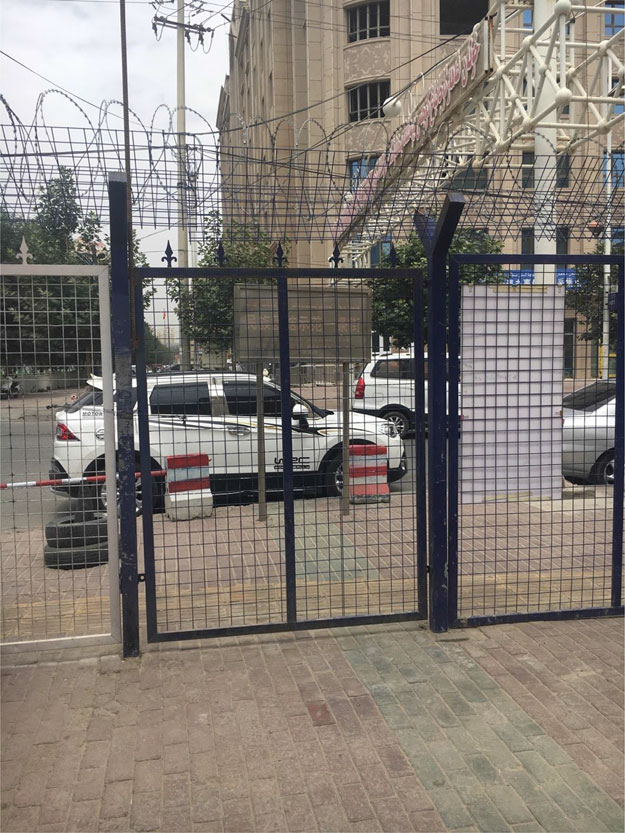
Such checkpoints are everywhere in Xinjiang – at least, I encountered them in each of the four cities I visited, as well as on the highways and in train stations while travelling between cities. Movement of people is closely monitored, registered, and in many cases, heavily restricted. ID cards are routinely scanned, allowing authorities to track the movement of people across the region but also as they go about their daily lives within their hometowns. Here state security agendas are visible and felt in everyday practices of control, monitoring, and restriction, as ordinary people move, or are stopped from moving, in and between the ordinary spaces in which they live their lives. The visual omnipresence of security personnel, checkpoints, CCTV and surveillance create an atmosphere of control but also of tension. The photograph carries at least some of this atmosphere, the metal gate and fence topped with barbed wire occupying much of the visible space, conveying a feeling of restriction, of being closed in. In the background, we see a largely abandoned city street.
The photograph Restriction/Protection 2 (Figure 2) was taken at a popular market in Hotan and shows three members of the security police back-to-back in triangle formation, each holding a separate piece of the riot equipment I had by now become used to seeing in mundane spaces all around me. Security personnel all around the city were in a constant state of readiness, creating a strange atmosphere of juxtapositions: a mundane ongoing crisis, a state of exception made routine. Around them, locals make their purchases of fruit, bread, honey, seeming to notice the security presence only when they had to walk around them.
Restriction/Protection 2, Hotan, Xinjiang, 2018.
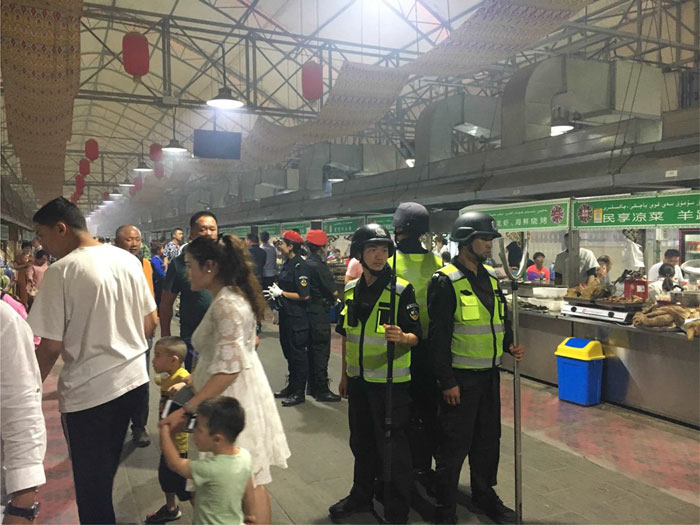
Here security is about controlling movement, about permanent exceptions and a constant state of readiness, all of which feels familiar to most of us who study security politics. But these are security practices we tend to associate with the border or war zones. The control of flows and circulation of people inside states, in times of peace and stability, is not given much attention in IR or security studies. This brings us back to questions of visuality and positionality. The exception made mundane, occurring day to day in ordinary spaces, is rarely seen in dominant visions of security, or indeed in explorations of everyday IR. Security is either exceptional or everyday, but rarely both. The title Restriction/Protection evokes a tension at the heart of security politics. The process of ‘making safe’ necessitates making threats, something to be made safe from. At the same time, it inscribes lines around those or that which is worthy of protection. The photographs show the materiality of protection: the gate, the barbed wire, the uniforms, the riot gear. But they also hint at the lived experience, at the atmosphere and feelings of restriction produced by the security regime.
Reflecting on positionality and photography in turn opens up questions around invisibility, what we cannot see. Here ‘writing to’ photographs is crucial. Foreigners and locals are treated differently by security personnel, but security also impacts the local population differently. The Chinese state has developed increasingly restrictive and violent policies towards ethnic minorities in the name of security. While travel in Xinjiang is severely restricted and monitored, as a white foreign traveller with a European passport I benefited from significant privilege. This privilege also enabled me to photograph what could be considered sensitive from a place of relative safety. Briefly detained and interrogated by heavily armed security personnel, my passport inspected and scanned, I was eventually released from the police compound and allowed to continue my journey.
I took Participation/Co-optation 1 (Figure 3) while walking through an underpass in Kashgar, Xinjiang. It portrays an ID check, bag scan, and metal detector, which all passers-through must use. The screen on the open laptop shows the scanned IDs of those who have recently passed through, likely storing their information in a centralised database. The security check is juxtaposed against the beauty stores in the background, where women stand around chatting. These practices have become routine and unexceptional for many of those who encounter them daily, normalising extreme monitoring of civilian movement. Photography raises the question of what is made visible here, and what is not. In the photograph we see the state’s attempts to quell what they would call terrorism or extremism. We see ordinary people participating-in/submitting-to monitoring. We don’t see the complex power relations between a centralised state and its restive borderlands. No one can opt out of monitoring. It is impossible to move through the city without participating to some degree in the security regime. We don’t see the violence faced by those who do attempt to resist the state. Of course, it is possible to photograph this violence, and photographs from China’s prison camps in Xinjiang have circulated widely in international media. Photography raises important questions about ethics and complicity when addressing political violence. Here I have chosen not to show photos where individuals can be identified, for example, to protect their identity. At the same time, not looking, or ignoring violence, is in itself a form of complicity.Footnote 100
Participation/Co-optation 1, Kashgar, Xinjiang, 2018.
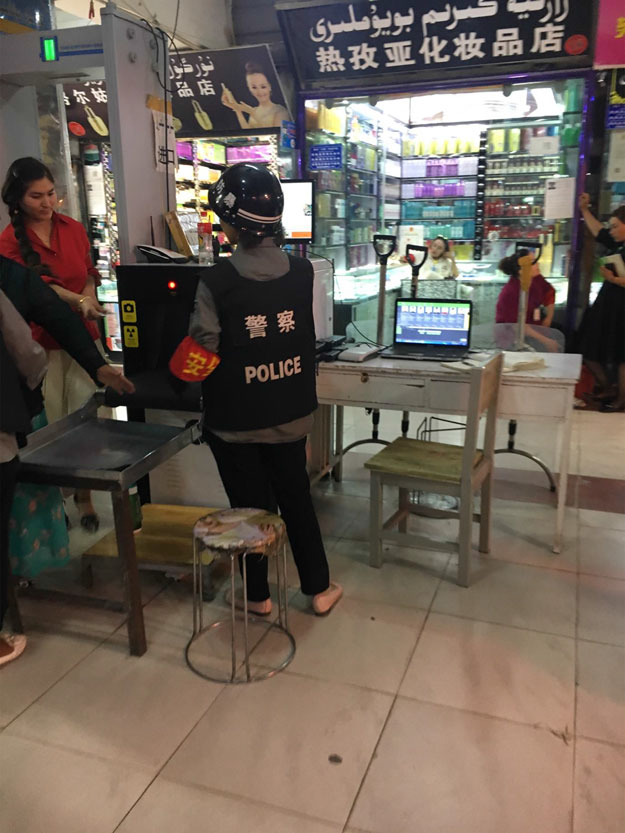
Using photography during my fieldwork deepened my understanding of agency. It forced me to think about mass mobilisation and who ‘does’ security in contemporary China, here presented in stark visual contrast with the dominant image centred on elite politics and foreign policy. The dominant vision of security in both mainstream and critical security studies is one of a deeply professionalised field: it is performed by authorised agents of the state. In the process of my fieldwork I kept coming across instances where the line between who does security and who is the subject of security was more blurred, complicating questions of agency and participation, and raising questions about what is see-able and what is not in the frame.
Participation/Co-optation 2 (Figure 4) shows a group of civilians patrolling a street in Kashgar carrying heavy wooden bats. They all wear red armbands indicating their status as ‘security volunteers’. It was not the first time I observed such exercises, though on previous occasions I had stayed further away. The first time I noticed them was in a small square in Urumqi, which suddenly filled up with uniformed security officers while I was eating breakfast. In dark blue/black uniforms and riot gear, they were variably labelled ‘SWAT’ (in English) and ‘teqin’ (special duty), and they lined up to listen to a supervisor for instructions before setting out to inspect the shops around the square. On this occasion, too, one of the first things I noticed was the incongruous nature of the uniforms, the exercise itself, and the participants: some looked a little lost, others were elderly or even frail looking. It seemed like a random collection of ordinary people, and nothing like a SWAT team.
Participation/Co-optation 2, Kashgar, Xinjiang, 2018.
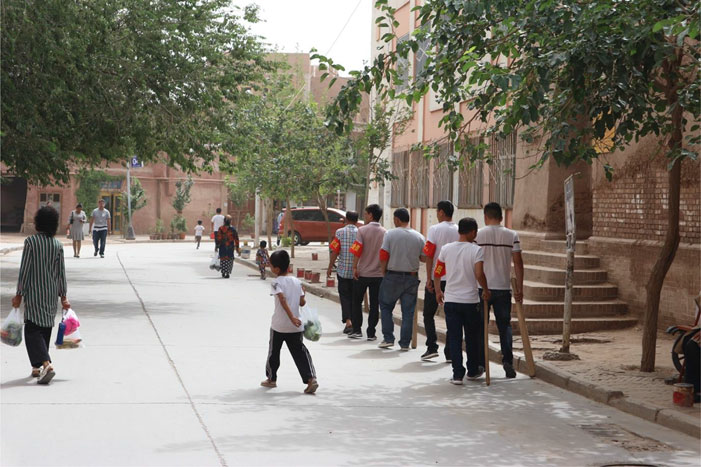
Participation in these exercises is usually compulsory. This in turn reflects the darker side of the participatory nature of China’s security state, the co-optation of the people in their own surveillance and monitoring, a process that effectively makes the people part of the state. The pervasive and mundane atmosphere of these exercises, together with the ordinariness of the participants, stand in stark contrast to their wooden clubs and the imagined calamity they are supposedly designed to prevent. There is an incongruity here, these things do not ‘fit’ naturally together. It represents an enveloping security paranoia that plays out as a form of everyday violence. Both literally, in the forced placing of wooden bats in the hands of random citizens, but also indirectly, in the enforced participation through which people become the state. They represent a stark new division of roles into ‘the state’ and ‘the threat’: there are no other parts available here. It also raises questions about the purpose of visibility when it comes to security. States can use overt security infrastructure to reassure, but also to ‘calibrate public anxiety’,Footnote 101 capitalising on the sense of insecurity to justify increased control.
Photography helps to make visible these everyday spaces, practices, and lived experiences that are rarely considered in academic research on security or on Chinese security, working to untangle and disrupt the dominant vision. It shows that security doesn’t just happen in elite spaces, as rupture/event, or behind closed doors, visualising the unseen. These counter-visualisations show that security-as-exception happens everyday, which in turn can open alternative ways of seeing and awareness of experiences that are not our own. It tells us something about who does security, raising questions around participation, power, and violence, and about where and when security happens: on regular city streets, on ordinary days. It invites the viewer to think about the lived experience of security in contemporary Xinjiang.
Photographing health security: Beyond face masks (Adam Ferhani)
My research grew out of frustration with the reliance on securitisation theory in the health security literature: not there is anything necessarily ‘wrong’ with securitisation, but the prevalence of securitisation has resulted in research largely focusing on the framing of, and response to, major outbreak events. The upshot of this is that very little is known about the everyday and what (if anything) happens between major events such the 2014/15 West African Ebola outbreak, the 2015/16 Zika outbreak in Latin America, and the (at the time of writing ongoing) SARS-CoV-2 pandemic. The literature is full of productive and edifying analyses of discrete health crises through the lens of securitisation, which – as is well known – attend to securitising actors, speech acts, exceptional measures, referent objects, and audience acceptance. Perhaps because of this prevalence of securitisation – which is built on Schmittian presentism and decisionism – the dominant ‘view’ of health security is one of crisis and drama: of deserted streets and closed airports, of emergency evacuations and temperature checks, of face masks, vaccination centres and field hospitals, of eerie plastic clad emergency workers. As Polly Pallister-Wilkins notes of personal protective equipment (PPE) and the West African Ebola outbreak: ‘humanitarian workers clad in plastic clothing with their faces obscured by masks [were] an easy visual cue for the virus itself and the complexities of the public health and biosecurity response.’Footnote 102
In an attempt to move analysis of health security away from securitisation theory,Footnote 103 I spent twelve months (between October 2018 and October 2019) undertaking non-participant observation at ports and airports of Port Health Officers (PHOs), who are responsible for routine preventative/prophylactic work at the UK Border. While next to nothing has been made of PHOs in the IR engagement with health security, they are central to the quotidian workings of International Health Regulations (IHR) (2005) in the UK. The IHR are crucial as the ‘primary international instrument and governance mechanism that guides collective behaviour in the event of a disease outbreak’.Footnote 104
Figure 5 is a photograph is of a PHO boarding a general cargo ship at Runcorn Docks. The image captures what is at the heart of the day-to-day business of the IHR, and Ship Sanitation inspections as a routine practice: an unspectacular, though nonetheless consequential, embodied movement. The minor and ‘overlooked’ act of moving and boarding a ship is one of myriad everyday practices that contribute to the contemporary constitution of health security. Donning a high visibility jacket and hardhat work boots, and black trousers – curiously none of the PPE we might expect – the PHO could easily be mistaken for a longshoreman – or else a member of the ship’s crew, an engineer, surveyor, or similar – rather than necessarily a health security professional. The ‘one way’ and speed limit signs (complete with the solitary, random traffic cone), functional clothing give the impression of a building site or similar, not that of a supposedly exceptional space – the border – where health security takes place. Behind me, out of the frame, the operations continue, and the docks are a hive of activity: paperwork is being exchanged, amber beacons flash, clouds of dust rise as earthmovers are buzzing around moving cargo into dump trucks for onward ‘inland’ travel. Salty ozone mixes with an acrid chemical whiff in the air – most likely carried by the wind from refineries or chemical plants upstream. A rather bleak, but by no means hostile place.
Hinterland, Runcorn Docks, 2018.
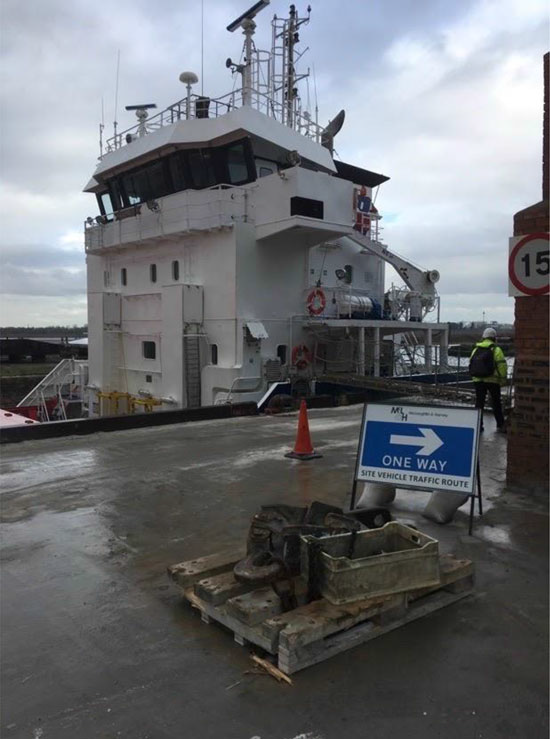
It is almost clichéd in IR to suggest that the border is frequently seen and understood as an exceptional site – one of intense securitisation. Here, there was no real sense of that – far from it in fact. The border was perhaps not a cosy space, but here there was no sense of it being a securitised one: here, the border felt incredibly ‘normal’. Admittedly, the work of PHOs is about infectious disease control and prophylaxis, rather than criminality or (im)migration. Yet this space is the contemporary border. Moreover, the above shows a rather traditional, orthodox view of the border. One of the clearest expressions of the ‘state’ of the contemporary border comes from Balibar:Footnote 105 ‘We are living in a conjecture of the vacillation of borders … borders are no longer at the border, an institutionalised site that could be marginalised on the ground and inscribed on the map, where one sovereignty ends and another begins.’ Maybe so, but Hinterland is at odds with the view of the contemporary border being dispersed and heterogeneous: here a security professional is carrying out their work at a geopolitical borderline. The border is very much at the border. In addition, despite the growing shift in security practice towards automation (manifest in machine learning, algorithms, and so on), Hinterland is a stark reminder of the continued agency of humans in contemporary security: here, pen and paper are the tools of the trade.
Hinterland is from early on in my time in the field, and one of the first photographs I took. I recall taking this photo as if it were yesterday and over two years down the line – among the most boring photographs I have ever taken (and probably worst: blurred lines, poor light, poor colours) – it still provokes a wry smile. The beauty and politics of Hinterland lies in its nothingness. My first thought getting out of the PHO’s car at Runcorn was ‘is this really it?’ followed swiftly by ‘well, this isn’t what I was expecting.’ I remember standing on the dock under a sky the colour of an old bruise, a vaguely industrial, low frequency hum and clatter of dump trucks in the distance looking around and thinking to myself I was barking up the wrong tree. I was meant to be researching health security, spending a year immersed in the heat of practice with security professionals, not spending a year spotting ships in the hinterland. There is something important to be said about hinterland though. In many respects the word crystallises the broader significance of this photograph. On a literal level I did spend the best part of a year in the hinterland, though not necessarily spotting ships, and Hinterland depicts this: a year interloping in the land immediately inland from the coast.
I also spent a year in the metaphorical hinterland: that which is frequently obscured or hidden. Why was the scene in this photograph not consonant with my expectations of everyday health security? What did I expect to find, to see? The view of health security (and something made particularly acute at the time of writing by the SARS-COV-2 pandemic) is one from above: the visuality of health security (and therefore our knowledge of it) is typically characterised by outbreaks and defined by moments of drama and rupture, and seen through visual modalities depicting facemasks, the hermetic isolation of hazmat suits, of makeshift field hospitals. Moreover, Hinterland allows us to see the humdrum visuality of everyday health security, provoking us to question one of the other core assumptions in the interdisciplinary literature on health security. The point of view here (and indeed in the previous and following photographs) is conspicuously one of the routine, rather than the exception, but it is also one taken onboard a ship. The alternative view here, then, is not consonant with the dominant one that stresses the interplay between the spread of (and attempts to control) infectious disease and (commercial) air travel, and typically overlooks the connections between international maritime intercourse and health security: the daily doings of health security (in the UK at least) are, for the most part, not concerned with temperature screening, quarantine, passenger locator cards, or spraying aircraft cabins to kill mosquitoes. The result of proximity, of immersion, of actually being there, Hinterland disrupts and questions what health security looks like. Photography, then, is able to render visible that which is not normally seen – in this case the everyday ‘doing’ of health security and its locality.
I never took Waiting (Figure 6) with a view to it coming to define or show routine (health) security – I just happened to think it would make an attractive photograph. Maybe something about the Mersey Estuary and the Manchester Ship Canal framed by the ship’s windows in the frame of the photograph appealed to me. In retrospect, though, Waiting is one of many photographs that do not really show anything pertaining to routine (health) security practices (doings).Footnote 106 What does it show then? What does it tell us? Waiting raises questions about the spaces and temporality of everyday/routine security: ‘routine, repetitive, habitual daily doings that are often fleeting and seem insignificant [that] take place outside the spaces of formal politics or security governance’.Footnote 107 The body of literature attending to security and the everyday attests to sociopolitical effects of the mundane and the unremarkable: impalpable doings, or Huysmans’ ‘little security nothings’. Implicit in most of this literature is the idea that security is made up of processes and activities, and is ‘continually doing things’.Footnote 108 The point of view in Waiting does not necessarily challenge this. It does, however, highlight that a nuanced understanding of continual doing is needed: Waiting is characterised by its ‘non-doing’ and its nothingness, and is one of innumerable photographs from my fieldwork that show, well, not a great deal really. Inordinate periods of time spent in the field entailed observing absolutely nothing, quite simply sitting around, waiting, though not necessarily waiting for something to happen as such. By this, I mean that we were never waiting in a pre-emptive, future-oriented ‘act[ing] in the face of uncertainty’Footnote 109 sense of the word. We were never waiting for something ‘bad’ to happen, we just happened to be doing nothing. Waiting, then, disrupts the idea that everyday security is somehow continually doing, and is in fact characterised by eddies as much as it is by ebb and flow.
Waiting, Eastham Docks, 2019.

These photographs all challenge the traditional representational codes of security, though Nyman and Ferhani’s photos present rather different challenges. Nyman’s photos disrupt the idea of the spectacular exception with images of the exception-made-everyday, seen in mundane spaces, routine practices, and lived experience. They also disrupt the image of security as a purely professionalised practice, by capturing ordinary people co-opted into security practice. Ferhani’s photos disturb the idea of the security spectacle by rejecting the exception, showing instead the unseen routines of health security. They are not beautiful photographs: the practicalities of research photography, with limited time to capture phenomena, practices, objects before they disappear or move on, leaves images that are rarely sharp or well composed.
Conclusion
So what does all of this tell us about what security looks like? We have used this question as a springboard to interrogate visuality: what is seen and how, what is not seen, and the implications. In the process, the article challenges the narrow dominant vision of security. Although we have limited space here and therefore have included only a small number of photographs, they work to illustrate the potential of interpretive photography as method in IR. The article demonstrates that interpretive photography can disrupt how ‘we’ – as researchers – go about engaging with the field and the subjects or objects under study, in our case security. It enables us to see what we might not otherwise see: it forces us to look differently, capturing alternative points of view. Making photographs therefore reveals other ways of seeing, disrupting the dominant vision and exposing the critical potential of interpretive photography as method in IR.
This in turn draws attention to what is visible and what is hidden in analyses of security, including the everyday, creating a deeper and richer account of security. Our photographs challenge the dominant image of security, showing on the one hand, the exception-made-routine, and on the other, rejecting the exception by drawing attention to banal routines. They work as counter-visualisations of what security looks like, challenging both the discipline and disrupting state narratives about security. In the process we suggest reflecting on what kind of reality is produced by the dominant view, whose reality? Who is viewing, for what purpose? In developing an alternative exploratory interrogation of the visuality of security, the article has opened space for reflection: on how security is made visible, where one might look for it, and how one might go about producing knowledge about it. In this way, photography can change how ‘we’ – as a discipline – see security differently in different ways, and on different scales. In the words of Ailsa Winton, ‘[the] act of looking can change the way the world is seen.’Footnote 110
Acknowledgements
Thanks to Joanna Tidy and Simon Rushton for their helpful comments on earlier drafts. Thanks also to Eva Seiwert for friendship in the field and beyond.
Adam Ferhani is Associate Lecturer in International Relations in the School of International Relations at the University of St Andrews, UK. His research focuses on the politics of health security, and has been published in Security Dialogue and Contemporary Security Policy.
Jonna Nyman is Lecturer in International Relations in the Department of Politics and International Relations at the University of Sheffield, UK. Her research focuses on the politics and ethics of security, Chinese security politics, and energy-environmental security politics. She has published a monograph titled The Energy Security Paradox: Rethinking Energy (In)security in the United States and China (Oxford University Press, 2018), and a co-edited collection Ethical Security Studies: A New Research Agenda (Routledge, 2016).


 Open access

