


Dirt Cones on Jan Mayen Island
During early summer the lower ground of Jan Mayen Island bears numerous, rapidly dwindling patches of snow. The surfaces of many of these patches are raised in hundreds of small cones, each covered with the volcanic sand that is a ubiquitous feature of the island. Similar “dirt cones” have been recorded on snow patches in Iceland Reference Spethmann 1 , Reference Lewis 2 , Reference Swithinbank 3 but seldom from elsewhere. Dirt cones on ice, on the other hand, are known in a variety of forms from many regions, including Jan Mayen Reference Flint 4 ; but they differ in character and in origin from dirt cones on snow, and they are not considered here.
Dirt cones examined during June 1950 generally measured up to about 10 cm. high, and were distributed evenly but irregularly at intervals of a few decimetres. They typically had exactly the appearance of those figured for Iceland by Spethmann Reference Spethmann 1 and Swithinbank.Reference Swithinbank 3 The dirt cover of each cone was some 1 to 3 cm. thick on top of the cone, but thinner (down to 0.3 cm.) on the sides. The snow surface between the cones bore only a very light sprinkling of dirt. The sides of the cones sloped at a rather constant angle of about 60 degrees with the horizontal, steeper than that recorded for dirt cones in Iceland.
The Nature and Origin of the Dirt
Many of the snow patches on Jan Mayen bear a certain amount of debris. Generally this consists of a coarse sand, which, whenever it provides more than a very scanty covering, is associated with the formation of characteristic dirt cones. On some patches, however, the debris is partly or mainly organic, consisting especially of fragments of lichens and mosses; this type of debris may be associated with unevenness of the snow surface, but not with regular cone formation.
The character of the sand is probably important. First, it is dark in colour, and, when lying on snow which is forming cones, it is moistened by melt water and appears black. Secondly, it is composed almost entirely of coarse particles (see Table I), so that it endoses a considerable amount of air; pore volume in a typical sample represented 45·5 per cent. These features result in the dirt acting as an efficient absorber of radiant heat but also, when in depth, as a poor heat conductor. These properties are shown below to be essential in dirt cone formation. The fact that dirt cones have been recorded a number of times from Iceland and Jan Mayen but seldom from elsewhere may well be related to the abundance of appropriately coarse and dark coloured desert soils in these areas.
Particle Size Group Composition (Per Cent)

The rather even distribution of superficial debris and the absence of particles coarser than 2 mm. indicate that the dirt is wind-borne. (One case in which dirt had apparently been carried on to the snow surface by a stream was noted, but this process seems uncommon at Jan Mayen.) The coarseness of the sand, and its close textural similarity to the sand of ordinary desert soils (see Table 1)—indicating an absence of sorting—suggest that it is carried on to the snow surface by strong gusts of wind, rather than accumulated by gradual drifting under steady winds. High winds will be needed to transport such heavy particles, but wind speeds of over 100 km./hr. are not exceptional at Jan Mayen, and “dust devils” many metres high occur in the more exposed areas. It is likely therefore that the dirt on any one snow patch results from a limited number of depositions—perhaps only one. This may explain the fact that adjacent patches sometimes bear debris of extremely different organic content, and a single patch may be dirt-free in one part and covered by a relatively thick deposit in another. Much of the deposition probably occurs during May, when snow cover first becomes patchy; certainly little debris seems to be deposited during late June and July, for dirt-free snow remains clean, and only very scanty dirt cover is seen on the snow between dirt cones.
The Development of Dirt Cones
The way in which the conical form is produced was first described by Spethmann.Reference Spethmann 1 Snow lying under little patches of dirt is protected from insolation, so that ablation is here less rapid than from the surrounding, bare snow. Such covered areas consequently come to lie at a higher level than the unprotected snow, and this discrepancy in level is progressively increased until limitation sets in due to attenuation of the dirt cover. The assumption of a conical shape is the effect of gradual ablation on the distribution of the protective layer of dirt, and of the angle of rest taken up by this material.
This account of Spethmann’s has been accepted by later workers, and experimental evidence in confirmation of it is described later in this paper.
In one respect, however, the account is inadequate: it does not indicate what brings about that initial marked patchiness of dirt which subsequently causes differential ablation. It is necessary to explain why the dirt should accumulate to a depth of over a centimetre in many small patches but be almost absent elsewhere. Lewis’s account Reference Lewis 2 is of a row of dirt cones which arose under mud deposited locally by a stream running over the snow surface; the same feature has been seen at Jan Mayen. Where, however, wide areas of snow are covered uniformly with dirt cones and it is obvious that the deposit has been wind-borne, the cause of the initial patchiness is not immediately apparent. Spethmann Reference Spethmann 1 found no explanation, but he gave evidence for his conclusion “dass Unebenheiten der Schneefelder keinen Einfluss auf die Verteilung des Schuttes ausübten.” Nevertheless, Swithinbank Reference Swithinbank 3 states that the inception of dirt cones on snow “is traceable to the original unevenness of the snow-field causing variations in the thickness of the superficial deposit. The effect of ablation is to accentuate the depth of any initial concavity, however slight.” This argument seems faulty, for the thickest accumulation of dirt is expected to occur in sheltered concavities in the snow, and differential ablation resulting from the protection it gives will reduce, not accentuate, initial unevenness. Moreover, it is doubtful whether dirt will in fact drift into concavities for, once carried on to the snow surface, it usually adheres.
It is suggested, therefore, that no satisfactory explanation of that patchiness of deposit which causes dirt cone formation has been given; and a hypothesis is presented in the following sections to account for this uneven distribution.
The Relation of Ablation Rate to Depth of Dirt
There is no doubt of the insulating effect of a thick layer of dirt on the snow which it covers. Blocks of snow covered with several decimetres of dirt persist at Jan Mayen for several weeks after snow patches have generally melted, and blocks of sea ice are similarly preserved from May, when ice retreats from the shore, until July, although mean air temperatures are above zero throughout this period. The thicker the dirt covering is, the more effective, presumably, is the insulation it provides.
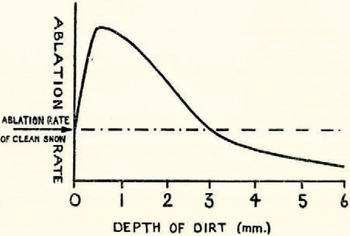
Below a certain critical thickness, however, the insulating effect ceases to be evident and is in fact replaced by an opposite effect: a thin dirt cover accelerates ablation by absorbing heat and transmitting it to the snow. This process has been called “indirect ablation.” Reference Sharp 5 The efficiency of heat absorption by the sand at Jan Mayen is indicated by the fact that soil temperatures commonly rise 6°C. above air temperatures on sunny days; indeed, on several occasions clouds of steam have been seen rising from insolated soil. Indirect ablation no doubt accounts for the fact that where one part of a snow patch bears dirt cones and another part is dirt-free, the former is at a lower level than the clean area. The effectiveness of indirect ablation under sunny conditions in mid-June at Jan Mayen was shown by the formation of a depression just over a centimetre deep where a thin sprinkling of dirt had six hours previously been dusted on part of a dirt-free snow surface.
Fig. 1 (p. 285) summarizes in graphical form the relations described here. The curve is purely diagrammatic and not based on experimental observations; its detailed form will no doubt vary according to conditions of humidity, insolation, debris type, etc. The quantity of debris is expressed as “depth of dirt” because this measure is easy to comprehend; at values lower than the mean particle size (i.e. when the cover is discontinuous) “weight of dirt per unit area” would be a more satisfactory measure. It is believed that the curve is correct in indicating that: (a) most rapid ablation occurs at or near that depth of dirt (about 0.5 mm.) which just provides complete cover; (b) compensation of indirect ablation is achieved by the insulation provided by about 3 mm. of dirt.
Curve to show diagrammatically the general relationship between ablation rate and depth of dirt. (See text, p. 283)
The Shrinkage of the Snow Surface Associated With Ablation
The melting of snow patches at Jan Mayen is accompanied not only by a gradual lessening of the total area of the patch but also by a shrinkage of the snow surface. As a result of this shrinkage, superficial debris is progressively concentrated towards the middle of the patch (although a certain amount is deposited at the receding edges) and in some cases eventually becomes several decimetres thick. This accumulated debris protects the remaining snow from melt for some time but is finally deposited in the middle of the late snow area. Repetition of such concentration and deposition year by year modifies the soil at the centre of the area to such an extent that the vegetation is affected, being enriched when the deposit is organic in nature, and containing sand-binding species when the deposit is sandy.
The rate at which this shrinkage of the snow surface may occur is indicated by the following observation. A row of 30 stones, each of diameter a little under a centimetre, was placed on an almost level area of snow in Jøssingdalen. The snow patch bore dirt cones in one part, but the experimental area was almost dirt-free and showed no sign of cone formation. Initially the stones were placed at intervals of I in. (25.4 mm.), giving an overall dimension between the ends of the row of 29.0 in. Between 11.00 hr., 17 June and 18.00 hr., 19 June the line of stones contracted evenly so that the overall dimension was reduced to 25.5 in. A rectangle of sand, 12 by 8 in., showed rather more rapid contraction; the rates, expressed as percentage contraction per day, were:
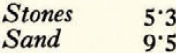
Several factors will affect shrinkage, but it seems likely that rate of ablation will be of primary importance. Thus the rate of shrinkage of the line of stones rose during an especially warm period (11.00 to 17.00 hr., 17 June) to 13.6 per cent per day.
A Hypothesis to Explain Dirt Cone Initiation
In the two preceding sections it has been shown that:
(1) A thin layer of dirt increases ablation of the underlying snow, but a thick cover reduces the rate of ablation.
(2) The snow surface shrinks as ablation proceeds; and the greater the rate of ablation, the greater (in all probability) is the rate of shrinkage.
From these two conclusions it is likely that:
(3) A thin layer of dirt increases the rate of shrinkage, but a thick layer reduces the rate of shrinkage.
Statements (1) and (3) are believed to provide an explanation of the initiation of dirt cones. This is set out in diagrammatic form in Fig. 2 (p. 285).
A series of diagrammatic vertical sections through the surface of a small area of snow to illustrate the suggested course of dirt cone initiation; snow shown by hatching, dirt indicated by stippling; the arrows trace the successive positions of five points on the snow surface. (Below right) Graph representing the ablation rates across the area at the same five stages of cone initiation. Not to scale

Fig. 2a represents an area of level, dirt-free snow. The rates of ablation and shrinkage are uniform over the whole surface. Wind-borne dirt, when it falls on this snow, will not be distributed uniformly; vagaries of wind action will cause slightly heavier deposit in some places than in others. In Fig. 2b such a region of slightly greater deposit is indicated in the centre of the area. The increase in ablation resulting from dirt deposition will be more marked in this central region, under the heavier deposit, than elsewhere; and shrinkage of the snow surface will accordingly be most rapid. This will result in concentration of dirt occurring more quickly in this region than in the surrounding area where shrinkage is slower. This process will accentuate the differential character of ablation—and so of shrinkage—and it is clear that the two processes of concentration of dirt and of ablation and shrinkage of snow will reinforce one another in cumulative fashion, soon building up a relatively thick layer of dirt in the centre of the area. Thus if the rate of shrinkage of the snow surface in this area of rapid ablation averages 20 per cent per day, the depth of dirt will be quadrupled in the course of a week. This cumulative effect will come to an end only when the depth of dirt in the middle of the patch becomes sufficient to have an insulating effect (Fig. 2c ). This will both reduce the rate of ablation, so that the snow surface falls less rapidly beneath the thickened layer of dirt (Fig. 2d ), and will also reduce the rate of shrinkage here. Subsequent ablation will increase the height of the cone relative to the snow surface in the manner described by Spethmann Reference Spethmann 1 (Fig. 2e ).
In this way any slight variation in density of deposit may give rise, through differential ablation and shrinkage of the snow surface, to the marked local concentration of dirt necessary for dirt cone initiation.
The hypothetical description given above is for the initiation of a single cone; it needs some qualification in order to be applied to the groups of scores or hundreds of cones which are normally found on snow patches.
First, in a continuous surface bearing many cones (or cone “primordia”) the rate of shrinkage at a particular point, though still determined primarily by the rate of ablation, must be modified by the rates of shrinkage in neighbouring areas. Moreover, shrinkage at the rates suggested above, if acting over the whole of an extensive area of dirt cones, would cause the edges of the snow patch to move at a rate of several metres a day. It is hard to believe that such an effect would in fact occur, and indeed observations show that retreat of the edges (due to melting as well as shrinkage) amounts at the season concerned to the order of only 1 metre in two or three days. It seems likely, therefore, that shrinkage of the snow surface under each developing cone is accompanied by some expansion of the snow surface between the cones.Footnote * It is unlikely that this expansion is confined to the extensive fields of dirt cones on which this argument has been based, and it seems probable that it is a general feature of dirt cone formation. Such expansion must enhance the effect of contraction in bringing about patchiness of dirt; it helps to explain the paucity of dirt on the snow surface between cones. It may also be connected with the differences in hardness of snow which are mentioned below.
Secondly, dirt cones in a young field are rather constant in size, and moreover give the impression of having a spatial distribution which is more regular than random, i.e. “underdispersed.” Reference Clapham 6 It seems likely that the initial size of cones will be determined in large measure by the form of the “depth of dirt”/”ablation rate” curve (Fig. 1), and that the position of individual cone primordia will be affected by the distribution of neighbouring ones. Initial “chance” distribution of wind-borne deposit is not the only governing factor. More precise data than are at present available are, however, needed for consideration of these complicated effects.
The following observations have some bearing on the manner of dirt cone initiation and formation:
-
a. Small, circular accumulations of dirt were generally to be found where a light deposit of dirt was present on a flat snow surface, e.g. at the periphery of an area of dirt cones. These local concentrations were very striking in appearance, and clearly were not due merely to vagaries of wind or to microtopography of the snow surface. They are regarded as representing an early stage in dirt cone formation, such as that shown in Fig. 2c . No attempt was made to verify this relationship by continued observation, but some confirmation is provided by the following feature.
-
b. The surface of the snow forming the core of dirt cones was harder than that of the relatively clean snow between the cones, and this hardness was also apparent beneath the accumulations of dirt mentioned in (a). A similar effect has been recorded Reference Workman 7 in nieves penitentes.
-
c. An attempt was made to bare some cones of dirt; this was difficult, since the lower layers of dirt were stuck to the snow core. Cones which were partially cleaned—care being taken not to remove any snow—covered themselves with dirt again in the course of two days, although they became somewhat reduced in size during this period. Cones which were completely cleaned (by scraping off a thin layer of outer snow) disappeared.
-
d. Small, circular patches of dirt which were placed on a clean snow surface (Fig. 3, p. 285) caused more rapid ablation, so that the snow level fell relatively quickly under the dirt; at the same time the patches became concentrated and subsequently a hump of snow arose beneath them. Dirt slipping on to the snow surface round about caused an accelerated fall in level there. At the end of two days, “artificial” dirt cones about 2 cm. high had been formed. Steep-sided cones as small as these are not formed naturally, since the process of dirt concentration is not efficient enough.
Vertical sections to show the effect of placing a patch of dirt on a clean snow surface; (left) at start, (centre) after one day, (right) after two days. The fall in the level of the surrounding dirt free snow is not indicated. (See text p. 286)

Later Stages of Dirt Cones
General shrinkage of the snow-patch surface results in the individual dirt cones being brought closer together until, eventually, fusion of cones may occur. Stages in this process are often to be found and can be seen in Swithinbank’s Reference Swithinbank 3 photograph. It seems likely that the large cones of over a metre in height which sometimes occur have been produced by the fusion of many smaller cones in this way, and the facets of hard snow observed on some large cones may be a result of such fusion. Continued shrinkage will progressively reduce the extent of the relatively dirt-free snow between cones, until finally dirt may cover the field in a more or less uniform mantle and individual dirt cones disappear. This final stage commonly occurs at Jan Mayen in areas where dirt deposition has been heavy, and it is well shown in Spethmann’s Reference Spethmann 1 photograph. In areas of lighter deposition, dirt cones form later in the season and may remain separate until their end. It was sometimes observed in such cases that by the time when melt water had filled the interstices of snow and dirt, the dirt ceased to act as an insulator and instead hastened melting of the underlying snow, so that “dust wells” Reference Sharp 5 were produced.
The main hypothesis advanced in this paper is based on such a restricted set of observations that it must be proposed somewhat tentatively. It is possible that under certain conditions melt water or wind action may supplement contraction of the snow surface in causing dirt accumulation, although neither of these agencies seems to be important at Jan Mayen. It is worth noting that the hypothesis of dirt cone initiation outlined above could easily be checked by field observations, which might profitably include some investigation of the more basic problem of the forces bringing about that strange movement of the snow surface which has been recorded above and seems to occupy a central rôle in dirt cone initiation.
I am grateful to Professor A. Austin Miller for his advice and criticism; and to Michael Cullen and Tom Neales, in collaboration with whom the experiments described above were carried out.



