

Implications
Productive lifespan of dairy cows is short compared to their natural life expectancy. Culling decisions often depend on disposal reasons that indicate reduced welfare leading up to culling but also on the supply of genetically improved replacement heifers. Productive lifespan is mostly driven by dairy farmer decision-making. Improvement of culling decision support tools will help to optimise the economically optimal productive lifespan for individual cows.
Introduction
Productive lifespan of dairy cows may be defined as the time from first calving to death. Typically, cows produce milk during 80% to 90% of this time with the remaining time spent in the dry period to prepare for the next calving. The productive lifespan of average cows is between 2.5 and 4 years in most developed dairy industries. Cows calve for the first time at 2 years of age, which brings their total lifespan from birth to death between 4.5 to 6 years. The natural life expectancy of dairy cattle is approximately 20 years, however. In addition, improvements in cow comfort, reproduction and genetic merit for productive life in the last decades have not markedly led to increases in the productive lifespan of dairy cattle. This short lifespan increasingly raises questions about the welfare and ethical use of dairy cattle. Longer productive lifespans are actively promoted in countries like the Netherlands and Denmark. Extending productive lifespan may have environmental benefits. On the other hand, economic considerations are major factors that affect productive lifespan, but decisions to replace cows may not necessarily be economically optimal.
In this paper, we will briefly review risk factors for culling that lead to a longer productive lifespan. Animal welfare and its association with productive lifespan are briefly described. We will also summarise the effect of productive lifespan on environmental sustainability. Economics is a main driver of productive lifespan. Finally, we address economically optimal replacement decisions and point to a need for better decision support.
The literature on factors that affect productive lifespan is very large, and we made no attempt to be comprehensive. Furthermore, the emphasis will be on productive lifespan in North American dairy systems because we are most familiar with those. The material is further limited to productive lifespan of dairy cows. Approximately, 10% to 15% of dairy female calves born alive and intended to become cows do not reach a first calving. Morbidity and mortality in preweaned dairy heifer calves based on different health, feeding, and management practices, as well as environmental factors were recently summarised by Urie et al. (Reference Urie, Lombard, Shivley, Kopral, Adams, Earleywine, Olson and Garry2018).
Trends in productive lifespan
Productive lifespan of dairy cattle is on average less than 3 years in the United States. Within herds, productive lifespans for individual cows vary from 1 day to more than 10 years (Pinedo et al., Reference Pinedo, De Vries and Webb2010), although it is rare for dairy cows to reach 10 years of age. Productive lifespan is determined by culling (exiting), which is the departure of cows from the herd because of sale, slaughter, salvage or death (Fetrow et al., Reference Fetrow, Nordlund and Norman2006). Data from the Dairy Herd Information Association (DHIA) show that among 9158 herds with greater than 50 cows each, the average annual cow cull rate was 38% (a standard deviation of 12%) (Dairy Records Management Systems, 2019). This average includes 4% of cows sold for ‘dairy’ purposes, which means these cows continued their productive life on other dairy farms. Over 85% of cows in these herds are Holsteins. The 34% of cows that were sold annually for reasons other than ‘dairy’ had an average productive lifespan of 35.3 months (12 months/34%), equivalent to fewer than three lactations. This annual cow cull rate is slightly greater than cow cull rates reported two decades ago for a similar population (Hadley et al., Reference Hadley, Wolf and Harsh2006). Nieuwhof et al. (Reference Nieuwhof, Norman and Dickinson1989) reported an average productive lifespan of 38.4 months for Holsteins that first calved after 1965 in the United States. These productive lifespans are similar to or slightly higher than averages reported for other countries (Mohd Nor et al., Reference Mohd Nor, Steeneveld and Hogeveen2014; Haine et al., Reference Haine, Delgado, Cue, Sewalem, Wade, Lacroix, Lefebvre, Arsenault, Bouchard and Dubuc2017). Within countries, annual cull rates vary greatly, however. Hare et al. (Reference Hare, Norman and Wright2006) showed that the trend for decline of many productive lifespan indicators slowed or ended after the early 1990s. In contrast, annual cull rates for beef cows are approximately 10% to 15% (Ramsey et al., Reference Ramsey, Tisor, Hulsman Hanna and Ringwall2017), leading to productive lifespans of 7 to 10 years after first calving.
The higher cow cull rates of dairy cows compared to beef cows are associated with more intense genetic selection including for milk production and by fine-tuning of nutrition and management (Rauw et al., Reference Rauw, Kanis, Noordhuizen-Stassen and Grommers1998). The increase in milk production has been associated with risks of altering behavioural, physiological and immunological conditions (Rauw et al., Reference Rauw, Kanis, Noordhuizen-Stassen and Grommers1998), leading to greater risks for health disorders, which are primary reported reasons for culling.
Cull reasons
Cows avoid culling when they get pregnant on time, avoid mastitis and injury, are healthy, produce enough milk and have functional udders, and feet and legs. In addition to regular daily milkings, such cows have four non-milking events per lactation: (1) the first insemination results in pregnancy, (2) the pregnancy diagnosis confirms the pregnancy, (3) dry off ends the lactation, and (4) calving starts a new lactation.
Other than the reason death, culling is the result of the decision by the dairy farmer to remove a cow from the herd. Culling can occur voluntarily due to low milk production, behavioural conditions and market prices, or involuntarily due to conformation, disease, injury, infertility or death (Fetrow et al., Reference Fetrow, Nordlund and Norman2006). The distinction between voluntary and involuntary culling is not useful for decision-making, however, because often multiple reasons can be given for culling and even involuntary culling is the result of economic decision-making including trade-offs by the dairy farmer (Fetrow et al., Reference Fetrow, Nordlund and Norman2006).
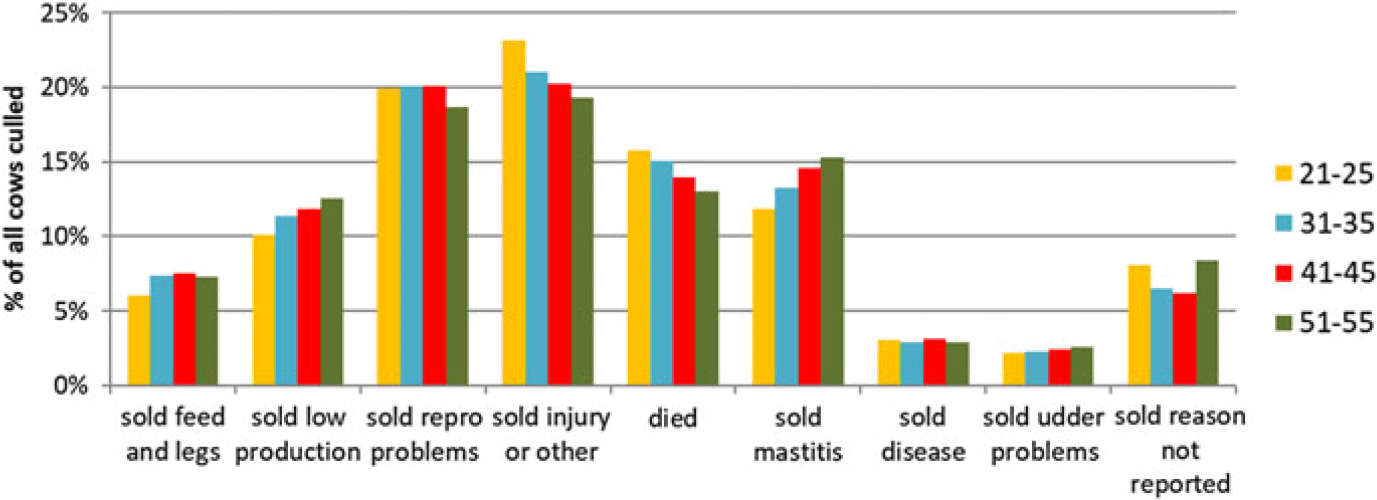
The DHIA system in the United States allows dairy farmers to report the primary reason for culling by using one of nine disposal codes. The primary disposal code was died (20.6% of all culling), followed by reproduction (17.7%), injury/other (14.3%) and low production and mastitis (both 12.1%) in a dataset of cows calving between 2001 and 2006 in 2054 herds in the eastern United States (Pinedo et al., Reference Pinedo, De Vries and Webb2010). Hadley et al. (Reference Hadley, Wolf and Harsh2006) reported that up to 80% of all culling was due to health issues. DHIA disposal codes for 2015 reported by the Council on Dairy Cattle Breeding (CDCB, 2019) showed that the most reported reason was injury and other, followed by reproduction problems, then mastitis and died. The frequency of individual cull reasons varied little with the annual cull rate (Figure 1). Thus, herds with low annual cow cull rates (long productive lifespans) have similar frequencies of reasons for culling than herds with short productive lifespans. Further differentiation and accurate recording of primary reasons for culling could define specific targets for improvement.
Frequency of disposal codes reported in 2015 by 11 985 herds participating in the Dairy Herd Information Association in the United States by four categories of annual cow cull rates. Cull reasons for herds with low or high cull rates are generally similar. Source: Council on Dairy Cattle Breeding. Retrieved on 10 July 2019 from https://queries.uscdcb.com/publish/dhi.cfm.
Farmers’ culling criteria may differ between production systems in the same country. For example, seasonal grazing herds depend on good reproduction and cows not pregnant on time are culled easier than in non-grazing herds. Ahlman et al. (Reference Ahlman, Berglund, Rydhmer and Strandberg2011) reported that main reason for culling cows in organic herds was poor udder health, whereas for cows in conventional herds it was low fertility. These differences may be due to other standards of production, for example, use of antibiotics. However, no consistent patterns in culling were found for culling reasons in organic v. conventional production in the literature (Ahlman et al., Reference Ahlman, Berglund, Rydhmer and Strandberg2011). Beaudeau et al. (Reference Beaudeau, van der Ploeg, Boileau, Seegers and Noordhuizen1996) reported that culling reasons are dependent on farmers’ styles. Different farmers make different culling decisions for identical cows.
Risk factors for culling
Disposal codes are indications of risk factors for culling. The risk of culling with various disposal codes varied with stage of lactation, parity, milk yield, reproductive status, herd size and season (Pinedo et al., Reference Pinedo, De Vries and Webb2010). Died and reproduction were the most frequently reported codes for cows leaving during early and late lactation, respectively. Early lactation was also a critical period for culling with the disposal codes injury/other and disease, and the risk increased with days after calving for the codes low production and reproduction. Pregnancy and high milk production protected against culling. These disposal risks are associated with health problems around calving and failure to conceive again later in lactation. Older cows had greater risks of culling. The risk of culling with the disposal code died showed the greatest seasonal pattern with increased risk of death in spring and summer (Pinedo et al., Reference Pinedo, De Vries and Webb2010). Cow and herd risk factors for culling are briefly described as follows.
Mastitis is one of the most frequent and most costly diseases in dairy cattle. The occurrence of mastitis is greater in early lactation (Gröhn et al., Reference Gröhn, Eicker, Ducrocq and Hertl1998), but clinical mastitis can be observed throughout the entire lactation (Beaudeau et al., Reference Beaudeau, Ducrocq, Fourichon and Seegers1995). The daily risk of culling with primary reason ‘mastitis’ (Pinedo et al., Reference Pinedo, De Vries and Webb2010) closely follows the occurrence of clinical mastitis. Gröhn et al. (Reference Gröhn, Eicker, Ducrocq and Hertl1998) found that mastitis was the disease that most influenced culling in dairy herds. Studies with data from slaughterhouses reported that between 3% and 9% of dairy culled cows had mastitis, although that may not have been the reported reason for culling (Nicholson et al., Reference Nicholson, Nicholson, Frenzel, Maddock, Delmore, Lawrence, Henning, Pringle, Johnson, Paschal, Gill, Cleere, Carpenter, Machen, Banta, Hale, Griffin and Savell2013). Cows with subclinical mastitis produce less milk and have elevated somatic cell counts (SCC). Mohd Nor et al. (Reference Mohd Nor, Steeneveld and Hogeveen2014) found that herds with a higher average SCC and a higher percentage of new high SCC had greater cow cull rates.
Fresh cow diseases like retained placenta, metritis, displaced abomasum and ketosis are mostly associated with cull reason ‘disease’. Retained placenta is a condition in which all or part of the placenta remains attached to the uterus within 12 h after parturition. Several studies reported no significant effect of retained placenta on the culling risk (Dubuc et al., Reference Dubuc, Duffield, Leslie, Walton and LeBlanc2011; Probo et al., Reference Probo, Pascottini, LeBlanc, Opsomer and Hostens2018). However, retained placenta was reported as a risk factor for metritis (LeBlanc, Reference LeBlanc2008), resulting in negative effects on reproductive performance and was therefore indirectly linked to increased culling.
Metritis is an inflammation of the wall of the uterus caused by bacterial infections encountered within 21 days after parturition. Although metritis might cause only a short-term decrease in milk production, it has been associated with increased days between first service and conception. This association with lower milk production and inefficient reproduction may lead to more culling in dairy cows. Cows with metritis had greater risk to be culled when comparing with cows without metritis (Oltenacu et al., Reference Oltenacu, Frick and Lindhé1990). On the other hand, Probo et al. (Reference Probo, Pascottini, LeBlanc, Opsomer and Hostens2018) did not find an association between metritis and culling risk, which is in accordance with other studies (Gröhn et al., Reference Gröhn, Eicker, Ducrocq and Hertl1998; Dubuc et al., Reference Dubuc, Duffield, Leslie, Walton and LeBlanc2011; Hertl et al., Reference Hertl, Schukken, Bar, Bennett, González, Rauch, Welcome, Tauer and Gröhn2011).
The transition period around calving is characterised by the incapacity to meet the energetic demand for milk production, leading to a negative energy balance, and increased risk of ketosis. Ketosis was associated with increased risk of culling in multiparous cows (Seifi et al., Reference Seifi, LeBlanc, Leslie and Duffield2011; Roberts et al., Reference Roberts, Chapinal, LeBlanc, Kelton, Dubuc and Duffield2012; Probo et al., Reference Probo, Pascottini, LeBlanc, Opsomer and Hostens2018). One study found no assocation between ketosis and culling in primiparous cows (Hertl et al., Reference Hertl, Schukken, Bar, Bennett, González, Rauch, Welcome, Tauer and Gröhn2011).
Milk fever or hypocalcaemia is a peripartum disease that is manifested clinically or subclinically. Low blood calcium levels are indicative of milk fever. Roberts et al. (Reference Roberts, Chapinal, LeBlanc, Kelton, Dubuc and Duffield2012) and Gröhn et al. (Reference Gröhn, Eicker, Ducrocq and Hertl1998) observed that cows with milk fever had greater risk to be culled compared to cows not diagnosed with milk fever. Probo et al. (Reference Probo, Pascottini, LeBlanc, Opsomer and Hostens2018) demonstrated that milk fever was the most influential disease associated with risk for culling within the first 120 days in milk. This increased cull risk early in lactation was also found by Seifi et al. (Reference Seifi, LeBlanc, Leslie and Duffield2011). The risk of culling of cows with milk fever is especially high when the cow is not able to stand (Gröhn et al., Reference Gröhn, Eicker, Ducrocq and Hertl1998). On the other hand, Cha et al. (Reference Cha, Hertl, Schukken, Tauer, Welcome and Gröhn2013) did not observe any relationship between milk fever and culling. Some authors have suggested positive associations between milk fever and other peripartum diseases such as dystocia and metritis (Rajala-Schultz and Gröhn, Reference Rajala-Schultz and Gröhn1999).
Displaced abomasum is characterised by the movement of the abomasum from its normal position on the right ventral aspect of the abdomen to the right or left side in cattle. Studies from the 1990s reported that displaced abomasum was the second most important culling reason after reproductive disorders (Seegers et al., Reference Seegers, Beaudeau, Fourichon and Bareille1998). Recently, Probo et al. (Reference Probo, Pascottini, LeBlanc, Opsomer and Hostens2018) showed that although displaced abomasum was the disease with the lowest incidence, it was the second most determinant metabolic disease for culling, followed by mastitis and ketosis. Cows with displaced abomasum often had high risks to be culled (Seifi et al., Reference Seifi, LeBlanc, Leslie and Duffield2011; Cha et al., Reference Cha, Hertl, Schukken, Tauer, Welcome and Gröhn2013).
Lameness is an abnormal walk or stance of a cow, which is usually a result of some dysfunction of the locomotor system. Lameness is known for negatively impacting reproductive efficiency and milk production of dairy cows and is often a reason for culling in dairy herds (Bicalho et al., Reference Bicalho, Vokey, Erb and Guard2007). Some studies did not find a relationship between lameness and risk of culling, however. Nicholson et al. (Reference Nicholson, Nicholson, Frenzel, Maddock, Delmore, Lawrence, Henning, Pringle, Johnson, Paschal, Gill, Cleere, Carpenter, Machen, Banta, Hale, Griffin and Savell2013) reported that 18% of culled dairy cows were lame. Lameness will reduce dry matter intake and milk production (Dubuc et al., Reference Dubuc, Duffield, Leslie, Walton and LeBlanc2011). Additionally, lame cows will reduce expression of oestrus or avoid being mounted by other cows, with consequently poor reproductive outcomes. These reasons, associated with management and costs for frequent hoof-trimming cows, will influence the farmer to cull lame cows. We suspect that the effect of lameness on culling might be highly dependent on the farm’s hoof-trimming practices, but we found no studies that reported such assessment.
As expected, pregnancy greatly reduces the risk of culling (Cha et al., Reference Cha, Hertl, Schukken, Tauer, Welcome and Gröhn2013). Non-pregnant cows had a four times greater risk of culling compared with pregnant cows (De Vries et al., Reference De Vries, Olson and Pinedo2010). Pregnancy leads to calving which leads to renewed lactation and a calf. Consequently, De Vries (Reference De Vries2006) reported that the longer the duration of the pregnancy, the greater the economic value of the pregnant cow compared to that of the non-pregnant cow at the same stage of lactation. The risk of culling for failure to get pregnant increases with stage of lactation (Pinedo et al., Reference Pinedo, De Vries and Webb2010). Usually, cows culled for reproductive reasons are cows that have greater interval to first service, greater number of services per conception and increased days open (Millan-Suazo et al., Reference Millan-Suazo, Erb and Smith1989). Usually, failure to get pregnant is linked to several preceding disorders such as twinning, dystocia (Roberts et al., Reference Roberts, Chapinal, LeBlanc, Kelton, Dubuc and Duffield2012), metritis, and retained placenta. Failure to get pregnant can be also related to management factors such as insufficient heat abatement, poor oestrus detection and low body condition score. Cows with twins had higher culling rates (Bicalho et al., Reference Bicalho, Vokey, Erb and Guard2007; Probo et al., Reference Probo, Pascottini, LeBlanc, Opsomer and Hostens2018) than cows with singletons. Risk of culling increased for cows that had greater calving difficulty, gave birth to males, were in herds with fewer days to first insemination or had longer days to conception (De Vries et al., Reference De Vries, Olson and Pinedo2010). Cows in herds that did not use a synchronised breeding program had slightly lower risks of culling than those in herds that used a synchronised breeding program (De Vries et al., Reference De Vries, Olson and Pinedo2010). Pinedo and De Vries (Reference Pinedo and De Vries2010) showed that cows that became pregnant later in lactation had increased risk of culling in the subsequent lactation.
Low milk production is an obvious risk factor for culling. To maintain or improve herd productivity, dairy farmers will make an economic decision to cull cows producing below a certain threshold and replace them with higher producing cows. Dürr et al. (Reference Dürr, Monardes, Cue and Philpot1997) reported that culling attributed to poor milk production had decreased from 17% in 1981 to 4% in 1994. Gröhn et al. (Reference Gröhn, Eicker, Ducrocq and Hertl1998) reported that higher milk production was protective effect against culling. Greater milk production was associated with a lower relative risk of culling (Pinedo et al., Reference Pinedo, De Vries and Webb2010). Weigel et al. (Reference Weigel, Palmer and Caraviello2003) warned that excessive culling based on milk production might increase the risk of illness, injury and infertility among high-producing cows. This is mainly related to the fact that high-producing cows are more prone to diseases than low-producing cows, which ultimately might affect the culling risk associated with factors other than milk production.
Type traits affect risk of culling (Caraviello et al., Reference Caraviello, Weigel and Gianola2003). Correct conformation of especially udder depth, fore udder attachment, front teat placement and udder support protected against culling of Jersey cows (Caraviello et al., Reference Caraviello, Weigel and Gianola2003). Caraviello et al. (Reference Caraviello, Weigel and Gianola2003) further reported that cows with inbreeding coefficients greater than 10% had a slightly higher risk of culling than animals with inbreeding coefficients less than 5%.
There is increasing interest in factors early in the female’s life before first calving that affect her productive lifespan. For example, calf growth is associated with lifetime productivity (Soberon and Van Amburgh, Reference Soberon and Van Amburgh2013). Heat stress during late gestation in cows negatively affects the performance of the dam and her calf (Tao et al., Reference Tao, Dahl, Laporta, Bernard, Orellana Rivas and Marins2019) and leads to a shorter productive lifespan. Even the environment at conception affects productive lifetime performance (Pinedo and De Vries, Reference Pinedo and De Vries2017). Prediction of future productivity early in life is a rich area of investigation.
Herd-level variables such as facilities design, herd size, organic production and labour also affect the risk of culling. For example, herds with fewer cows per employee and a greater percentage of labour supplied by family members tended to have lower risk of involuntary culling of profitable cows (Weigel et al., Reference Weigel, Palmer and Caraviello2003). These authors also found that high-producing cows in herds with fans, sprinklers, self-locking manger stalls, palpation rails and maternity pens had a lower risk of culling than cows in herds without such facilities. Three times per day milking and use of a custom heifer grower led to unfavourable trends in involuntary culling. Dairy farms in Spain that switched from conventional parlours to automated milking systems reported lower risk of death or emergency slaughter, but higher risk of culling due to low production, udder problems, infertility or lameness (Bugueiro et al., Reference Bugueiro, Fouz, Camino, Yus and Diéguez2019). These higher risks are likely due to dairy farmers wanting to have mobile, easy to milk high-producing cows that do not need help in their automated milking systems. Mohd Nor et al. (Reference Mohd Nor, Steeneveld and Hogeveen2014) found higher cow cull rates to be associated with a longer average calving interval, a higher average 305-day protein production, a higher average SCC, a higher percentage of new high SCC cases, a more than 5% decrease in herd size and herds that purchased more animals per year. Poor or limited amounts of feed or cash flow needs might also result in more culling of cows.
Table 1 shows herd statistics for 7786 Holstein herds that participated in the DHIA milk-testing program, sorted in seven categories of percent cows left per year (annual cow cull rates). Herds with the longest productive lifespan had the highest herd SCC, highest age at first calving and highest conception rate. The percentage of heats (oestruses) observed and the rolling (annual) herd milk yield were the lowest among the seven categories. They also had on average the lowest 21-day pregnancy rate, the smallest herd size and the lowest genetic merit. Herds with the longest productive lifespan also had the fewest heifers per cow and number of calvings per cow present. Rolling herd milk yield was highest in herds where on average 45% of cows left every year. Heats (oestruses) observed and pregnancy rate were the highest in herds with on average 38% cows left per year. These associations are not causative. Differences in cow cull rates can be explained by multiple factors. For example, herds with relatively high cull rates may have good reproduction and raise many heifers to replace culled cows. It is not clear from Table 1 which average productive lifespan is the most profitable.
Statistics for 7786 Holstein herds that participate in the Dairy Herd Information Association milk-testing program, sorted in seven categories of percent cows left per year
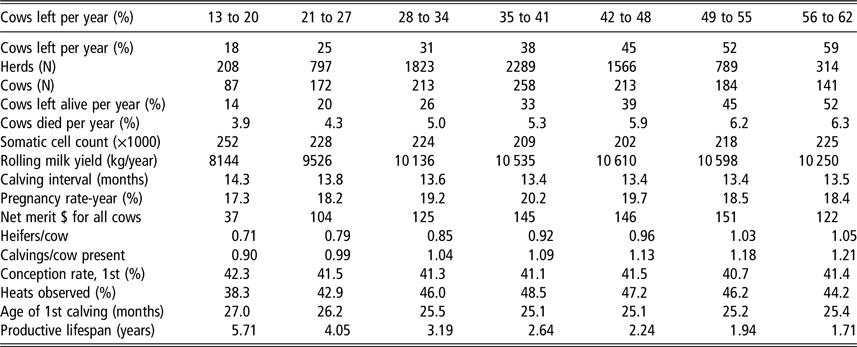
Source: Dairy Records Management Systems, Raleigh, NC. Last updated 10 March 2019 from =http://retro.drms.org/Login.aspx?OrigURL=/DairyMetricsRun.aspx.
Welfare and productive lifespan
Animal welfare includes animal health but also concerns about the ability to live a natural life (e.g., access to pasture) and affective states (von Keyserlingk et al., Reference von Keyserlingk, Martin, Kebreab, Knowlton, Grant, Stephenson, Sniffen, Harner, Wright and Smith2013). Public input is needed to provide valuable insights into which specific dairy production practices are important to the general public, as well as identify potential areas of concern that may hinder the sustainability of the dairy industry (Cardoso et al., Reference Cardoso, Hötzel, Weary, Robbins and von Keyserlingk2016). An online survey of people in the United States who were not affiliated with the dairy industry about their views on the ideal dairy farm showed that animal welfare was the primary issue raised (Cardoso et al., Reference Cardoso, Hötzel, Weary, Robbins and von Keyserlingk2016). Respondents expressed direct concern about the quality of life for the animals. They did not mention length of life as a concern by itself. It is conceivable, however, that society will start to demand longer productive lifespans that are more in line with the natural life expectancy, given that health problems are major drivers of culling at a young age. This in turn may lead to changes in management and housing that are not necessarily profitable for the farmer. Examples could be access to pasture, longer calving intervals and further improved cow comfort. Such changes might become minimum requirements for the social license to produce milk.
Many cows are culled for culling reasons that suggest temporarily poor welfare caused by disease, feet and legs (lameness) and mastitis. Important welfare concerns by the general public include the high prevalence of lameness on many dairy farms (von Keyserlingk et al., Reference von Keyserlingk, Martin, Kebreab, Knowlton, Grant, Stephenson, Sniffen, Harner, Wright and Smith2013). Involuntary culling is necessary to reduce further suffering in individual animals, but a high proportion of involuntary culling in the herd indicates poor animal welfare and inefficient use of animal resources, which oppose sustainable dairy production (Ahlman et al., Reference Ahlman, Berglund, Rydhmer and Strandberg2011).
A short productive lifespan may indirectly be of societal concern if caused by welfare problems. Culling because of health problems would perhaps be more acceptable if this occurred towards the end of the natural lifespan of approximately 20 years. Leading causes of death for humans also include diseases that reduce welfare towards the end of life (Davis et al., Reference Davis, Penha, Mbowe and Taira2017). Thus, dairy cattle welfare would be improved if cows were culled before diseases started to occur (e.g., possibly predicted by biological sensors) or if culling for non-health-related causes such as low milk production or failure to get pregnant would be economically justified before animals experienced health issues. Increases in milk production and reproductive performance over time (CDCB, 2019) make the latter driver to improve dairy cattle welfare less likely.
A long productive lifespan is not necessarily a sign of good welfare, nor is a short productive lifespan necessarily a sign of poor welfare. If cows have long productive lifespans, a smaller fraction of their offspring will be needed to replace the cow. The surplus offspring will generally be raised as meat animals with an age at slaughter of less than 2 years. The surplus offspring therefore would have a much shorter lifespan than the cow who was already around 2 years of age when she had a first calf. Therefore, increasing productive lifespan for cows will at some point decrease the average age at death per born calf. If calves not kept for replacement are slaughtered younger than 1.5 years of age, then increasing productive lifespan for the cow will reduce the age at death per born calf. Increasing calving intervals by voluntarily planning for extended lactations will reduce the number of surplus offspring. This strategy will be discussed later in the text.
Environmental impact
Increasing productive lifespan may reduce the environmental impact of milk production. Herds with increased productive lifespan will need fewer non-milk-producing replacement heifers and will have more mature (higher producing) cows. A herd with a high proportion of heifers and primiparous cows excretes more phosphorus and emits more methane in the environment per unit of milk when compared with a herd with a greater proportion of multiparous cows (Hristov et al., Reference Hristov, Ott, Tricarico, Rotz, Waghorn, Adesogan, Dijkstra, Montes, Oh, Kebreab, Oosting, Gerber, Henderson, Makkar and Firkins2013). For example, Knapp et al. (Reference Knapp, Laur, Vadas, Weiss and Tricarico2014) showed that the contribution of replacement heifers to whole-herd enteric methane emissions ranged from 20% to 33%, depending on age at first calving and productive lifespan. However, increasing productive lifespan of cows will decrease the amount of beef contributed by the dairy industry and would require an increase in beef animals to maintain the same beef supply (Knapp et al., Reference Knapp, Laur, Vadas, Weiss and Tricarico2014). Consequently, extending the productive lifespan of dairy cows is less effective at reducing greenhouse gas emissions per kg of milk when the amount of beef produced is accounted for (Vellinga and de Vries, Reference Vellinga and de Vries2018). On the other hand, beef from dairy animals produces significantly less greenhouse gas per kilogram of meat when greenhouse gas allocated to milk is accounted for than meat produced in feedlot or extensive production systems by none or low milk-producing animals (Zehetmeier et al., Reference Zehetmeier, Baudracco, Hoffmann and Heißenhuber2012).
Economics
Herd replacement costs, defined as the cost to maintain a fixed herd structure, are approximately 10% of the total cost of operations on dairy farms in the western United States (Frazer, Reference Frazer2018). In 2017, these costs were on average $3.68 per 100 kg of milk sold and $424 per cow per year. Herd replacement costs are calculated as the annual expenses to obtain calving heifers minus the revenues from culled cows, divided by the amount of milk sold. The average cost to obtain a replacement heifer was $1739 per head. In these data (Frazer, Reference Frazer2018), the annual cull rate was 38%, equivalent to 31.4 months of productive lifespan when assuming all culling ended the productive life of cows.
Increasing productive lifespan would decrease herd replacement costs per cow per year but might increase lifetime productivity. Expected benefits from improving lifetime productivity include more productive dairy herds due to a longer average age and therefore greater lifetime milk production (Coffey et al., Reference Coffey, Horan, Evans and Berry2016), reductions in costs due to requiring fewer replacement animals (Mohd Nor et al., Reference Mohd Nor, Steeneveld and Hogeveen2014) and a reduction in costs due to fewer health treatments and performance-limiting health disorders (Beaudeau et al., Reference Beaudeau, Ducrocq, Fourichon and Seegers1995). Extending productive lifetime is not necessarily profitable, however.
A principle in agricultural economics is that profitability should be expressed per unit of the most limiting factor per unit of time. The unit of time is important because there is an opportunity cost of a replacement cow that could take the position of the cow currently in the herd (Groenendaal et al., Reference Groenendaal, Galligan and Mulder2004). Van Arendonk (Reference van Arendonk1991) calculated that the relative value of productive lifespan was overestimated by 260% when opportunity costs of postponed replacement were not accounted for. Facilities are often the most limiting factor on dairy farms in the United States which makes expressions of profitability per cow per year, or per milking cow per year, the most relevant. Extending productive lifetime will increase milk production and profitability per cow. However, the greatest profit per cow may not lead to the greatest profitability per cow per year. Likewise, extending productive lifespan does not necessarily increase profitability per cow per year. From an economic point of view, extending productive lifespan is the wrong criterion when profit is the only goal.
At least three factors are important when determining the optimal economic productive lifetime of a dairy cows. One factor is rational economic decision-making considering the existing performance of dairy cows, including the risk factors described above. As summarised by Fetrow et al. (Reference Fetrow, Nordlund and Norman2006) and Hadley et al. (Reference Hadley, Wolf and Harsh2006), past research based on modelling or surveys of dairy farm financial records has consistently estimated optimal herd-level culling rates ranging from 19% to 29%. The main driver of these lower cow cull rates points to suboptimal decision-making by dairy farmers, for example, because they may give cows not enough opportunity to get pregnant or underestimate the cost to raise replacement heifers. Furthermore, criteria for culling vary between farmers (Beaudeau et al., Reference Beaudeau, van der Ploeg, Boileau, Seegers and Noordhuizen1996) and between farmers and their advisors (Haine et al., Reference Haine, Delgado, Cue, Sewalem, Wade, Lacroix, Lefebvre, Arsenault, Bouchard and Dubuc2017). There is a lack of current studies that determine the economically optimal productive lifespan of dairy cows.
The second factor that determines the optimal economic productive lifespan is changes in cow performance over time. The risk of health problems increases with age, while reproductive ability decreases (Pinedo et al., Reference Pinedo, De Vries and Webb2010). Healthy cows reach full maturity in approximately the fifth lactation when they produce the most milk (Grandl et al., Reference Grandl, Amelchanka, Furger, Clauss, Zeitz, Kreuzer and Schwarm2016). A first lactation cow may produce only 80% of a mature cow. Cows older than when they first reached full maturity may produce less milk again. Observations on milk production per lactation are biased by culling of low-producing cows, however, because only surviving cows contribute to milk production in later lactations.
Third, genetic progress in sires available for artificial insemination has accelerated the last decade due to genomic testing which has shorted generation intervals (García-Ruiz et al., Reference García-Ruiz, Cole, VanRaden, Wiggans, Ruiz-López and Van Tassell2016). This accelerated genetic progress also means that heifers are becoming genetically improved faster than in the past. Replacement should occur faster when the challenger animal is better than the incumbent animal (Groenendaal et al., Reference Groenendaal, Galligan and Mulder2004). This implies that productive lifespan should become shorter. Accelerated genetic progress should result in increases in cow cull rates by a few percentage points, the equivalent of a few months (De Vries, Reference De Vries2017). On the other hand, genetic merit for the trait productive life has increased for decades without marked changes in actual productive lifespan (CDCB, 2019).
Historical cow cull rates in the United States have at least partly been determined by dairy farmers who believe that all available dairy heifer calves should be raised to replace cows. Motivation has been the perceived value of genetic progress and the fear of not having enough heifers if involuntary culling is unexpectedly high. Another reason has been the lack of a valuable market for dairy calves that are not raised to be dairy cows, including dairy heifers. When the national herd size is stable (9.3 million dairy cows in the United States in 2018), if only conventional semen is used, and all dairy heifer calves are intended to be raised, then the cow cull rate must be approximately 35% to maintain the national herd size.
Lately, the use of sexed semen combined with improvements in reproductive performance and cow comfort has increasingly led to a realisation that not all dairy calves need to be raised. Dairy farmers obtain high cow cull rates because cows need to be culled to make room for calving heifers. Dairy advisors and dairy farmers are aware that short productive lifespans are increasingly the result of too many heifers on dairy farms that lead to removal of cows in order to make space for calving heifers. In addition, heifers may be included in legislation regarding environmental issues, such as currently in place in the Netherlands. A greater number of heifers imply that fewer milk-producing cows are allowed.
Raised surplus dairy heifers are often sold at a loss compared with the cost of raising them. Alternatively, the number of replacement heifers could be reduced by selling surplus dairy heifer calves at a young age or producing fewer replacement heifers through extended lactations or breeding a portion of the herd to beef semen. Extended lactations are realised primarily by a longer voluntary waiting period for first insemination. Extended lactations will reduce the number of calves born per cow per year and reduce the frequency of early lactation risk periods. Extension of the voluntary waiting period for first breeding of high-yielding cows up to 120 days may have no adverse effects regarding milk production, involuntary culling, udder health or body condition score gain (Niozas et al., Reference Niozas, Tsousis, Malesios, Steinhöfel, Boscos, Bollwein and Kaske2019). Extended lactations reduce the number of youngstock per cow and increase lifetime production. With extended lactations, greenhouse gas emissions per cow are reduced but maybe unchanged per kilogram milk because of lower efficiency later in lactation (Lehmann et al., Reference Lehmann, Mogensen and Kristensen2019). High premiums for dairy-beef crossbred calves should affect breeding strategies that produce such calves and reduce the number of dairy females that are born and raised to enter herds.
Replacement decision support
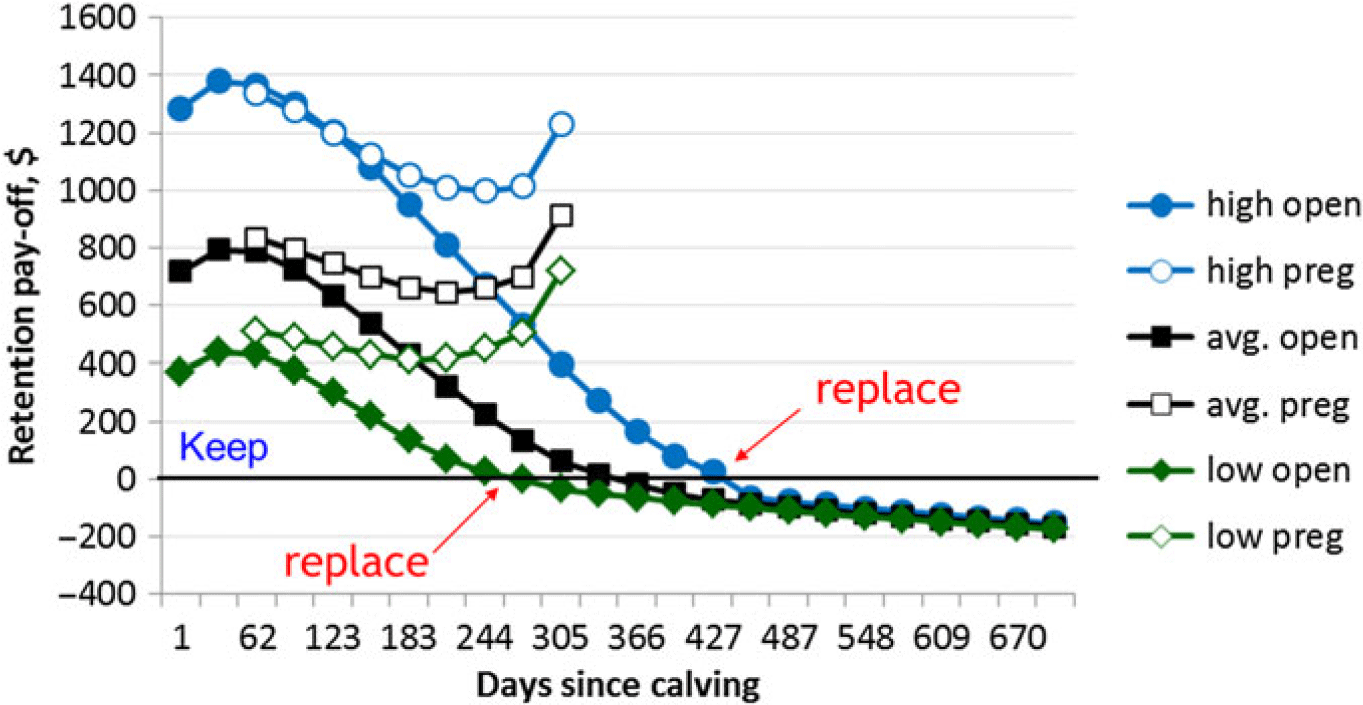
Financial considerations, including profit, cash flow and risk, are major economic factors affecting culling decisions (Lehenbauer and Oltjen, Reference Lehenbauer and Oltjen1998). Economically optimal culling decisions are not trivial decisions to make given the many considerations that are involved. Farmers’ management styles also play a role (Beaudeau et al., Reference Beaudeau, van der Ploeg, Boileau, Seegers and Noordhuizen1996). Unless a cow dies, economically optimal culling decisions involve projections of cash flow into the future of each alternative decision. These projections include the current cow, her replacement and future replacements until the decision made today has no longer any effect. For cull v. keep decisions, this is approximately 5 years (De Vries, Reference De Vries2006). Almost all decision support models in the literature maximise profit per cow place with the current cow and potential replacement heifer through the maximisation of future cash flows. Differences in the net present value of these future cash flows can be used to rank animals for future value (also called retention pay-off or cow value). Cows with the lowest future value should be replaced first. When the future value is decreased to below $0, profit is in theory maximised by immediately replacing the cow with a calving heifer. Figure 2 is an example of future values by days in milk at three levels of milk production and open and pregnant cows.
Retention pay-offs for cows that vary in level of milk production (high, average (avg.), low) and reproductive status (open and pregnant (preg), with conception on day 62 after calving). Retention pay-offs are the net present values of keeping the current healthy cow in the herd instead of immediate replacement with a calving heifer. Adapted from De Vries (Reference De Vries2006).
Prediction of future cash flows depends on the accuracy of the prediction of cow performance (such as milk yield, disease and fertility), prices (such as for milk, feed, breedings, calves, cull cows and replacement heifers), calculation method (such as the optimisation of sequential decisions or more limited non-optimal future decisions) and factors that make decisions for individual cows dependent on decisions for other cows. Examples of the latter are short-term fluctuations in cow numbers as well as by planned herd expansion (Lehenbauer and Oltjen, Reference Lehenbauer and Oltjen1998), the number of available replacement heifers, parlour capacity, contagious diseases and seasonal milk pricing. When space is available to expand the herd size, the opportunity costs for postponed replacement are lower and cows should be kept longer. Optimisation of culling decisions under such group constraints is still in its infancy because of the additional computing power needed and because formulation of the optimisation problem is less clear.
Lehenbauer and Oltjen (Reference Lehenbauer and Oltjen1998) suggested to include in a decision support system at least critical components for adequately describing biological traits related to milk production, reproduction and mastitis. Older decision support models classify cows by at least differences in parity, milk yield and reproductive status. Sometimes season is added or disease states such as mastitis or lameness. Genetic merit of various traits has been added as well (Kelleher et al., Reference Kelleher, Amer, Shalloo, Evans, Byrne, Buckley and Berry2015).
A study that compared ranking of cows based on Cow Value, a future profitability ranking based mostly on differences in milk yield, parity and reproductive status provided by the dairy management program Dairy Comp 305 showed that many cows were culled when their future values were much greater than $0. These high values suggest that these cows should have been kept (Sorge et al., Reference Sorge, Kelton, Lissemore, Sears and Fetrow2007). Dairy farmers making these ‘non-optimal’ culling decisions likely considered cow attributes not included in the calculation of the Cow Value. This example supports the idea that there is opportunity to improve predictions of future cow performance (e.g., milk yield forecasting) and include categories that represent every cow in the herd, such as a detailed categorisation of health events. Ideally, decision support systems become so accurate that cow culling decisions that do not follow the recommendation are clearly not optimal. Following optimal replacement decisions would also determine the optimal herd average productive lifespan.
Conclusions
Productive lifespan of dairy cows is primarily determined by disposal reasons that indicate reduced health and welfare leading to culling, but also by other factors such as the supply of genetically improved dairy heifers. Improvements in health, conformation, and fertility will reduce forced culling and allow for more culling decision-making on functionally sound cows. Decision-making regarding productive life is currently more art than science. Improvements in decision support tools that help with ranking cows and heifers for culling, but also with insemination decisions, may help optimise productive life of dairy cows.
Acknowledgements
This work is supported by Food and Agriculture Cyberinformatics and Tools grant award no. 2019-67021-29923 from the USDA National Institute of Food and Agriculture. Any opinions, findings, conclusions, or recommendations expressed in this publication are those of the authors and do not necessarily reflect the view of the US Department of Agriculture. The abstract was first published in Advances in Animal Biosciences (De Vries and Marcondes, Reference De Vries and Marcondes2019).
A. De Vries 0000-0003-4511-0388
Declaration of interest
The authors declare no conflict of interest.
Ethics statement
We did not obtain approval from an ethics committee.
Software and data repository resources
Data are available upon request from the corresponding author. We did not deposit our data and models in an official repository.



