


The ICD–10 (World Health Organization, 1992) and DSM–IV (American Psychiatric Association, 1994) diagnostic criteria for hyperkinetic disorder and attention-deficit hyperactivity disorder (ADHD) require symptoms or impairment in two or more settings. There is no clear consensus as to how these criteria are best assessed, although the use of multiple informants is advocated (Reference BarkleyBarkley, 1998; Reference Taylor, Sandberg and ThorleyTaylor et al, 1991; Reference Simonoff, Pickles and HervasSimonoff et al, 1998). Teacher rating scales are most commonly used but may be subject to limitations, such as rater errors and poor response rates (Reference Conners, Sitarenios and ParkerConners et al, 1998), and children who score above an accepted cut-off do not necessarily show disorder (Reference Taylor, Rutter, Taylor and HersovTaylor, 1994). Telephone interviews with teachers provide an alternative strategy. The aim of this paper is to describe the Child ADHD Teacher Telephone Interview (CHATTI), designed to assess systematically the hyperactive, inattentive and impulsive symptoms and impairment in a school setting. We present data on the stability, test–retest reliability and criterion validity of this measure in a clinical sample of children with suspected ADHD.
METHOD
Ascertainment of sample
The sample described in this paper is part of a larger sample from an ongoing genetic study consisting of children with a suspected diagnosis of ADHD referred to district child and adolescent psychiatry and paediatric clinics in South Wales, the south-west of England, Greater Manchester and Cheshire. Children with full-scale IQ test scores of below 70 (assessed using the Wechsler Intelligence Scale for Children – version III, WISC–III; Reference WechslerWechsler, 1992), major medical or neurological conditions, Tourette syndrome or pervasive developmental disorder were excluded. Each child was assessed comprehensively (see Reference Holmes, Payton and BarrettHolmes et al, 2000 for a full description) with clinical information obtained using the parent version of the Child and Adolescent Psychiatric Assessment (CAPA; Reference Angold, Prendergast and CoxAngold et al, 1995). Diagnoses were assigned according to ICD–10, DSM–IV and DSM–III–R (American Psychiatric Association, 1987) classification systems.
Procedure and sample characteristics
The parents of each child were asked for written parental consent to contact the school. This consent form was then posted to the child's school, together with a study information sheet, teacher consent form (giving us permission to contact them by telephone to administer the CHATTI) and a short questionnaire package that contained the Abbreviated Conners Teacher Ratings Scale (ACTRS; Reference ConnersConners, 1973), which at the time of the study was one of the rating scales most commonly used by clinicians in the UK, and the DuPaul ADHD rating scale (Reference DuPaulDuPaul, 1981). A reminder letter was sent to teachers who failed to respond to the first mailshot. The return rate for the questionnaires was 94% (79/84). Data from the teachers of this sample of 79 children (73 males; 6 females) aged between 6 and 13 years (mean=8.76; s.d.=1.75) were used for the purposes of assessing the criterion validity of the CHATTI.
Once the consent form and questionnaire package had been returned, the researcher telephoned the teacher to carry out the CHATTI. The interview and questionnaires were always completed by the same teacher, typically the child's class teacher because the majority of children who participated in the study were in primary school. However, for those children in secondary school the teacher who had the most extensive knowledge of the child's behaviour was chosen to complete the interview and questionnaires. Phase 1 of the study involved interviews with 79 teachers, of whom 20 were reinterviewed one week later by the same experienced interviewer (a research psychologist (J.H.) and two child psychiatrists (A.Tr., H.F.), who had all been trained previously to use a research diagnostic interview). Phase 2 of the study involved a further 16 interviews (new sample) undertaken with the same teacher 1 week apart by two different interviewers (one of whom had been trained in the CAPA (D.L.) and the other who was an assistant psychologist (H.P.) who had not received training in diagnostic interviews).
All teachers who consented to the study (94%) were interviewed. The interviews took place during regular school hours. The children in these groups were aged between 6 and 13 years (mean=9.13, s.d.=1.7; 32 males, 4 females) and fulfilled either DSM–III–R or DSM–IV criteria for ADHD or ICD–10 criteria for hyperkinetic disorder.
Measures
The CHATTI is a structured interview that takes 15–20 min to complete and should be conducted with the teacher who has the most extensive knowledge of the child's behaviour (class teacher for primary school children). The interview focuses on the occurrence of ADHD symptoms during the preceding 3 months. The CHATTI contains 18 items included in the ICD–10 criteria for hyperkinetic disorder and DSM–IV diagnostic criteria for ADHD.
The CHATTI is divided into three overall symptom areas: inattention (e.g. ‘difficulty concentrating’); hyperactivity (e.g. ‘fidgets or squirms in seat’); impulsiveness (e.g. ‘interrupts or intrudes on others’). Each symptom is explicitly defined and teachers are asked whether the index child shows the symptom in different lessons and to a greater extent than other children of his/her developmental age. In addition to the 18 ADHD items, the CHATTI includes a question on whether the ADHD symptoms cause significant impairment in the child's social or academic functioning at school.
Symptom scores were summed to provide continuous measures, a total ADHD score and scores from the three sub-scales, namely inattention, hyperactivity and impulsiveness.
In this study the interview was developed to be used in conjunction with the parent version of CAPA (Reference Angold, Prendergast and CoxAngold et al, 1995) but could be used with other similar diagnostic interviews. Again in this study, diagnoses were primarily based on parent-derived interview data with the teacher information used only to define the ICD–10 and DSM–IV criterion of pervasiveness (i.e. symptoms at school as well as at home), but the instrument could be used differently. At the start of the study, the criterion of ‘symptom pervasiveness’ for ICD–10 hyperkinetic disorder was operationally defined by a consensus of experienced child psychiatrists as the presence of at least one definite symptom from each of the symptom areas (i.e. inattention, hyperactivity, impulsiveness) reported by the teacher, with associated impairment in functioning in school in addition to meeting the diagnostic criteria at home using parental interviews. For DSM–IV ADHD, the criterion of ‘some impairment from the symptoms is present in two or more settings’ was rated using the response to the question on impairment of functioning.
Statistics
Symptom scores (categorical data) and scale scores (continuous data) were generated from the interview data. For the reliability analysis, Cohen's κ (Reference CohenCohen, 1960) was used to assess agreement on categorical variables, whereas the scale score agreement was measured by the intraclass correlation coefficient (ICC) (Reference EverittEveritt, 1996). Criterion validity was assessed by investigating the association between scores on the CHATTI and ACTRS (Reference ConnersConners, 1973) and the DuPaul ADHD scale (Reference DuPaulDuPaul, 1981). Internal consistency also was checked using Cronbach's α coefficient. Within-subject associations of measures were investigated using Spearman's correlations, because questionnaire scores from the DuPaul rating scales and ACTRS were negatively skewed.
All statistical tests were considered significant at P<0.05. Two-tailed P values are presented. Statistical analyses were carried out using the Statistical Package for the Social Sciences, Windows version 7.5 (SPSSW; SPSS Inc).
RESULTS
Criterion validity
Mean scores (and standard deviations) for all 79 teachers were as follows: total CHATTI, 10.60 (5.12); ACTRS, 19.11 (6.70); DuPaul ADHD total scale, 37.24 (11.80). Total CHATTI scores were strongly correlated with total scores on the DuPaul ADHD rating scale (r=0.65, P<0.01) and moderately correlated with scores on the ACTRS (r=0.46, P<0.01).
Stability of the CHATTI across time – same interviewer
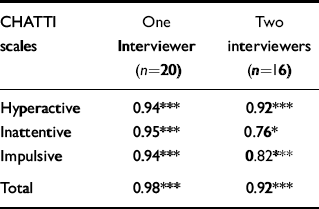
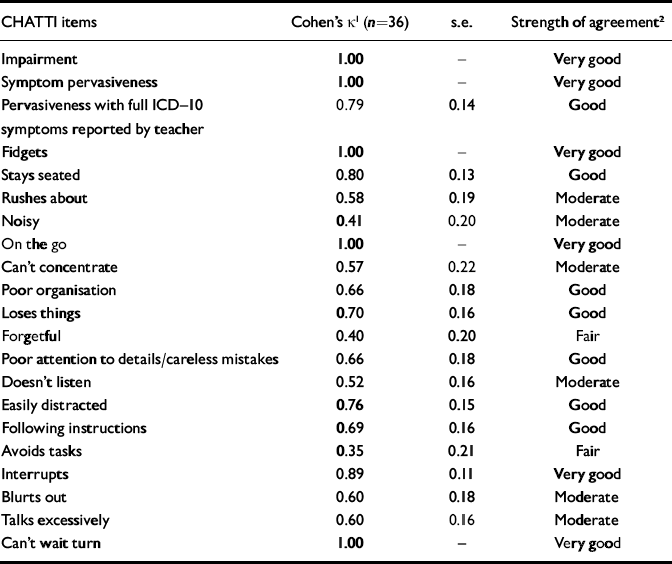
Table 1 shows the agreement across time for scores on the CHATTI total scale and sub-scales. The ICCs ranged from 0.94 to 0.98. Kappa coefficients were then calculated to assess agreement between time 1 and time 2 for each individual item and for the criterion of ‘pervasiveness’. Table 2 shows the stability of the criteria of ‘pervasiveness’ (1.0) and ‘impairment from symptoms’ (1.0) necessary to make a diagnosis of ICD–10 hyperkinetic disorder and DSM–IV ADHD, respectively. According to the benchmarks provided by Landis & Koch (Reference Landis and Koch1977), the strength of agreement for CHATTI items ranged from fair (0.35 for ‘avoids tasks’) to perfect (1.0 for ‘can't wait turn’). Cronbach's α was 0.91 for internal consistency. Some researchers operationalise the ICD–10 criterion of pervasiveness as requiring that the full ICD–10 criteria for hyperkinetic disorder (i.e. at least six symptoms of inattention, three symptoms of hyperactivity and one symptom of impulsivity) are met at school (as well as at home). Therefore we also examined the stability of this stricter definition of ‘pervasiveness’. The κ coefficient was 0.79.
Stability across time for the scores on the Child Attention-Deficit Hyperactivity Disorder Teacher Telephone Interview (CHATTI) (total and sub-scales) in terms of the intraclass correlation coefficient
| CHATTI scales | One Interviewer (n=20) | Two interviewers (n=16) |
|---|---|---|
| Hyperactive | 0.94*** | 0.92*** |
| Inattentive | 0.95*** | 0.76* |
| Impulsive | 0.94*** | 0.82*** |
| Total | 0.98*** | 0.92*** |
Stability across time for the Child Attention-Deficit Hyperactivity Disorder Teacher Telephone Interview (CHATTI) items — same interviewer (n=20)
| CHATTI items | Cohen's κ1 (n=36) | s.e. | Strength of agreement2 |
|---|---|---|---|
| Impairment | 1.00 | - | Very good |
| Symptom pervasiveness | 1.00 | - | Very good |
| Pervasiveness with full ICD—10 | 0.79 | 0.14 | Good |
| symptoms reported by teacher | |||
| Fidgets | 1.00 | - | Very good |
| Stays seated | 0.80 | 0.13 | Good |
| Rushes about | 0.58 | 0.19 | Moderate |
| Noisy | 0.41 | 0.20 | Moderate |
| On the go | 1.00 | - | Very good |
| Can't concentrate | 0.57 | 0.22 | Moderate |
| Poor organisation | 0.66 | 0.18 | Good |
| Loses things | 0.70 | 0.16 | Good |
| Forgetful | 0.40 | 0.20 | Fair |
| Poor attention to details/careless mistakes | 0.66 | 0.18 | Good |
| Doesn't listen | 0.52 | 0.16 | Moderate |
| Easily distracted | 0.76 | 0.15 | Good |
| Following instructions | 0.69 | 0.16 | Good |
| Avoids tasks | 0.35 | 0.21 | Fair |
| Interrupts | 0.89 | 0.11 | Very good |
| Blurts out | 0.60 | 0.18 | Moderate |
| Talks excessively | 0.60 | 0.16 | Moderate |
| Can't wait turn | 1.00 | - | Very good |
Test–retest reliability across time – two different interviewers
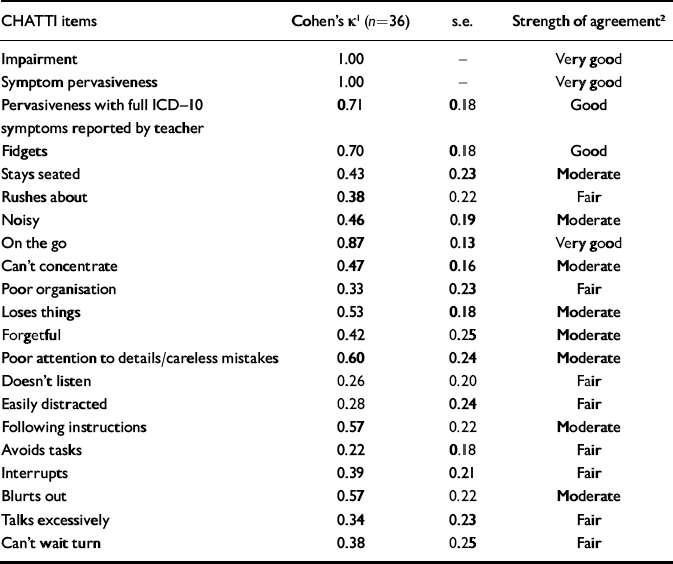
Intraclass correlations for total and sub-scores for different raters across time are shown in Table 1. These range from 0.76 to 0.92. Table 3 shows that agreement across time for the criteria of ‘impairment’ (1.0) and ‘pervasiveness’ was perfect (1.0). However, κ coefficients for individual items were very variable (ranging from 0.16 for ‘avoids tasks’ to 0.87 for ‘constantly on the go’). The test–retest reliability for the stricter definition of ‘pervasiveness’ was 0.71.
Agreement across time for the Child Attention-Deficit Hyperactivity Disorder Teacher Telephone Interview (CHATTI) items — two different interviewers
| CHATTI items | Cohen's κ1 (n=36) | s.e. | Strength of agreement2 |
|---|---|---|---|
| Impairment | 1.00 | - | Very good |
| Symptom pervasiveness | 1.00 | - | Very good |
| Pervasiveness with full ICD—10 | 0.71 | 0.18 | Good |
| symptoms reported by teacher | |||
| Fidgets | 0.70 | 0.18 | Good |
| Stays seated | 0.43 | 0.23 | Moderate |
| Rushes about | 0.38 | 0.22 | Fair |
| Noisy | 0.46 | 0.19 | Moderate |
| On the go | 0.87 | 0.13 | Very good |
| Can't concentrate | 0.47 | 0.16 | Moderate |
| Poor organisation | 0.33 | 0.23 | Fair |
| Loses things | 0.53 | 0.18 | Moderate |
| Forgetful | 0.42 | 0.25 | Moderate |
| Poor attention to details/careless mistakes | 0.60 | 0.24 | Moderate |
| Doesn't listen | 0.26 | 0.20 | Fair |
| Easily distracted | 0.28 | 0.24 | Fair |
| Following instructions | 0.57 | 0.22 | Moderate |
| Avoids tasks | 0.22 | 0.18 | Fair |
| Interrupts | 0.39 | 0.21 | Fair |
| Blurts out | 0.57 | 0.22 | Moderate |
| Talks excessively | 0.34 | 0.23 | Fair |
| Can't wait turn | 0.38 | 0.25 | Fair |
DISCUSSION
Although telephone interviews have been used previously to assess psychopathology (Reference Rohde, Lewinsohn and SeeleyRohde et al, 1997), including symptoms of ADHD (Reference Nadder, Silberg and EavesNadder et al, 1998), these have nearly all been designed to be used with the subject or the parent. Nadder et al (Reference Nadder, Silberg and Eaves1998) developed a brief telephone survey for the assessment of ADHD and oppositional defiant disorder/compulsive disorder symptoms symptoms displayed at home, for twins aged 7–13 years, participating in the Virginia Twin Study of Adolescent Behavioural Development. This survey contained ten items coded as absent or present, of which six items related to ADHD symptomatology. Correlations between the summed ADHD items and maternal ratings on the Child Behavior Checklist hyperactivity sub-scale (Reference AchenbachAchenbach, 1991) were 0.67 and 0.61 for males and female twins, respectively, indicating good criterion validity for this instrument. However, this instrument was developed for the assessment of ADHD symptoms at home within a population-based sample. Furthermore, this instrument covers 6/18 items of DSM–IV and ICD–10 diagnostic criteria and was not intended to be a diagnostic instrument.
Although gathering information from teachers by telephone may occur commonly in clinical situations, to our knowledge there has been only one published report describing the use of a structured teacher telephone interview as an adjunct for making the diagnosis of ADHD for research purposes (Reference Tannock, Hum and MaselliTannock et al, 2000). Although psychometric data have not been published, this instrument has been found to be a useful adjunct to parent interviews (R. Tannock, personal communication, 2003).
Although it is usual to consider interview methods as the gold standard for assessing psychopathology it is still essential to assess the reliability, validity and acceptability of a new interview-based instrument. We sought to examine criterion validity using two commonly used questionnaires. The CHATTI was found to be strongly correlated with the ADHD rating scale (Reference DuPaulDuPaul, 1981) and moderately correlated with the ACTRS (Reference ConnersConners, 1973). The observed strong correlations between the CHATTI and the DuPaul ADHD rating scale are not surprising, given that both measures include the DSM–III–R symptoms of ADHD.
The CHATTI was found to yield highly consistent results across a 1-week test–retest period. Specifically, the CHATTI showed excellent reliability for our operationalised definition of symptom pervasiveness (κ=1.00) and high stability for total and sub-scale scores based on symptom counts and the stricter definition of ‘pervasiveness’. Test–retest reliability for total CHATTI scores (0.98) are similar or higher than those for the DuPaul ADHD scale (0.96) and ACTRS (0.7–0.90). Moreover, the CHATTI showed acceptable levels of stability even at the individual symptom level. Kappa coefficients for the majority of individual symptoms ranged between moderate to perfect agreement.
Test–retest reliability over time with two different interviewers was also examined. Here, the ICCs for symptom scores were still high and reliability for the categories of ‘symptom pervasiveness’ and ‘impairment’ was perfect and for the stricter definition of ‘pervasiveness’ was good. Nevertheless, reliability for individual items was highly variable and for some items it was low. We conclude that one contributory factor to this may have been the choice of interviewers. One of the two interviewers was a trained interviewer whereas the other was a psychology assistant who had not been trained in research diagnostic interviews. However, this approach was adopted not only for practical reasons (availability of researcher time) but also to consider whether it would be feasible for a clinician untrained in research diagnostic interviews to use this instrument.
Overall initial findings suggest that the CHATTI is cost- and time-efficient and acceptable to teachers. It provides a highly stable measure of symptom pervasiveness and teacher-reported total ADHD symptom scores and impairment at school. Although questionnaires are easy to use and cheap to administer, and many of them show high reliability, they can be inaccurate at identifying individuals as hyperactive and can be subject to rater biases and poor response rates (Reference Taylor, Rutter, Taylor and HersovTaylor, 1994; Reference Conners, Sitarenios and ParkerConners et al, 1998). Moreover, it is not clear how to integrate questionnaire-derived data with parent interviews to generate the criteria of ‘symptom pervasiveness’ or ‘impairment in two or more settings’ reliably. The CHATTI represents an attractive alternative to teacher questionnaires, particularly when a systematic method is required to be used in conjunction with a standard parent diagnostic interview for assigning the diagnosis of ADHD or hyperkinetic disorder. The CHATTI also provides an alternative means of assessing symptoms in studies focusing on teacher-reported ADHD symptoms and in clinical settings. Indeed, it can be argued that in clinical settings, for children with suspected ADHD, early clinician contact with schools by telephone rather than by letter is highly desirable for assessment and treatment purposes.
One limitation of this study is that data were collected from a clinic sample of children with suspected ADHD, nearly all of whom fulfilled the diagnostic criteria for hyperkinetic disorder or ADHD. Diagnostic severity may influence the measurement of reliability, with reliability coefficients being higher in more severely affected groups (Reference Jensen, Roper and FisherJensen et al, 1995). Thus, it is important to examine the psychometric properties of the CHATTI within a non-clinic sample and in children with other diagnoses before it can be recommended for widespread use in other populations. Further research also will be necessary to investigate the discriminant validity of the CHATTI to differentiate children with ADHD from other clinic groups, such as those with oppositional defiant disorder, anxiety and depression. However, we suggest that it is most useful when used as an adjunct to parent interviews to assess the presence of ADHD symptoms or impairment in more than one setting rather than as a diagnostic tool in itself.
In summary, with the advent of ICD–10 and DSM–IV, clinicians and researchers are required to assess the presence of hyperactive, impulsive and inattentive symptoms or impairment across settings, in order to determine a diagnosis of hyperkinetic disorder or ADHD. Research findings also suggest the importance of using multiple informants for the diagnosis of hyperactivity in order to reduce rater biases and discrepancies between parent and teacher ratings of hyperactivity (Reference Simonoff, Pickles and HervasSimonoff et al, 1998; Reference Mitsis, McKay and SchulzMitsis et al, 2000). The CHATTI is a new instrument designed for the assessment of ADHD symptomatology within school settings. Preliminary data suggest that the CHATTI shows acceptable reliability in clinical samples with suspected ADHD, it is easy to use and it is acceptable to teachers.
Clinical Implications and Limitations
CLINICAL IMPLICATIONS
-
▪ The Child Attention-Deficit Hyperactivity Disorder Teacher Telephone Interview (CHATTI) is a teacher telephone interview that can be used to assess attention-deficit hyperactivity disorder (ADHD) symptoms in school.
-
▪ The CHATTI appears to show acceptable reliability and stability in clinical samples with suspected ADHD.
-
▪ The CHATTI is short, easy to use and acceptable to teachers.
LIMITATIONS
-
▪ The instrument was tested in a clinical sample of children with suspected ADHD.
-
▪ Patients were referred to a study of ADHD.
-
▪ Most of the interviewers were trained to use research diagnostic interviews.
Acknowledgements
We thank the families and teachers who participated in this study.




eLetters
No eLetters have been published for this article.