




1. Introduction
At the same time as the use of traditional Danish dialects is diminishing (Kristiansen Reference Kristiansen2009), new language varieties are emerging in multilingual urban areas in Denmark and many other European countries (Quist & Svendsen Reference Quist and Ailin Svendsen2010, Källström & Lindberg Reference Källström and Lindberg2011, Kern & Selting Reference Kern and Selting2011, Nortier & Svendsen Reference Nortier and Ailin Svendsen2015, Madsen et al. Reference Madsen, Sif Karrebæk and Spindler Møller2016). This paper describes a linguistic feature in one of these new urban dialects: a prosodic pattern which I call ‘Strong Finals’, found in data from multilingual residential areas in Aarhus West and South. In example (1), 15-year-old Zuuz uses Strong Finals twice when telling club worker Martin about how often he plays football.
(1)
Monday
Footnote
1
(AUDZrisk 02:39)
01 →
Zuuz:
n
u
sp
i
ller jeg f
o
dbold (.) m
a
nd
ag:
↗
‘now I play football Monday’
02
Martin:
h
a
r du det som v
a
lgfag eller hv
a
‘do you have it as an elective course or what’
03 →
Zuuz:
>ja< n
u
sp
i
ller jeg f
o
dbold m
a
ndag t
i
rs
dag::
→
‘yes now I play football Monday Tuesday’
04
t
o
rsdag fr
e
dag↘
‘Thursday Friday’
Zuuz pronounces the bisyllabic words mandag (‘Monday’, line 1) and tirsdag (‘Tuesday’, line 3) with stress on both syllables. In the transcript this is illustrated with underlining, colons to indicate lengthening, and arrows to indicate movement of pitch. Following general rules of Danish phonology (Grønnum Reference Grønnum1992, Schachtenhaufen Reference Schachtenhaufen2013), we would expect the dag (‘day’) syllables to be unstressed, heavily reduced, and produced with falling intonation. I name Zuuz’s prosodic pattern ‘Strong Finals’ because of the unexpected non-reduction and because the pattern is found at the end of prosodic strings.
In a dataset of about ten hours of natural interaction in multilingual areas of Aarhus, 265 examples of Strong Finals are found.Footnote 2 They are found across field sites, age, gender, linguistic, and ethnic background, and in all types of contexts: talking to peers and adults, explaining the rules of boardgames, drunken talk during a night out, gossiping while waiting for the bus, giving directions on the phone, discussing maths homework, and many other contexts.
The same prosodic pattern has been described as ‘continuer intonation’ (‘fortsætterintonation’) by Mette Vedsgaard Christensen, who shows examples supporting a hypothesis that the speaker always gets to keep the turn afterwards (Christensen Reference Christensen2012:127). In most of my examples, however, the speaker does not get to keep the turn. In (1), Zuuz does not get to keep the turn because club worker Martin inserts a clarifying question (line 2). One general description of Strong Finals is that they project something more to come, but there are major differences in terms of how this ‘more’ is produced (and who produces it).
This article seeks to investigate which interactional actions are supported by Strong Finals. In Section 2 we describe the dialect in which the phenomenon is found, and account for the data collection and data processing methodology. Section 3 provides an acoustic description of Strong Finals’ prosodic characteristics and a description of how they differ from Standard Danish and regional standard prosody. The main part of the article, Section 4, shows five interactional categories in which Strong Finals are often found and provides a thorough analysis of interactional actions in two examples from each category. Finally, Section 5 discusses whether Strong Finals are specific to certain speakers or contexts, and whether they may have arisen because of transfer from other languages.
1.1 New urban dialects
In the first study of the new kinds of urban varieties, Kotsinas (Reference Kotsinas1988) took a dialect perspective by naming the variety Rinkebysvenska, referring to the geographical area Rinkeby where the variety was spoken. When Quist (Reference Quist2000) found a linguistically similar variety in a demographically similar suburb in Copenhagen, she coined the more generic term ‘multi-ethnolect’. The ‘-lect’ ending indicates that this is a linguistic variety similar to a dialect; ‘ethno-’ marks that it is often spoken by and associated with ethnic minorities; and ‘multi-’ marks that it arises when multiple languages and ethnicities are present. The problem with using a term referring to ethnicity is, as Quist (Reference Quist2006) also notes, that it may give grounds for the exotification of a language variety. Aarhus-based linguist Christensen (Reference Christensen2010) addresses another potential problem of using multi-ethnolect as a generic term. Since similar linguistic similarities are found across cities, it is easy to conclude that the language has spread from one city to another, or that the demographic similarities of the cities in question prove that the new varieties arise as a result of transfer from specific immigrant languages. Many linguistic studies have focused on forms that are similar across multi-ethnolects, such as consonant realisation, syntactic constructions, and lexicon (Quist Reference Quist2000, Maegaard Reference Maegaard2007, Svendsen & Røyneland Reference Svendsen and Røyneland2008, Opsahl Reference Opsahl2009, Hansen & Pharao Reference Hansen and Pharao2010, Pharao et al. Reference Pharao, Maegaard, Møller Spindler and Kristiansen2014). In a matched-guise study, Christensen (Reference Christensen2010) showed that despite linguistic similarities, speakers from Aarhus and Copenhagen, respectively, do not recognise each other’s varieties and do not identify with each other. Christensen concludes that the varieties are locally rooted and locally understood by the speakers, and that linguists should do the same:
Speakers from linguistic and ethnic minority backgrounds are embedded in the local speech community, be it Aarhus, Copenhagen or any other locality, and should therefore be considered as such, both in sociolinguistics and in public discourse. Mohammed from Copenhagen does not consider Mohammed from Aarhus ‘one of his kind’. (Christensen Reference Christensen2010:224)
The existence of strong roots in a local community is what inspired me to work with the new varieties from a dialect perspective and to focus on the grammatical description of a single variety. During the data collection, I used the term dialect to describe my research area, as this word had the advantage of not implying anything specifically ethnic or exotic, but instead highlights the geographical component. Recently, Quist & Skovse (Reference Quist and Ailin Svendsen2020) have adopted a similar local angle on urban varieties, describing how traditional regional features and ethnically associated features are intertwined in a new urban dialect in Odense, Denmark. Quist & Skovse also find that prosody is an important marker of local identity.
1.2 Prosodic studies of new urban dialects
In the expanding volume of literature on multi-ethnolects, most prosodic studies focus on segmental features such as pronunciation of /t/ and other individual phonemes (Maegaard Reference Maegaard2007, Bodén Reference Bodén2010, Pharao et al. Reference Pharao, Maegaard, Møller Spindler and Kristiansen2014). A study by Hansen & Pharao (Reference Hansen and Pharao2010) demonstrates that alteration of vowel length is the acoustic explanation of what has been impressionistically described as the prosodic feature ‘staccato-like intonation’ (cf. Quist Reference Quist2000, Svendsen & Røyneland Reference Svendsen and Røyneland2008). None of the Copenhagen-based studies report on phenomena similar to Strong Finals. Strong Finals were first described in Aarhus by Christensen (Reference Christensen2010, Reference Christensen2012) in data from 2003. Christensen refers to Strong Finals as ‘continuer intonation’ and describes them as ‘characterised by the final tone being heard as rising and the vowel of the last syllable vowel as longer than expected’ (Reference Christensen2012:123, my translation). Christensen kindly donated her recordings to me, and my acoustic analyses have shown the same prosodic and interactional characteristics in Christensen’s 2003 data as in my own data from 2017, on which this description is based (see Section 2). In data from Odense, Skovse (Reference Skovse2018) observes Christensen’s ‘continuer intonation’ in the multilingual suburb of Vollsmose. I have listened to but not made acoustic analyses of Skovse’s recordings, but my impression is that the Vollsmose phenomenon bears a strong resemblance to Strong Finals. I have performed acoustic analyses of a certain amount of media dataFootnote 3 from Vollsmose and found clear examples containing the same prosodic characteristics as the Strong Finals in Aarhus.
Outside Denmark, Swedish linguist Bodén (Reference Bodén2011) describes what seems to be a similar pattern in recordings from Malmö. The pattern is characterised by the substantial lengthening of lexically unstressed syllables, and this lengthening sometimes co-occurs with an F0 rise. Bodén names this pattern ‘phrase-final lengthening’. Whether it is similar or connected to what I describe as ‘Strong Finals’ is yet to be studied.
2. Data
The description of Strong Finals is based on a corpus of approximately ten hours of transcribed recordings of natural interaction between speakers of Danish as a first language. The corpus is available for other researchers; please contact the author. It consists of recordings collected in four different residential areas dubbed West 1–3 and South; see Table 1. Recordings were collected in three different periods: in 2003 by Mette Vedsgaard Christensen (see Christensen Reference Christensen2012), and in 2012 and 2017 by the author. Strong Finals are found in all four areas, in all three different periods of time and in speech from about 30 different speakers aged 10–29. It is important to note that Standard Danish prosodic patterns are by far the most common in the dataset: Strong Finals seem to be merely an extra option that dialect speakers can use in certain contexts.
Corpus of recordings
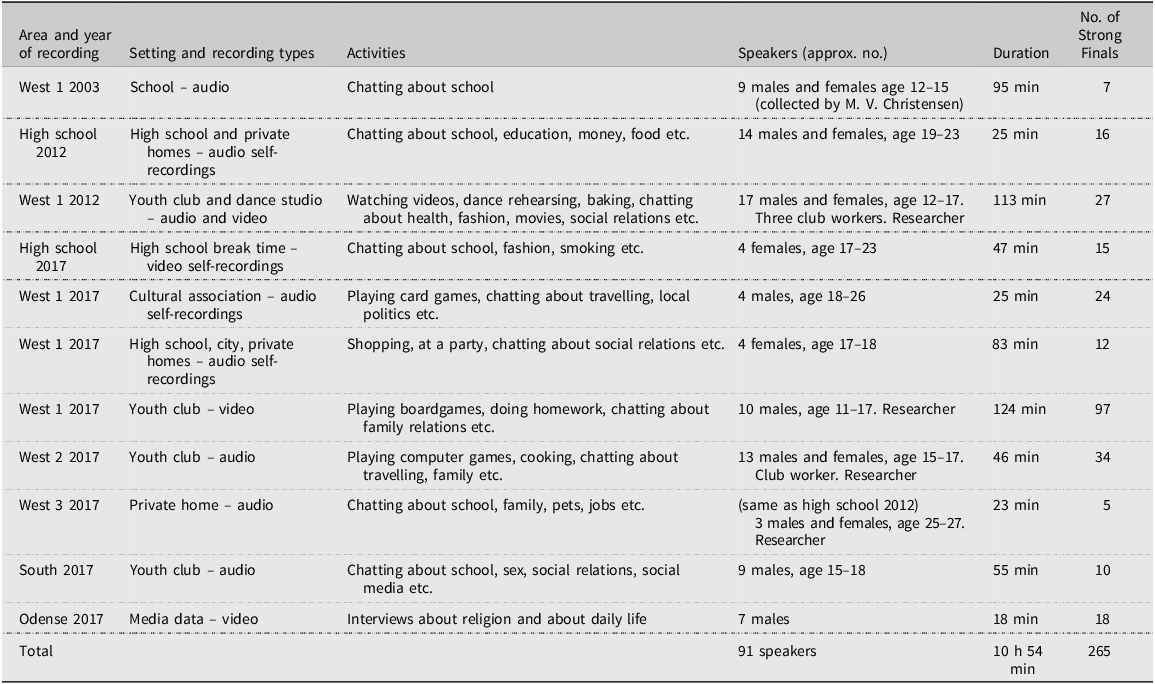
Table 1 Long description
The table presents a detailed summary of recordings of natural interaction between speakers of Danish as a first language. It includes columns for the area and year of recording, setting and recording types, activities, number of speakers, duration, and the number of strong finals. The table has 11 rows and 7 columns. The first column lists the area and year of recording, such as West 1, 2003, High school 2012, and so on. The second column describes the setting and recording types, including school, high school, youth club, cultural association, private home, and media data. The third column details the activities, such as chatting about school, watching videos, playing board games, shopping, and interviews about religion and daily life. The fourth column specifies the number of speakers, their age range, and sometimes additional participants like researchers or club workers. The fifth column indicates the duration of each recording in minutes. The final column shows the number of strong finals identified in each recording. Notable trends include a variety of settings and activities, with strong finals found in all areas and periods, highlighting its usage across different contexts and age groups.
2.1 Data collection, data types and speaker characteristics
Any prosodic and interactional analysis will benefit from having as many examples of the phenomenon involved as possible, and for this reason the choice of field sites was based on hypotheses regarding where most speakers of the local dialect were to be found. The four residential areas are all characterised by having a high percentage of immigrants and descendants of immigrants from non-western countries (Danish housing and planning authority 2019), which is a demographic characteristic we know from previous studies as an indicator of where new urban dialects have developed (see Kotsinas Reference Kotsinas1988, Quist Reference Quist2000, Svendsen & Røyneland Reference Svendsen and Røyneland2008, Bodén Reference Bodén2010, Freywald et al. Reference Freywald, Mayr, Özçelik and Wiese2011). For the data collection, I chose to go as far and as wide as possible rather than limiting myself to predefined types of interaction or controlled groups of speakers. I contacted clubs, schools, social media fora, and personal networks to get permission to record people in their everyday activities. The result is a dataset of very mixed data types, as can be seen in Table 1. Please note that the categories of settings and social activities are loosely defined and cannot be treated as variables that can be correlated with the frequency of Strong Finals. Nevertheless, the overview gives a sense of where to look and which hypotheses to form for a possible future distribution analysis. Generally, there are four types of data.
-
Video and audio recordings of speakers who each provided background information on their age, geographical upbringing, and linguistic association.
-
Self-recordings made by speakers who then subsequently provided background information for the other speakers in the recordings.
-
Recordings collected by Mette Vedsgaard Christensen. Available background information: geographical location of the recordings.
-
Media data from Odense used for comparison of acoustic analyses, but not for interactional analyses.
All the speakers gave their verbal, informed consent that the data could be used for research, played for researchers, and represented in written form when anonymised.
One criterion applying to the speakers taking part was that they were born and raised in Aarhus and spoke Danish as their main everyday language. Some reported speaking additional first languages at home, for example Arabic, Kurdish, or Turkish, but they all reported Danish to be their main language. This contradicts a general understanding of all urban dialect speakers as bilingual. The majority of the speakers self-report as having an immigrant background, but Strong Finals are also used by speakers with no immigrant background, including one adult club worker. Across all groups of speakers, some use Strong Finals and some do not. All speakers in the dataset grew up in multilingual urban areas, mostly in the areas where the recordings were made.
2.2 Coding procedure: impressionistically and acoustically
The phenomenon was registered initially at an open data session with students of Linguistics at Aarhus University. The Strong Finals immediately caught everyone’s attention and fascination, and they were described impressionistically as having ‘a certain swing’ and ‘a sound of double stress’. After an initial acoustic analysis of a small part of the dataset (Azulay Reference Azulay2017), the subsequent discovery procedure in the entire dataset followed a process of auditory and acoustic inspection ‘done reflexively through repeated comparison of what can be heard with what can be identified in acoustic records’, as recommended by Walker (Reference Walker2012:456). Potential candidates were selected intuitively, and acoustic analyses of individual words showed that the final syllables all met at least two of the three criteria described below in Section 3.1, ‘Three acoustic characteristics’. In total, one-third of the examples, including all examples shown in this paper, have been tested on linguists working with Danish Talk-in-InteractionFootnote 4 to make sure they were all evaluated as notably different from Standard Danish.
2.3 Levels of analysis: acoustic measurements and transcriptions of interaction
Examples are shown with different levels of context. For the prosodic description in Section 3, the utterances with Strong Finals are transcribed in IPA (following Heegård Petersen et al. Reference Heegård Petersen, Juul, Pharao and Maegaard2021), and acoustic measurements of pitch and intensity as well as syllabic duration are shown in diagrams made in the acoustic software Praat (Boersma & Weenink Reference Boersma and Weeninkn.d.). For the interactional analyses in Section 4, the wider interactional context is shown by including preceding and following utterances by all speakers taking part in the activity. Stress, lengthening, and intonation movements are shown with the transcription conventions of Conversation Analysis (see Appendix). All names of speakers and locations are pseudonymised.
3. Prosodic form
In the following part, I present prosodic characteristics of Strong Finals, first exemplified on word level by mandag (‘Monday’) and tirsdag (‘Tuesday’) from example (1), and secondly on phrase level based on further examples with different syllabic and sentential context. The definition of ‘prosodic’ here follows that of interactional linguists Elisabeth Couper-Kuhlen and Margret Selting, who use ‘prosodic’ for descriptions of non-segmental features such as intonation, while ‘phonetic’ is reserved for segmental auditory effects (Couper-Kuhlen & Selting Reference Couper-Kuhlen and Selting2017:chapter E).
3.1 Three acoustic characteristics
In Standard Danish we would expect mandag and tirsdag to be produced with unstressed dag syllables, as transcribed in Den Danske Ordbog (DDO, The Danish Dictionary):
mandag
‘Monday’
[ˈmanˀda]
tirsdag
‘Tuesday’
[ˈtiɐ̯ˀsda]
DDO’s description is based on careful speech, whereas in spontaneous speech we would expect the dag syllables to be produced with even less material, as unstressed syllables in Standard Danish spontaneous speech are often heavily reduced (Schachtenhaufen Reference Schachtenhaufen2013). A probable production in spontaneous speech could be [ˈmanˀd] [ˈtiɐ̯ˀsd], omitting the vowel part of the dag syllables. Compared to Standard Danish careful or spontaneous speech, the dag syllables in Strong Finals are produced with significantly more material. In Figures 1a–1b, syllabic duration is shown in seconds on the x-axis, pitch (fundamental frequency over time) is marked with a solid line on the y-axis, and intensity (volume over time) with a dashed line. Pitch span is based on the speaker’s pitch range in the surrounding couple of minutes. The acoustic measurements of mandag and tirsdag produced as Strong Finals show that the dag syllables are characterised by the following acoustic criteria:
-
i. longer duration than the first syllable
-
ii. non-falling intonation, i.e. either rising or flat pitch
-
iii. equal or higher intensity compared to the first syllable
Mandag ‘Monday’ (line 1, example 1) produced as Strong Final.
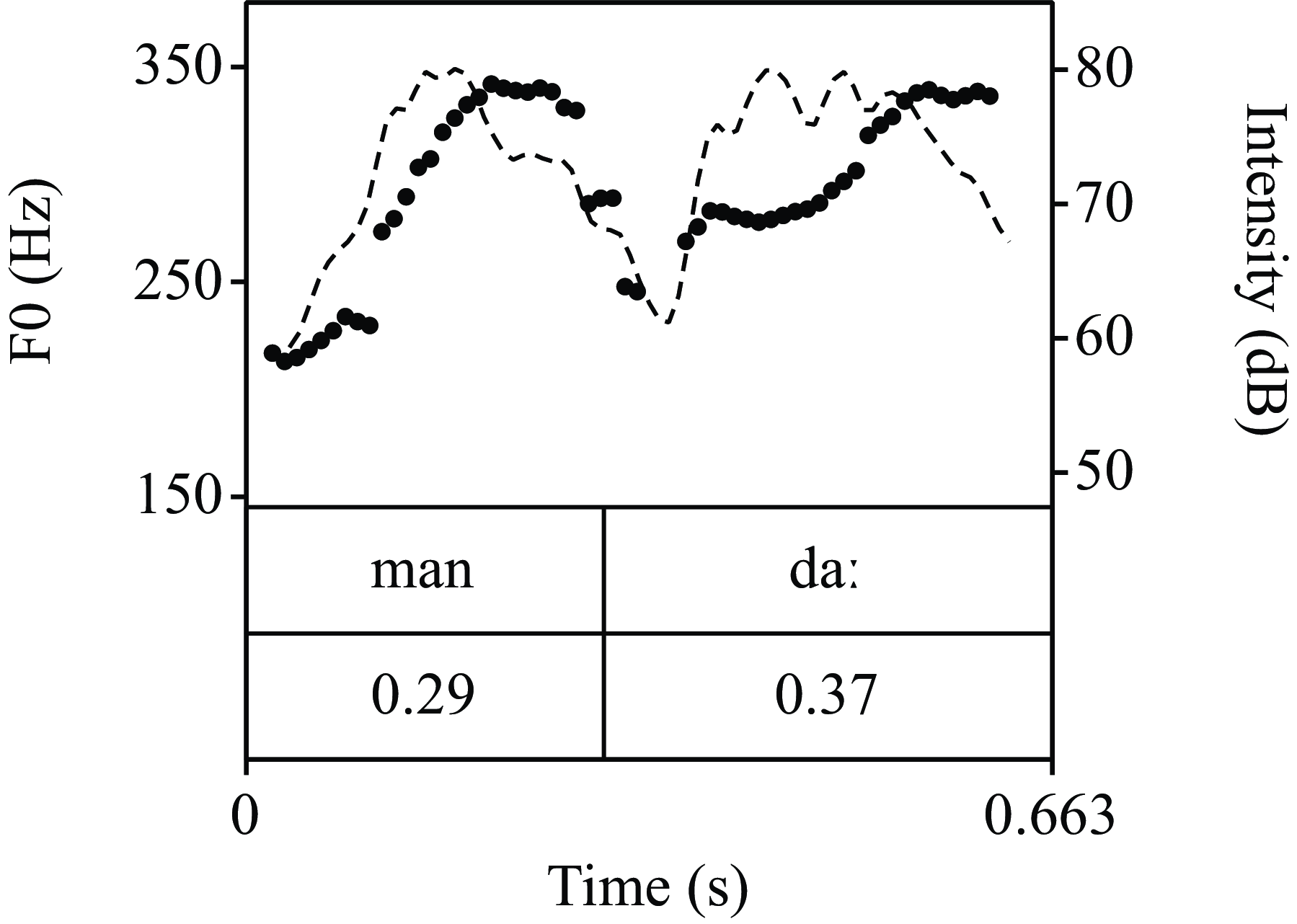
Figure 1a Long description
A line graph displays the fundamental frequency (F0) in Hertz and intensity in decibels over time in seconds for the word 'Mandag Monday'. The x-axis represents time in seconds, ranging from 0 to 0.663 seconds. The y-axis on the left represents the fundamental frequency (F0) in Hertz, ranging from 150 to 350 Hertz. The y-axis on the right represents intensity in decibels, ranging from 50 to 80 decibels. The graph shows two distinct sections labeled 'man' and 'da:', with durations of 0.29 seconds and 0.37 seconds, respectively. The F0 values start at around 250 Hertz, rise to approximately 350 Hertz, and then fluctuate before stabilizing around 300 Hertz. The intensity values start at around 60 decibels, rise to approximately 80 decibels, and then fluctuate before stabilizing around 70 decibels. All values are approximated.
Tirsdag ‘Tuesday’ (line 3, example 1) produced as Strong Final.
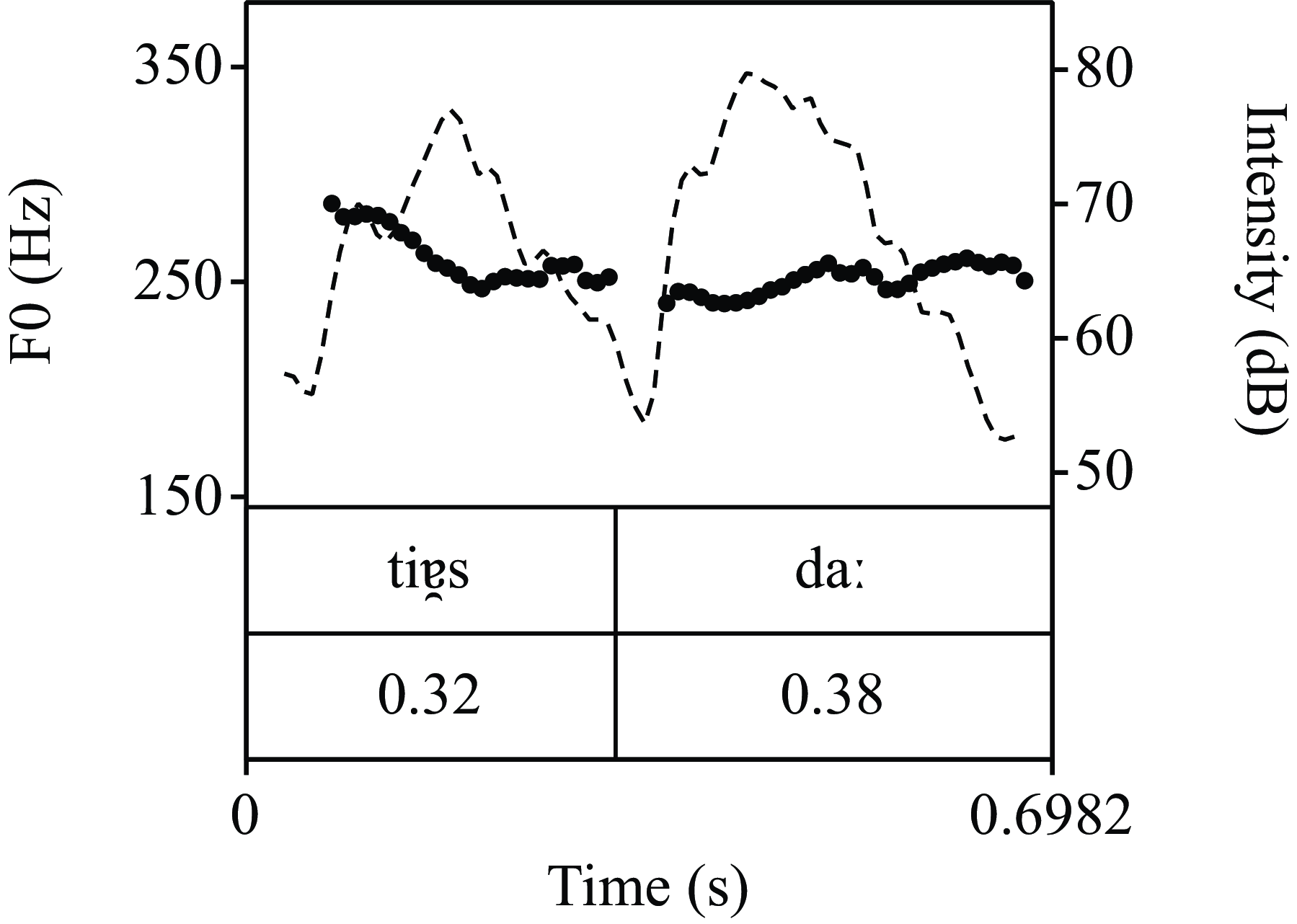
Figure 1b Long description
A line graph displays the fundamental frequency (F0) in Hertz and intensity in decibels over time in seconds. The x-axis represents time in seconds, ranging from 0 to 0.6982 seconds. The left y-axis represents the fundamental frequency (F0) in Hertz, ranging from 150 to 350 Hertz. The right y-axis represents intensity in decibels, ranging from 50 to 80 decibels. The graph shows two data lines: a solid line for F0 and a dashed line for intensity. The solid line fluctuates around 250 Hertz, while the dashed line shows peaks and troughs between 50 and 80 decibels. The graph is divided into two segments labeled 'tigs' and 'da:', with durations of 0.32 seconds and 0.38 seconds, respectively. All values are approximated.
Altogether, the perceived ‘double stress’ in Strong Finals is realised by increasing the three acoustic features duration, pitch, and intensity for syllables which in Standard Danish would be unstressed.
Figure 1c shows acoustic measurements of ‘Thursday Friday’, which follow the Standard Danish pattern of heavily reduced dag syllables.
Torsdag fredag ‘Thursday Friday’ (line 4, example 1) produced with Standard Danish reduction of final syllables.
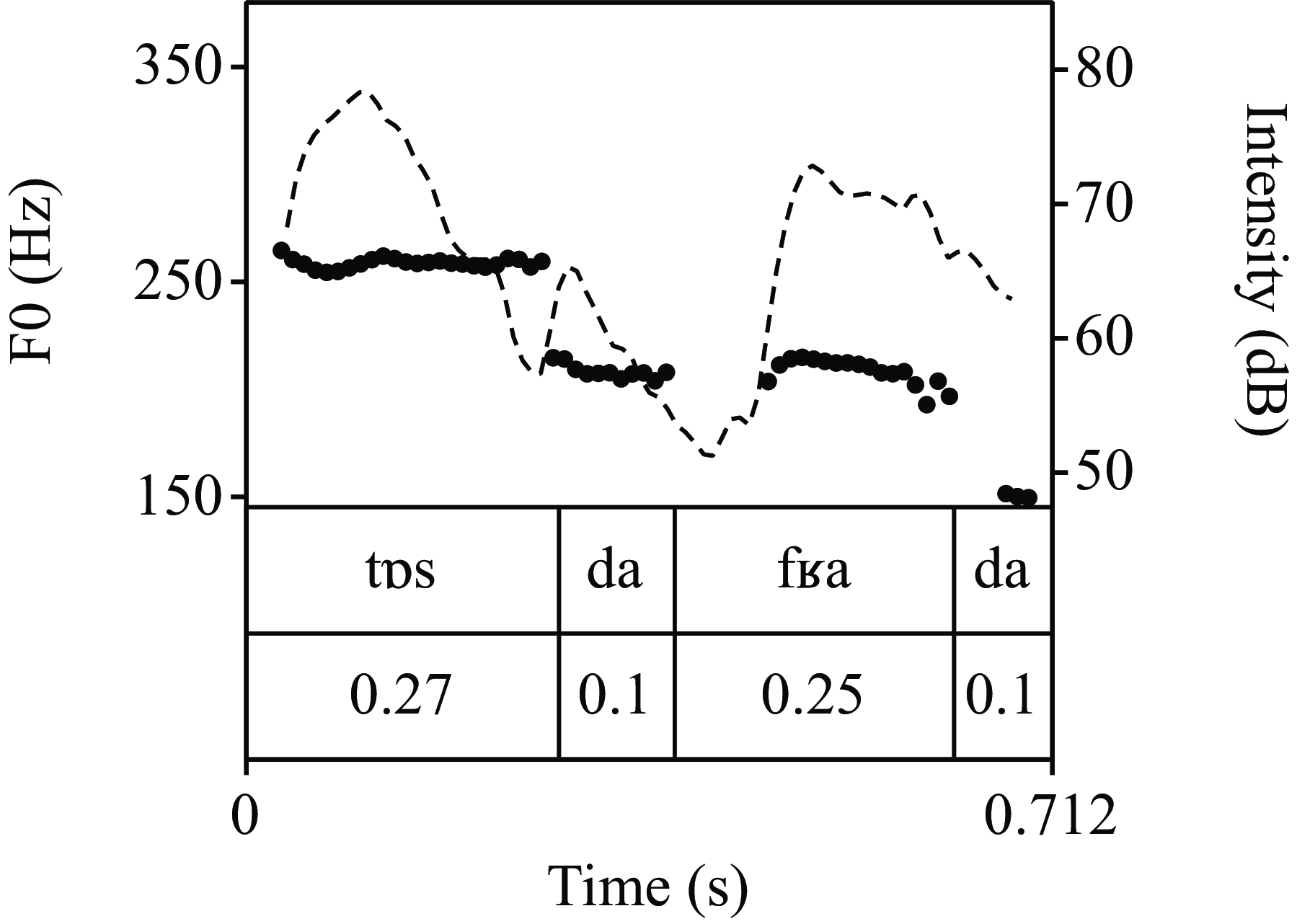
Figure 1c Long description
The line graph shows two data lines representing the fundamental frequency (F0) in Hertz on the left y-axis and intensity in decibels on the right y-axis over time in seconds on the x-axis. The solid line indicates the fundamental frequency, which fluctuates between approximately 150 and 350 Hertz. The dashed line represents the intensity, ranging from around 50 to 80 decibels. The x-axis spans from 0 to 0.712 seconds. Below the graph, a table segments the time into intervals labeled with syllables: tps, da, fra, and da, with corresponding time durations of 0.27 seconds, 0.1 seconds, 0.25 seconds, and 0.1 seconds respectively. The graph illustrates variations in pitch and intensity during the spoken phrase.
3.2 Realisation in different syllabic and sentential contexts
The impressionistically categorised examples of Strong Finals were found both in mono-, bi- and trisyllabic words and in different syntactic positions. Examples (2–5) below (see also Figures 2–5) show some of the different variation and combinations, each with orthographic and phonetic transcription, glossing, translation, and acoustic illustrations.
(2)
jeg
løb
sån
[jɑ
løb
ˈsɒːn↗]
I
ran
like.this
‘I ran like this’
(3)
min
far
han
var
gift
før
[min
ˈfɑ
ɑn
v
ˈgifd
ˈfɶˈɐ̯↗]
my
dad
he
was
married
before
‘my dad has been married before’
(4)
og
hvis
du
får
tre
forskellige
[ʌ
ves
du
ˈfɒɐ̯
ˈtʁæ
ˈfɒsˈgεlˈiː↗]
and
if
you
get
three
different
‘and if you get three different ones’
(5)
kender
du
(0.3)
en
tuneser
[ˈkεnɐ
ˈduː↗
en
tuˈneˈsɐː↗]
know
you
a
Tunisian
‘do you know (0.3) a Tunisian’
sån [sɒːn] ‘like.this’ (from example 2) pronounced as a Strong Final.
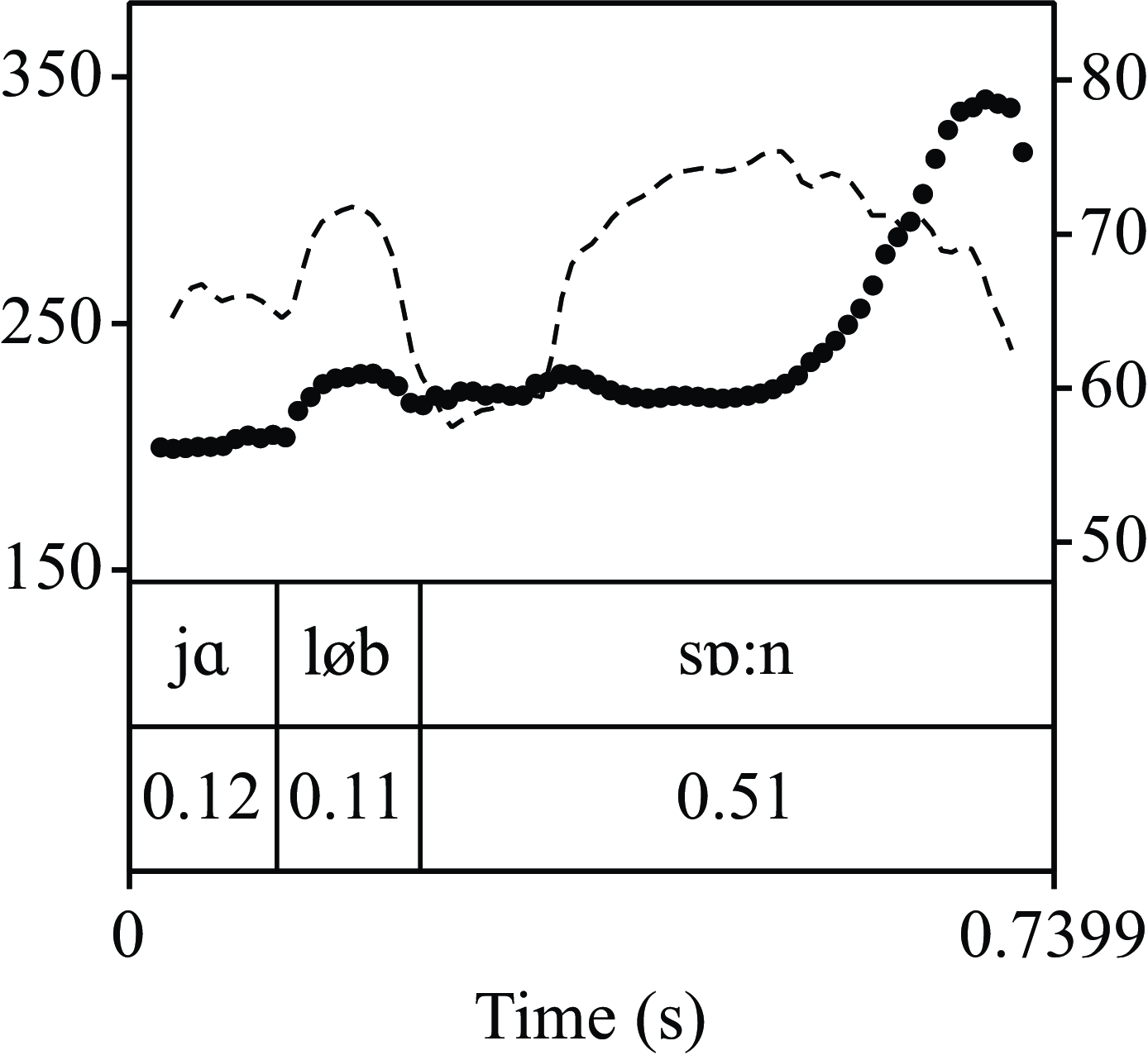
Figure 2 Long description
A line graph with two data lines representing different measurements over time. The x-axis ranges from 0 to 0.73999 seconds, and the y-axis on the left ranges from 150 to 350, while the y-axis on the right ranges from 50 to 80. The solid line represents one set of data points, and the dashed line represents another set of data points. The solid line starts at around 150, rises slightly, and then fluctuates around 250 before rising sharply towards the end. The dashed line starts at around 250, rises and falls in a wave-like pattern, and then fluctuates around 70 towards the end. Below the graph, a table shows three categories labeled 'ja', 'lob', and 'sp:n' with corresponding values of 0.12, 0.11, and 0.51 respectively. All values are approximated.
før [fɶːˈɐ̯] ‘before’ (from example 3) pronounced as a Strong Final.
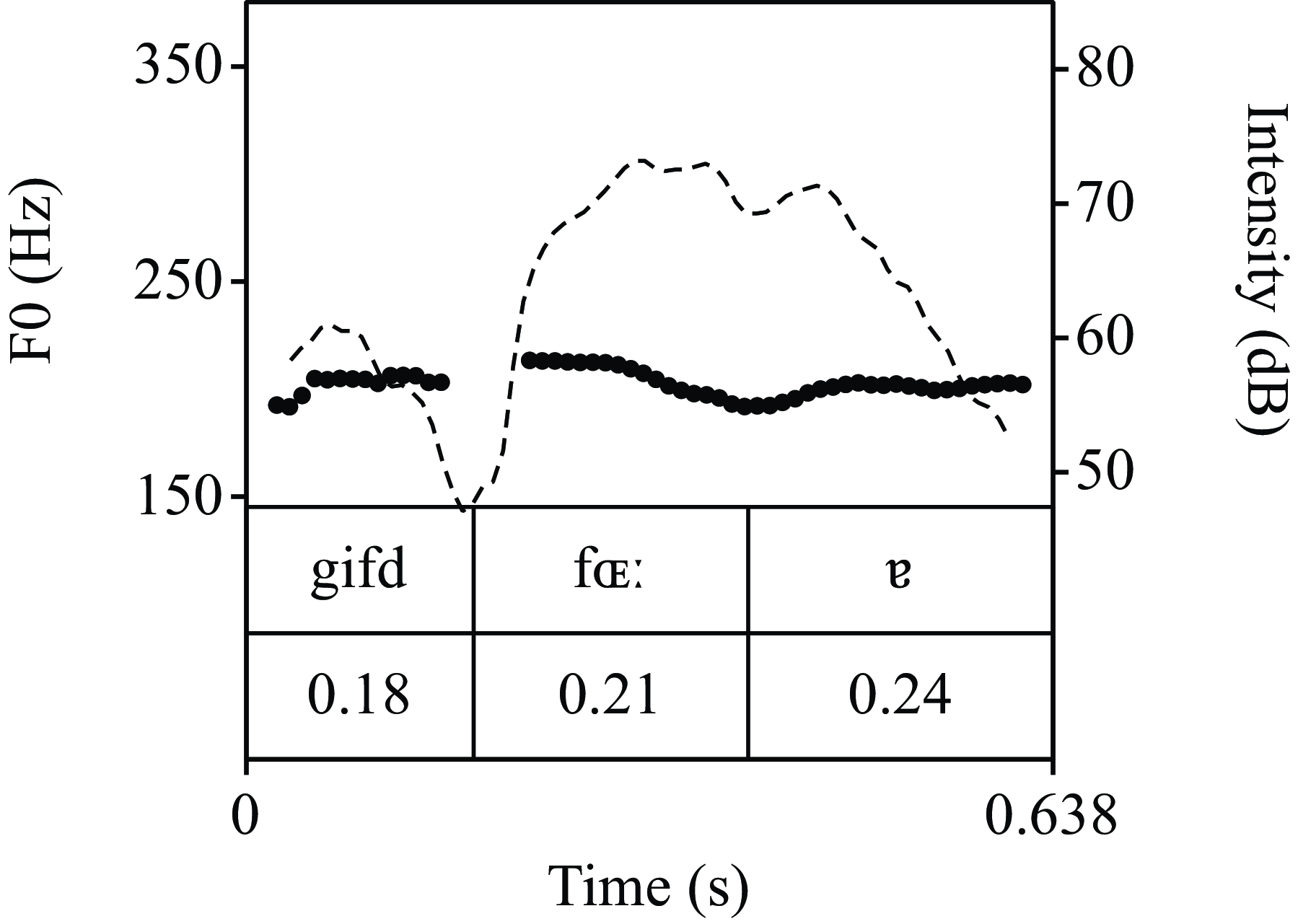
Figure 3 Long description
A line graph illustrates the relationship between fundamental frequency (F0) in Hertz and intensity in decibels over time in seconds. The x-axis represents time in seconds, ranging from 0 to 0.638 seconds. The left y-axis represents the fundamental frequency (F0) in Hertz, ranging from 150 to 350 Hertz. The right y-axis represents intensity in decibels, ranging from 50 to 80 decibels. The graph features a dashed line indicating intensity and solid dots representing F0 values. The dashed line shows a peak in intensity around the middle of the time range, while the solid dots indicate a relatively stable F0 with slight variations. The graph is divided into three segments along the x-axis, labeled with phonetic symbols and corresponding time values: gifd at 0.18 seconds, fE: at 0.21 seconds, and v at 0.24 seconds. All values are approximated.
forskellige [fɒsˈgεlˈiː] ‘different’ (from example 4) pronounced as a Strong Final.
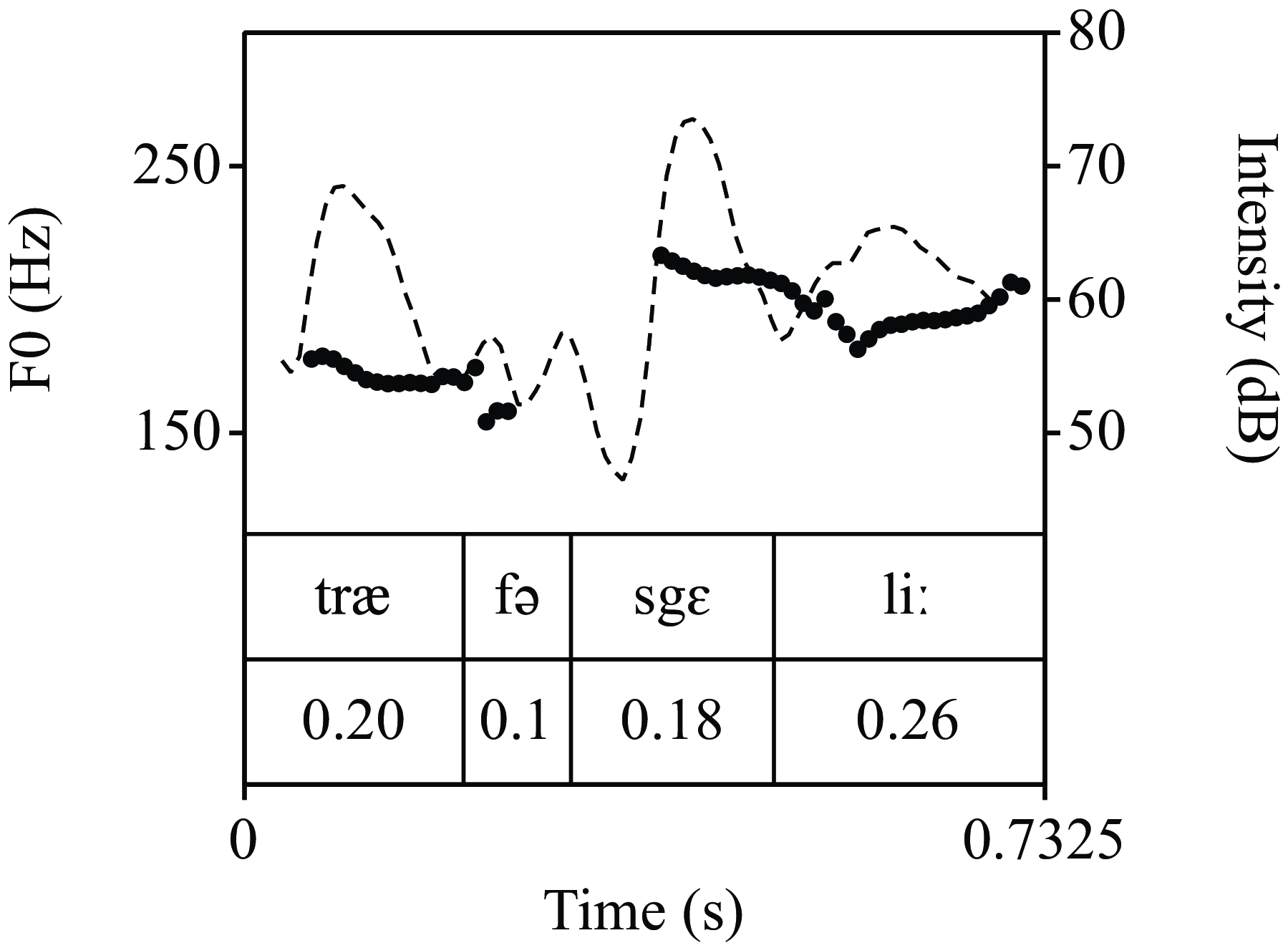
Figure 4 Long description
A line graph illustrates the relationship between F0 in Hertz and Intensity in decibels over a time span of 0.7325 seconds. The x-axis represents time in seconds, ranging from 0 to 0.7325 seconds. The y-axis on the left represents F0 in Hertz, ranging from 150 to 250 Hertz, while the y-axis on the right represents Intensity in decibels, ranging from 50 to 80 decibels. The graph features a dashed line representing F0 and a solid line with dots representing Intensity. Below the graph, a table lists four segments labeled 'træ', 'fø', 'sgε', and 'li:', with corresponding durations of 0.20 seconds, 0.1 seconds, 0.18 seconds, and 0.26 seconds respectively. The dashed line shows fluctuations in F0, peaking around 250 Hertz and dipping to around 150 Hertz, while the solid line with dots shows variations in Intensity, peaking around 70 decibels and dipping to around 50 decibels. All values are approximated.
du [du] ‘you’ and tuneser [tu ˈne ˈsɐ] ‘Tunisian’ (from example 5) pronounced as Strong Finals.
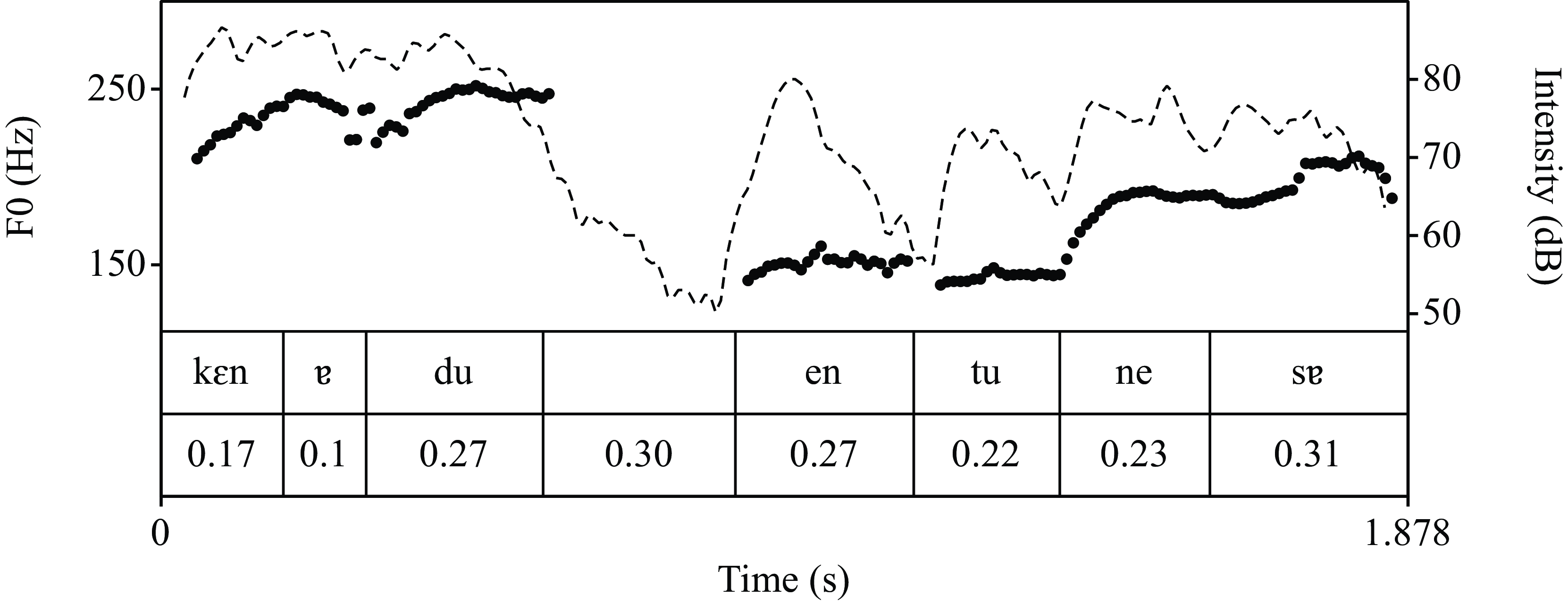
Figure 5 Long description
A line graph displays the pitch frequency (F0 in Hertz) and intensity (in decibels) of the pronunciation of the words mandag and tirsdag by Zuuz. The x-axis represents time in seconds, ranging from 0 to 1.878 seconds. The y-axis on the left represents the pitch frequency (F0) in Hertz, ranging from 150 to 250 Hertz. The y-axis on the right represents the intensity in decibels, ranging from 50 to 80 decibels. The graph shows two lines: a solid line representing the pitch frequency and a dashed line representing the intensity. Below the graph, a table lists the syllables of the words mandag and tirsdag with their respective durations in seconds. The syllables are ken, a, du, en, tu, ne, and se, with durations of 0.17, 0.1, 0.27, 0.30, 0.27, 0.22, 0.23, and 0.31 seconds respectively. The table highlights the syllables en, tu, ne, and se in gray. All values are approximated.
In these examples, the Strong Final prosody is constituted by two or three of the three acoustic criteria. Monosyllabic Strong Finals are all lengthened and have either rising intonation, like (2) sån Footnote 5 and (5) du, or an extra syllabic boundary, like (3) før,Footnote 6 with two peaks in the intensity curve. The examples with monosyllabic words may appear similar to final lengthening in Standard Danish, as described by Tøndering (Reference Tøndering2010); but the difference is that Strong Final monosyllabic words are realised with rising intonation or an extra syllabic boundary, whereas Standard Danish final lengthening is just that, lengthening, with no rise or syllabic boundary. All the monosyllabic examples in the dataset were impressionistically identified as Strong Finals by Danish-speaking linguists. Bi- and trisyllabic Strong Finals appear to receive stress on both the ultimate and the penultimate syllable. The stress on the ultimate syllable is realised either by means of lengthening and increased volume, as in (1) tirsdag, by means of lengthening and rising intonation, as in (4) forskellige Footnote 7 and (5) tuneser,Footnote 8 or by means of all three characteristics, as in (1) mandag.
Syntactically, Strong Finals can occur at possible main clause endings as in (1–3) and (5) tuneser ‘Tunisian’, at subordinate clause endings as in (4), or mid-sentence but before a phonetic reset realised as a short pause as in (5) kender du (0.3) ‘do you know’. No correlations between syntactic environment and the way of realising Strong Finals have been found.
3.3 Intonation in Standard Danish
The main work on Danish intonation is Nina Grønnum’s (Reference Grønnum1992) intonation model, which predicts that, everything else being equal, we can expect falling intonation over the course of a sentence. As shown above, Strong Finals are characterised by the opposite, that is, non-falling intonation typically at the end of clauses. Grønnum’s work is mostly based on read-aloud speech, and is supplemented by John Tøndering’s (Reference Tøndering2008, Reference Tøndering2010) work of intonation in spontaneous talk in task-oriented speech. The main difference between read-aloud and spontaneous speech, Tøndering finds, is the existence of ‘final lengthening’ in spontaneous data. Tøndering defines final lengthening as ‘linguistic sounds which, all else being equal, have longer duration in final position than in non-final position’ (Tøndering Reference Tøndering2010:179, my translation). The durational aspect of Strong Finals may be connected to Tøndering’s final lengthening. Tøndering shows no examples in context, so no studies exist yet as to whether they appear in the same interactional environments. Nicolai Pharao has studied the acoustics of consonant reductions in Danish and notes that final lengthening, as described by Tøndering, may inhibit the tendency for reduction in spontaneous speech (Pharao Reference Pharao2010:51). In most cases, this is exactly what happens to vowels in Strong Finals: a usually unstressed and reduced syllable is produced with lengthening instead of reduction of the vowel. However, we have no clues yet that the origin or spread of Strong Finals can be related to the reduction in Standard Danish varieties.
Looking at whether specific syntactic utterance types are connected to specific intonation patterns, Grønnum & Tøndering (Reference Grønnum and Tøndering2007) compare spontaneous talk to read-aloud speech, and find that declarative questions are produced with steep falling intonation, wh- and inversion questions with falling but less steep intonation, and declarative questions with no fall, that is, their global contour is level (Grønnum & Tøndering Reference Grønnum and Tøndering2007:1229). The only difference between read-aloud and spontaneous speech is found in a subgroup of declarative questions which in spontaneous talk show steep falling intonation, and thus have the same intonation as declarative statements. No utterance types are always produced with rising global contour, but Grønnum & Tøndering show that some types are typically produced with a rise in post-tonic position. This ‘last rise’, as they call it, is seen after declarative statements and after declarative questions (Grønnum & Tøndering Reference Grønnum and Tøndering2007:1232). Note that Grønnum & Tøndering’s post-tonic rise is not the same phenomenon as this article’s Strong Finals, where the rise is on the actual tonic syllable, not in a post-tonic position.
Grønnum’s, Tøndering’s, and Pharao’s acoustic descriptions are based on speakers of Copenhagen Standard Danish; and even though Tøndering and Pharao use non-scripted speech, their data comes from a task-oriented experimental setting, namely the DanPASS corpus of map task dialogues (Pharao Reference Pharao2010), and might not accurately reflect patterns of speech in natural interaction.
3.4 Intonation in the regional standard
Danish is often described as one of the most standardised languages in Europe (see Pedersen Reference Pedersen, Auer, Hinskens and Kerswill2005, Kristiansen Reference Kristiansen2009), a language in which the only geographical variation left is regional differences in intonation. Grønnum (formerly Thorsen) describes the difference between Copenhagen Danish and Aarhus Danish intonation as being opposite tone-curves for stressed syllables followed by an unstressed syllable: in Copenhagen, the tone rises on the unstressed syllable, whereas in Aarhus, the tone falls (Thorsen & Jul Nielsen Reference Thorsen and Jul Nielsen1981:1), so in Standard Aarhus speech, we would expect a falling tone on the unstressed dag syllables. Kyst (Reference Kyst2008) describes an additional feature specific to the Aarhus regiolect: stød (a kind of laryngealisation: Pharao Reference Pharao2010:47) in monosyllabic words can be realised as ‘two-tonal’ words with falling pitch (Kyst Reference Kyst2008:238), i.e. similar to a prolonged diphthong. This would predict that a monosyllabic word like før (‘before’) in (3) could be pronounced [ˈfɶɐ↘] or lengthened [ˈfɶːɐ↘]. However, Kyst’s description does not account for lengthening with an extra syllabic boundary, nor does it describe monosyllabic two-tonals with rising intonation. Kyst’s two-tonal stød might be related to Strong Finals in a way that has not yet been studied, but stød is not the same as Strong Finals. In future studies it may be relevant to look at existing regional differences that might explain why Strong Finals are found in Western and Southern urban dialects in Aarhus and Odense, but not in the Eastern urban dialect in Copenhagen.
3.5 Summing up the prosodic description
What listeners perceive as ‘a certain swing’ or ‘double stress’ in Strong Finals is obtained through a combination of two or three acoustic features: (i) lengthening of a syllable, (ii) increased volume on a syllable, and (iii) non-falling intonation, i.e. flat or rising intonation. It is possible to say that the phonological rules of stress in Standard Danish and in the regional standard are altered in the urban dialect in certain contexts. It is important to note here that by far the most common prosodic pattern in the urban dialect is Standard Danish, and that Strong Finals simply seem to be an extra prosodic resource available to the speakers to use in certain contexts. In the following, I describe five interactional contexts in which Strong Finals are often used.
4. Interactional functions
The methodology used to investigate interactional functions supported by Strong Finals is Interactional Linguistics (IL), as described by Couper-Kuhlen & Selting (Reference Couper-Kuhlen and Selting2017). IL developed from Conversation Analysis (CA) and shares its focus on speakers’ micro-actions, such as overlap, pauses, restarts, re-use, stress, lengthening, and intonation movements. These micro-actions can unveil how a speaker has interpreted the previous utterance and how the speaker expects the recipient to interpret what follows. In IL, the terms ‘form’, ‘function’, and ‘action’ are sometimes used in different ways. In this article, I look at the linguistic form Strong Finals and use function to refer to how this form supports a certain ongoing action or interactional activity. Traditionally, IL has not focused on sociolinguistic variation and the comparison of dialects. But thanks to its ability to find systematicity in interaction, I find the method well-suited to investigating functions of a linguistic form which only occurs in spoken language. A similar approach has been used by Swedish dialectologists in a collection of papers called Interaktionell dialektologi (‘interactional dialectology’) (Bockgård & Nilsson Reference Bockgård and Nilsson2011). Here, Lindström (Reference Lindström2011) looks at responsives and modal particles, as these two forms are often the main difference between Swedish in one region and Swedish in another region. Öqvist (Reference Öqvist2011) combines sequential and acoustic analyses in a case study of heightened tonal peaks (förhöjda tontoppar) in traditional Stockholm Swedish, and shows that in contexts of trouble, the heightened peaks may serve as an interactional resource to seek response and support from the recipient (Öqvist Reference Öqvist2011:336). IL is also used in dialect studies by Huhtamäki (Reference Huhtamäki2014), who looks at Helsingfors Swedish prosody because prosody is the primary feature in which this dialect stands out from other varieties of Swedish. Huhtamäki combines sequential analysis with phonetic analysis, and problematises the common claim that intonation is used to identify non-interrogative questions. For English, Wells & Peppé (Reference Wells and Peppé1996) combine CA and impressionistic phonetics in a comparison of three varieties: Ulster English, London Jamaican English, and Tyneside English. Wells & Peppé’s point of departure is function, or action, rather than form, and they look at how the action turn-delimitation is carried out with different prosodic means. Like the Swedish studies, my study takes its point of departure in form, with Strong Finals being chosen because they are characteristic of this particular dialect.
IL builds on the premise that there is grammaticality in spoken interaction and that categories of interactional activities or practices can be described in terms of combinations of form and functions or actions. However, as Walker (Reference Walker2014) reminds us, combinations of functions and forms rarely form a one-to-one relationship. A function can usually be carried out with different forms, and a particular form can often support a number of different functions. The functions supported by Strong Finals are found through the method known as ‘collection analysis’ (Hoey & Kendrick Reference Hoey, Kendrick, de Groot and Hagoort2017), which includes individual interactional analysis of a large number of examples which are similar in terms of form. The analysis builds on 265 examples, 11 of which are shown in the article. The article shows five types of activities carried out with Strong Finals, but it is important to note that these categories are generalisations and that some examples in the dataset traverse different syntactic and interactional categories.
Overall, I claim that one common function of Strong Finals is to project ‘more to come’; but more specifically, this is carried out in different ways in contexts of different interactional action. The interactional analysis in Section 4 is structured around five different interactional actions, as shown in Table 2. The categories do not by any means constitute an exhaustive list of possible actions for Strong Finals. Remembering that the dataset is not representative of the dialect in general, the ‘No. of examples’ column only serves to illustrate that some of the analyses presented below build on more examples than others, and does not claim that one action is more frequent than the other. It is important to note that Strong Finals do not carry meaning in themselves, but rather support certain actions which are fulfilled together with other linguistic resources such as word order, wording, gaze, and bodily movements. For each interactional action outlined below, I provide two examples with detailed descriptions of other linguistic resources employed.
Interactional actions identified in the collection of Strong Finals
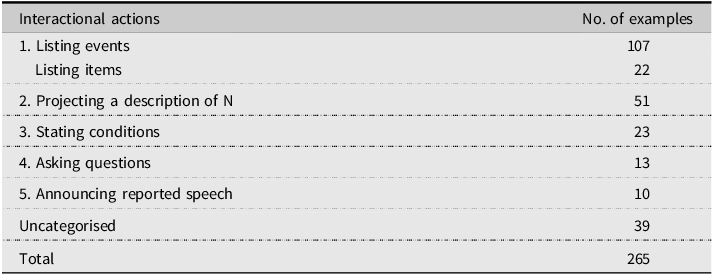
Table 2 Long description
A table with five rows and three columns detailing interactional actions and their corresponding number of examples in the Strong Finals collection. The columns are labeled Interactional actions, No. of examples. The rows list different interactional actions: Listing events with 107 examples, Projecting a description of N with 51 examples, Stating conditions with 23 examples, Asking questions with 13 examples, Announcing reported speech with 10 examples, and Uncategorised with 39 examples. The total number of examples is 265.
4.1 Listing items or events
This category of actions represents almost half of all examples of Strong Finals in the collection, a total of 129 examples out of 265. The category consists of two subtypes: listing items and listing events. Below is an example of listing items (6), followed by an example of listing events (7). Both subtypes are treated by recipients as a way of creating and resuming lists, and in both examples we can see a recipient treating it as such by choosing a place right after a Strong Final to insert a question about something they need clarified before the speaker can continue their list.
Creating a list is an action that requires a construction making it recognisable as a list for the recipients (Jefferson Reference Jefferson and Psathas1990), and in the examples below I show how Strong Finals support this action. On an abstract level, the examples may be described as [item A↗ and item B↘] or [event A↗ and then event B↘], where A elements are realised as Strong Finals and B elements are realised with prosodic step-down, a feature common on last elements of lists (Selting Reference Selting2007). Examples in the data suggest that there may be any number of A elements before the B element.
In example (6) (the same as example (1) in the Introduction) Zuuz is telling club worker Martin about his weekly football practice, and I will argue that by producing the item ‘Monday’ (line 1) as a Strong Final, Zuuz projects the beginning of a lengthy list of the type of item which could be called ‘weekdays’.
(6)
Monday (AUDZrisk 02:39)
01 →
Zuuz:
n
u
sp
i
ller jeg f
o
dbold (.) m
a
nd
ag:
↗
‘now I play football Monday’
02
Martin:
h
a
r du det som v
a
lgfag eller hv
a
‘do you have it as an elective course or what’
03 →
Zuuz:
>ja< n
u
sp
i
ller jeg f
o
dbold m
a
ndag t
i
rs
dag:
→
‘yes now I play football Monday Tuesday’
04
t
o
rsdag fr
e
dag↘
‘Thursday Friday’
Zuuz’s Strong Final ‘Monday’ (line 1) ends a declarative sentence which makes it a syntactically possibly completed turn. Seen as such, Martin’s next turn, ‘do you have it as an elective course or what’ (line 2), may simply be the beginning of a new sequence, a question–answer adjacency pair. But looking at Zuuz’s next turn (lines 3–4), we see that he treats Martin’s activity as a sequence whose function is to clarify a minor detail before the listing can continue. Zuuz delivers a minimal response, ‘yes’ (line 3), and repeats his initial telling with the same wording as in line 1, only now expanded with the additional weekday item ‘Tuesday’. ‘Tuesday’ is produced as a Strong Final in direct extension of ‘Monday’ without prosodic reset or conjunctional ‘and’, which gives the impression that ‘Monday Tuesday’ is now one connected item. By designing his turn in line 3 as a repetition of line 1’s prosody and wording, Zuuz seems to insist that he is redoing his original project, that it was a list, and that there are more items in the list. He then continues with two more items belonging to the same class (weekdays), ‘Thursday Friday’ (line 4), again produced in close connection as one connected item, but now with falling intonation. This completes the item list, which, at least in retrospect, appears to have had the form [item A↗] in line 1, but in lines 3–4 is changed to [items A-A↗ items B-B↘].
A similar form is found in lists of events. Example (7) shows multiple Strong Finals used for events in a story, until finally the story reaches its end, and the last event is produced with falling intonation. The excerpt comes from a recording of Melissa and her high-school friends Dorit and Ann talking about a recent running competition in which Dorit beat the school record. Melissa has disclosed that she cheated and did not finish the run, and Dorit has asked how that was possible. In the excerpt, Melissa is enacting a sequence of events on the day of the competition.
(7)
School run (AUDZmorgenmad 10:26)
01 →
Melissa:
jeg l
ø
b
så:n
↗
((gazes and points left with raised arm))
‘I ran like this’
02
Ann:
E
OW hvord
a
n
[tog de fr
a
været
‘hey how did they mark absence’
03
Melissa:
[jeg løb
op
‘I ran up’
04
Ann:
t
o
g de fr
a
været
‘did they mark absence’
05
Dorit:
hm
‘hm’
06
Melissa:
>ja< ((gazes briefly at Ann, arm still raised))
‘yes’
07 →
jeg l
ø
b sån op
he:r
↗
((gazes back left))
‘I ran like up here’
08
Dorit:
hm
‘hm’
09
Melissa:
å så l
øb
jeg sån
in
d (.)
o
ver↘ ((arm moves across body))
‘and then I ran like across’
10
☺i stedet for å g
å
hele v
e
jen r
u
ndt☺
‘instead of walking all the way around’
The last word of the first event, sån ‘like.this’ (line 1), is produced as a Strong Final and accompanied by a large gesture (see Figure 6), supporting the function of projecting that the turn is not finished. Disregarding this, Ann now self-selects and asks a question about absence marking (line 2). The registration of all absences is an important issue for Danish high-school students, as the percentage of hours of absence influences how many final exams they have to take. Ann draws attention to her utterance by using the interjection eow,Footnote 9 which is described by Zachariassen & Nielsen (Reference Zachariassen and Lykkegaard Nielsen2022) as an interjection indicating problems or solutions to problems, and which might serve as a misplacement marker. We do not know whether Melissa did not hear Ann’s question or whether she chooses to ignore the interruption, but either way, she continues her storytelling in an overlap with Ann’s question (line 3). Ann treats the non-answer as a need for repair, but she repeats only the overlapped part ‘did they mark absence’ (line 4), which makes it possible to interpret the question as a simple yes/no question instead of the original how question. Melissa treats Ann’s question as a yes/no question and delivers the minimal response ‘yes’ (line 6). Like Zuuz above, Melissa treats Ann’s question as a request to clarify a minor detail before the listing can go on. After the minimal response, Melissa restarts the story with ‘I ran like up here↗’ (line 7), with a slight re-framing of words but with the same Strong Final prosody as in line 1, and then moves on to the next and final event in the sequence: ‘and then I ran like across↘’ (line 9). It is produced with ‘and then’ and with falling intonation, and it is followed by a punchline produced laughingly (line 10), making it a possible conclusion of the story (Kjærbeck & Asmuß Reference Kjærbeck and Asmuß2005). Taken together, the falling intonation and the laughter indicate that this is the final event.
Still photos of Melissa’s gestures in example (7).
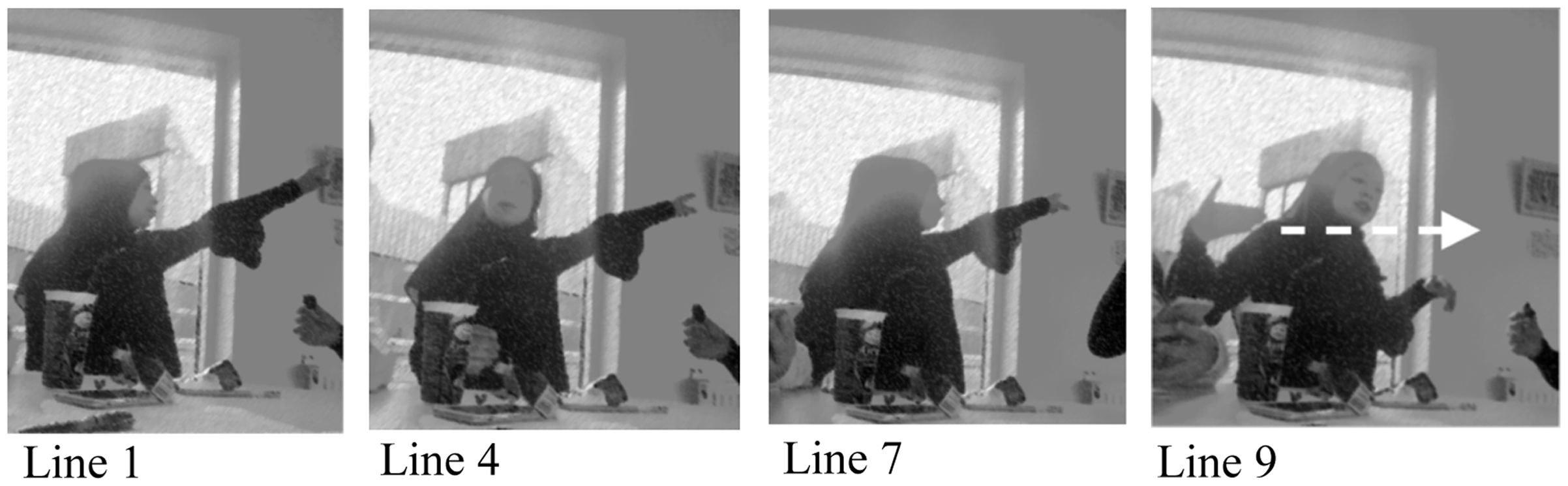
Figure 6 Long description
The image contains four still photos of Melissa's gestures in different positions, labeled as Line 1, Line 4, Line 7, and Line 9. In Line 1, Melissa is pointing with her right hand while standing. In Line 4, she is seated and pointing with her right hand. In Line 7, she is also seated and pointing with her right hand, but from a slightly different angle. In Line 9, she is seated and pointing with her right hand, with an arrow annotation indicating movement or direction. The photos are arranged side by side, showing the progression of her gestures.
The recipients’ actions show us that they orient towards Strong Finals as an indication that there is more to come. Ann does this by inserting a sequence with a misplacement marker, and the other friend, Dorit, does this by providing the response token hm (lines 5 and 8), serving as a ‘continuer’ (Schegloff Reference Schegloff and Tannen1982, not to be confused with Christensen’s ‘continuer intonation’, 2010), and thereby supporting Melissa’s storytelling project.
Summing up, Strong Finals together with other pragmatic, semantic, and gestural means support the construction of lists of items or events. In (6), Zuuz introduced an item in a class (weekdays) that has clear co-members (other weekdays) which makes listing relevant. In (7), Melissa described an event that was clearly not the entire story that was projected, together with a gesture. Both examples have a flavour of insisting on telling a story, as they are both followed by a repetition when resuming the storytelling after an inserted sequence.
A note on try-marking is due here. There is a further aspect to the interactional construction of lists: not only should the recipients know that the A item or event projects a lengthy list, but it may also be crucial that recipients recognise the references to things, people, and events in the list. In order to achieve recognition, speakers can use ‘try-markers’. Try-markers is a format originally described by Sacks & Schegloff (Reference Sacks, Schegloff and Psathas1979:18ff) for the reference to persons as the ‘use of such a recognitional as a first name, with an upward intonational contour, followed by a brief pause’. In examples of lists in my corpus, Strong Finals seem to function as try-markers by inviting recipients to indicate that they recognise what is being talked about. For example, in (7), Melissa’s explanation of the running route is formulated with deictics accompanied by large arm gestures (see pictures), and Dorit’s ‘hm’ (lines 5 and 8) may be seen as confirmation-of-recognition of the individual locations on the route. The form of this Strong Final differs from the form described by Sacks & Schegloff for (American) English try-marking as ‘an upward intonational contour’ which, judging from the cases shown here, amounts to a step-up in pitch. Strong Finals do not include step-up, as described above in Section 3.1. However, both Strong Finals and Sacks & Schegloff’s try-marking are prosodically marked, which helps to emphasise the word containing the marking, making it more relevant to interactional uptake (Selting Reference Selting1996). It is, of course, difficult in these cases to distinguish a continuer use of ‘hm’ from a confirmation-of-recognition use, and I will not proceed further with an attempt to disentangle the two here. I just wanted to point out that Strong Finals may have this ‘second-order’ function (Sacks & Schegloff Reference Sacks, Schegloff and Psathas1979:16) of locally inviting displays of recognition.
4.2 Projecting a description of N
The second most frequent action supported by Strong Finals is projecting a description. I call this ‘projecting a description of N’ because in many cases the Strong Final falls on a noun phrase. Two syntactic formats are common in this action: (i) a noun phrase in syntactic extra position ending with a Strong Final and followed by a subject copy, often a pronoun, as exemplified in (8), and (ii) a declarative main sentence ending with a Strong Final and followed by an adverb, often der (‘which’), initiating a subordinate clause, as exemplified in (9).
(8)
min
familie
i
ZimbabweFootnote
10
de er
flygtet
fra
Zimbabwe
til
øh
[min
faˈmilɪ̯ə
i
simˈbɑbˈvəː↗
diː
ˈfløgdəð
frɑ
simˈbɑbvə
te
əːː↘]
My
family
in
Zimbabwe
they.are
fled
from
Zimbabwe
to
ehh
‘My family in Zimbabwe they fled from Zimbabwe to ehh’
(9)
han
var
gift
med
en
trekant (0.5)
der
hedder
Fiona
[han
vɑ
ˈgifd
mε
en
ˈtʁaˈkaːnd↗
dɑ
ˈheðɐ
fiˈona↘]
he
was
married
with
a
triangle
which
is.called
Fiona
‘He was married to a triangle whose name was Fiona’
If we generalise pronouns and light adverbials as light elements (the two have been shown to constitute similar syntactic characteristics in Danish Talk-in-Interaction: Brøcker et al. Reference Brøcker, Hamann, Jørgensen, Lange, Mikkelsen and Steensig2012), the examples may be described on an abstract level as: [N↗ light element-initiated sentence↘].The Strong Finals in type (i) occur in a place where the turn for syntactic and semantic reasons cannot be finished yet, as in (8) where ‘my family in Zimbabwe’ constitutes only a noun phrase and not a full syntactic sentence. Strong Finals in type (ii), on the other hand, end a unit which constitutes a full syntactic sentence, and in (9) it is even followed by a pause. However, both type (i) and type (ii) Strong Finals are treated as signs that the turn is not finished yet, as we shall see in longer excerpts of (8–9) below.
Excerpt (8) is from a recording of a group of friends, a club worker, and the researcher, Ditte, talking about ethnic and national backgrounds. 14-year-old Muaaht describes his family’s background as refugees using a Strong Final when introducing the description.
(8, full excerpt) Refugees (AUDZetiopianere 06:56)
01 →
Muaaht:
mine FOR
Æ
LDRE de- men min fam
i
lie i Zimb
a
bw
e
:
↗
‘my parents they- but my family in Zimbabwe’
02
Ditte:
j
a
er
‘yeah’
03
Muaaht:
de:
flyg
tet fra Zimb
a
bwe til øh:: °t-°
‘they fled from Zimbabwe to eh’
04
(0.3)
05
j
a
er↘
‘yeah’
05
(0.4)
06
Rahman:
jeg: fra-øh
‘I’m from-eh’
After Muaath’s Strong Final in line 1, Ditte aligns as a listener by delivering a continuer ‘yeah’ (line 2), and Muaaht then proceeds with the description of the N element from line 1 (line 3). Muaaht leaves his turn open-ended with a word-searching ‘eh’ followed by a pause, and then produces a ‘yeah’ with falling intonation (line 5), which may serve as prosodically ending the turn without semantically and syntactically specifying where his family fled to. After a pause, Rahman self-selects for the next turn (line 6). This shows that Rahman treats falling intonation and a pause as a possible ending enabling him to take the floor, whereas Ditte treated Strong Final intonation as a place to align as a listener.
Excerpt (9) is from another youth club. Here Zuuz is explaining his family relations to a club worker by drawing a family tree with geometric symbols representing different family members.
(9, full excerpt) Triangle (AUDZrisk 06:28)
01
Zuuz:
I k
e
nder min f
a
r han er et
X
‘you know my dad he is an X’
02 →
han var gift med en tr
e
k
a
:nt→
‘he was married to a triangle’
03
(0.5)
04
der h
e
dde:r ↓Fi
o
na
‘named Fiona’
In line 2, Zuuz delivers a syntactically and semantically possibly completed turn followed by a pause (line 3), but the club worker does not take up the turn. Instead, as described, the club worker aligns as a listener with her gaze and her silence. The excerpt is from the beginning of a sequence with almost two minutes of Zuuz telling and drawing, and throughout the two minutes, the club worker follows Zuuz’s telling and his drawings closely, providing continuers like ‘yeah’ and ‘mm’ from time to time but mostly remaining silent, as is also the case in the excerpt.
Summing up, Strong Finals on noun phrases (Ns) can project a subsequent description or elaboration. Strong Finals are used when Ns are part of possibly completed turns, and when Ns are located in a place where the turn is structurally incomplete. We see that recipients orient towards Strong Finals on N elements as a projection that there is ‘more to come’ by aligning as listeners.
4.3 Stating conditions
Strong Finals in connection with conditional clauses are, like subcategory (i) of noun phrases in Section 4.2 above, part of a syntactically unfinished format which, in and by itself, indicates that there is more to come. In the category of Strong Finals described in this section, the format is a conditional clause, i.e. an ‘if-then’ or ‘when-then’ construction. An abstract representation looks like this: [if A↗ then B↘] or [when A↗ then B↘], and examples in the data suggest that there may be any number of A elements before the B element. Interactionally, ‘if-then’ constructions have been described (for instance by Lerner Reference Lerner1991) as a projecting device: upon hearing the ‘if’ component (which in these cases ends with a Strong Final), a recipient will know that a ‘then’ component must come before the syntactic structure is complete. Couper-Kuhlen & Selting (Reference Couper-Kuhlen and Selting2017) treat this form of syntactic projection under the general term ‘pre-posed hypotactic clauses’ and show how these clauses create turn-construction units which are connected as compounds (Couper-Kuhlen & Selting Reference Couper-Kuhlen and Selting2017:454). In (10) below, a Strong Final supports this function. The excerpt comes from a cooking class in which Said is whipping eggs for an omelette, and club worker Rasmus dares him to drink the raw eggs.
(10)
Spin-the-bottle (AUDZaeggekage 07:50)
01
Rasmus:
hva ska du h
a
for å dr
i
kke det
‘what would it take to get you to drink it’
02
Said:
jeg ska
A
Ldrig dr
i
kke det h
e
r
‘I am never going to drink this’
03
Rasmus:
n
e
j↗
‘no’
04
(3.0)
05
Said:
jeg h
a
r prøvet med mine f
æ
tre det der med k
o
rt=
‘I did try with my cousins that thing with cards’
06
=å så hv
i
s den- n
e
j >d
e
t der med den der< fl
a
ske=
‘and then if it- no that thing with the bottle’
07 →
=hvis den l
a
ndede ved
e:n
↗
‘if it stopped at you’
08
så sk
u
man dr
i
kke det↘
‘then you had to drink it’
Said responds to Rasmus’s question with a firm rejection: he is never going to drink the eggs, with emphasis on ‘never’ (line 2). Rasmus does not accept the answer but asks again ‘nej’, with rising intonation functioning as a sort of ‘are you sure’ question. Then follows a rather long pause before Said begins a story which functions as an argument for rejecting the dare. He is not a coward; in fact he has already participated in an egg-drinking dare in the past. Said rushes through the story with no pauses (marked with =) between the syntactic units, and ends the story in a conditional clause with a Strong Final ‘if’ part (line 7) and a falling intonation ‘then’ part (line 8). The ‘then’ part repeats the drikke det (‘drink it’) part of Rasmus’s initial question (line 1), and this repetition may support a concluding function showing that Said feels that this question has been answered sufficiently, and that Rasmus does not need to pursue it further because a thorough argument has been presented as to why Said does not have to take the dare.
As pointed out by Lerner (Reference Lerner1991, citing Sacks 1992 [Reference Sacks1964]), conditional clauses are, along with other types of turn-constructional compounds, an obvious basis for the joint production of utterances: they are cases in which one syntactic unit is produced by more than one speaker. Excerpt (11) includes such joint production: here one speaker produces the ‘if’ part and another the ‘then’ part. The excerpt comes from a self-recording by high-school students Charlie and Lizz, who are outside at a party talking about how they would both like to be more outgoing and how difficult it is to get to know new people at a party.
(11)
Party (AUDZfest 11:20)
01
Charlie:
jeg h
e
ller ikk >g
o
til det<=
‘I’m not good at it either’
02
=jo hvis jeg
i
kk k
e
nder n
o
gen over↑h
o
vedet
‘well if I don’t know anyone at all’
03
så ka jeg g
o
dt finde
u
d af å sn
a
kke
‘then I do manage to talk’
04
[med dem nogen gange
‘with them sometimes’
05
Lizz:
[jaer m det >l
i
ge præc
i
s< d
e
t=
‘yeah that’s exactly it’
06 →
=hvis du s
a
mmen med
e
nlanden du
ke
nd
er:
↗
‘if you’re together with someone you know’
07
·hhh
08
Charlie:
s
å
havde jeg
i
kk gjort sån
‘then I hadn’t done it’
In the first four lines, Charlie describes herself in specific, concrete examples: ‘I’m not good […] I don’t know […] I do manage […]’. Then Lizz takes the floor and describes a hypothetical general scenario rather than a personal one: ‘If you’re together with someone you know’ (line 6). The personal pronoun du (‘you’) is used here to refer to an unspecified person, as a synonym of the more formal man (‘one’) (Jensen Reference Jensen2007). Lizz begins her turn in recognitional overlap with the previous utterance, that is, at a place where she projects the ending of Charlie’s utterance (Jefferson Reference Jefferson1993). She prefaces the utterance with det lige præcis det (≈ ‘that’s it’, line 5), a format which may be used to express agreement, confirmation, and acceptance, but in a way in which the speaker claims to have epistemic authority (Olesen Reference Olesen2019). In this way, Lizz claims to know as least as much about the situation as Charlie. Lizz’s hypothetical, general scenario is formatted as an ‘if’ sentence with a Strong Final, and when she takes a short breath (line 7), Charlie takes the turn and produces the then component as a possible completion: ‘then I hadn’t done it’ (line 8). This collaborative construction of a compound unit seems to be emblematic for the interaction that follows it; and after the excerpt, the description of the scenario continues in the form of collaborative storytelling.
Summing up, in both (10) and (11) the syntactic structure of a conditional clause in itself projects a following ‘then’ part, and this projection is strengthened or focused on by the Strong Final in the first part of the conditional clause. However, (11) shows that this ‘more’ may be provided by either participant.
4.4 Asking a question
For listings (Section 4.1) and stating conditions (Section 4.2), there is usually an inherent element of self-selection for the next turn, in the sense that they are syntactically and/or semantically constructed in ways that makes them unfinished. The action described in this section – asking a question – is on the other hand usually inherently other-selecting and thus unlikely to be produced with a ‘continuer marker’. Only eight examples are found in the dataset, but the category is included here to show the diversity of constructional settings in which Strong Finals occur. Based on Grønnum & Tøndering (Reference Grønnum and Tøndering2007; also our Section 3.3), we would expect questions to have a falling intonation, with wh-questions having rather less steep falls than inversion questions. Declarative questions may be produced with level intonation, but no question types are described with rising intonation in Standard Danish. The eight examples of questions, three wh-questions and five inversion questions, are produced with rising intonation. There is no apparent pattern between steepness of rise and syntactical and/or interactional categories.
In the following, I show two examples of questions where Strong Finals support the action of requesting an answer which is more elaborate than just a confirmation or rejection. Example (12) is from a recording in a youth club where Baqir is bombarded with questions from club worker Rasmus about an exotic vacation from which he has just returned. Muaaht and six other boys are listening carefully to Baqir’s stories. The excerpt begins with Muaaht making an observation (line 1) which prompts Rasmus to ask one more question. This question is produced with a Strong Final.
(12)
Sun tan (AUDZaeggekage 11:05)
01
Muaaht:
Baqir han er blevet rød å sån
‘Baqir has turned like red’
02 →
Rasmus:
er han blevet s
o
lbr
ændt
↗
‘did he get a sun tan’
03
Baqir:
jeg ogs blevet solbrændt for første gang hele mit liv
‘I also got a sun tan for the first time in my whole life’
Rasmus’s question is formulated with a third-person subject, ‘he’ (line 2), as if Muaaht or someone other than Baqir has been selected to answer, but Baqir self-selects to answer (line 3). Rasmus’s question is a yes/no interrogative, but Baqir’s answer is not a type-conforming yes or no (Raymond Reference Raymond2003). Instead, he treats the question as an invitation to storytelling and formulates his reply with ‘also’ (ogs). Baqir’s turn can be seen as a non-answer as it ignores the speaker selection and does not conform to the type format. The speakers do not epistemically treat Rasmus’s interrogative as a question to which only the selected speaker has the knowledge to provide the answer (Heritage Reference Heritage2012). Instead, Baqir treats Rasmus’s interrogative as an invitation to storytelling.
In the next example (13), we see a similar case of an interrogative treated as a non-epistemic question. In the homework club five schoolmates are sitting around a table gossiping about people they know from school. Before the extract, Aziz has repeatedly tried to attract the attention of the other participants by calling their names, but without success. Ray and Yussuf are having a heated conversation about someone who allegedly would like to have sex with Yussuf. Dennis and Sivan are paying close attention to this interesting topic. The extract begins with Yussuf’s sceptical enquiry into the truthfulness of the story (line 1).
(13)
Tunisian (AUDZlektiedrenge 07:28)
01
Yussuf:
hvord
a
n v
e
d du hun vil ha ( )
‘how do you know she wants ( )’
02
Ray:
[ford
i
hun g
e
rne vil ha ( )
‘because she likes to get ( )’
03
Dennis:
[( ) (hun er)
LID
erlig hele [t
i
den
‘( ) (she is) horny all the time’
04 →
Aziz:
[
KE
nder d
u
:
↗
‘do you know’
05
(0.3)
06 →
en t
u
n
e
s
er
: ↗
‘a Tunisian’
07
fr
a
:: >(hva s
a
tan)< v
a
r det n
u
‘from (where the hell) was it’
08
fra:
E
jby
‘from ((name of suburb))’
09
(0.7)
10
Sivan:
en tun
e
ser↘
‘a Tunisian’
In lines 3–4, Ray and Dennis answer Yussuf in an overlap, both giving an assessment of the person in question, and the question–answer sequence is now completed. Aziz now self-selects as a speaker and introduces a new referent: ‘a Tunisian’ (line 5). In contrast to the earlier attempts to attract the attention of the participants by calling out their names, this time Aziz succeeds in taking the floor. Aziz does this by multiple linguistic and interactional means. Firstly, he begins at a recognitional onset, that is, in slight overlap (Jefferson Reference Jefferson1986). Secondly, he speaks loudly so he can be heard despite the overlap. Thirdly, he introduces a new referent, ‘a Tunisian’, which is unrelated to the previous topic. Fourthly, he formulates his turn as a question, appointing a recipient ‘you’ to deliver a second part, and finally he divides the question into two parts: ‘do you know’ + ‘a Tunisian’, each produced as Strong Finals. Stivers & Rossano (Reference Stivers and Rossano2010) describe a number of the above forms as ‘Response-Mobilizing Features’: interrogative morphosyntax, recipient-tilted epistemic asymmetry, and interrogative prosody. Stivers & Rossano’s third criterion can be regarded as equivalent to the use of a marked prosody, here the Strong Finals. After the excerpt, the conversation continues to focus on the Tunisian, and Aziz has succeeded in changing the topic, even though the new topic is far less interesting than the original topic.
Summing up, (12) and (13) both contain interrogatives that are treated as non-epistemic questions. Instead, the utterances are treated as an invitation to further engagement. The interrogative structures here seem to function as a response-mobilising feature rather than as questions.
4.5 Announcing reported speech
In this section I describe a fifth and final action in which Strong Finals support projection of ‘more to come’: before reported speech. In this category, the speaker has already given semantic clues that their project is not completed by using formulations like ‘he said to me’, and the added Strong Final supports building up to a story’s climax. Selting (Reference Selting2017) shows that many aspects of prosody can support this function of displaying and managing affectivity in story climaxes. The collection contains relatively few examples, but the category is included because I find it interesting that the formulations are so similar. They all consist of a pronoun subject + a verb synonymous to ‘speak’ – either ‘ask’, ‘tell’, or ‘say’. Examples of announcing reported speech are found across different locations, settings, age of speakers, and year of recording. Rathje (Reference Rathje, Gregersen, Parrott and Quist2011) discusses the lack of definitions of the concept ‘reported speech’ or ‘quotations’ and calls for a definition which takes into account the fact that quotations are always the responsibility of the quoter, not the quoted, and that they are always enactments and not replications of actual actions in the past. Additionally, Rathje points out, the quoted element can be thoughts, feelings, or facial expressions, as well as speech. A broader definition of quotatives, such as Rathje’s, might reveal more examples in my dataset that could be included in the collection.
Below I show two examples in which Strong Finals and reported speech support the build-up to a story’s climax. The build-up can be successful in that it makes a recipient respond as in (14), or it can be unsuccessful in summoning the recipients as in (15), where the speaker himself illustrates the climax by laughing at his own utterance. Example (14) is taken from a self-recording of Gözde telling her friend Bilge about a time when she owed a lot of money to the bank. The excerpt contains three Strong Finals, two in line 1 and one in line 2, which all contribute to the build-up to the story climax.
(14)
Debt (AUDZbanken 00:19)
01 →
Gözde:
i
å
:
å
r↗ jeg r
i
ngede til b
a
nken ikk
å
:
å
↗
‘this year I called the bank right’
02 →
jeg sp
u
rgte min-øh b
a
nkd
am
e:↗
‘I asked my-eh banker’
03
hvord
a
- hvo: hvor- hvord
a
n-øh s
e
r m
i:
n g
æ
ld ud↘
‘how- ho: how- how eh does my debt look’
04
du v
e
d fordi jeg betaler t
o
tusind
a
f hver m
å
ned↘
‘you know because I pay off two thousand every month’
05
(0.5)
06
Bilge:
walL
A
HH: t
o
t
u
:s
i
nd:
→
‘no way two thousand’
Lines 1–2 describe the event in which the reported speech occurred and has similar traits to the event lists in Section 4.1, except here the list consists of a time stamp, ‘this year’ (line 1), an event, calling the bank (line 1), another event, asking the banker (line 2), and then finally an element produced with falling intonation, here the reported speech (line 3). Bilge responds with awe, recognising that the amount Gözde pays every month makes this a story worth telling. Bilge’s response is prosodically marked with loudness, extra exhalation, and the lengthening of syllables, and semantically marked by the use of ‘wallah’, an interjection-like word often used for emphasis.
In the following example (15), the reported speech builds up to a climax which is not recognised as such by the recipients. But we can see that it was intended as a climax because the speaker himself laughs at his own utterance. The example comes from a homework club: Ray and Yussuf are mocking Amir (present but not in the excerpt) telling three other friends (ditto) about a time when Amir left a football camp all of a sudden.
(15)
London (AUDZlektiedrenge 01:01)
01
Ray:
han k
o
m f
ø
rste d
a
g til f
o
dboldsk
o
len
‘he came on the first day of football camp’
02
r
e
sten af d
a
gene han k
o
m ikke
‘the rest of the days he didn’t come’
03
Yussuf:
det var d
e
t
‘that’s it’
04
å:
f
o
lk de sp
ø
rger hvor Am
i
r h
e
nne
‘and people they ask where’s Amir at’
05
jeg s
a
gde til dem (0.3)
‘I told them’
06 →
Am
i
r i g
å
r han s
a
gde til mig i går
a
ft
e:
s↗
‘Amir yesterday he said to me yesterday evening’
07
hh ↓h
a
n skal t
i
l L
o
nd
o
n↘ (0.3)
‘he is going to London’
08
☺ å på gr
u
n:d det var s
å
n du s
a
gde ☺
‘and because that’s what you said’
09
.h hh ↓h
a
n skal t
i
l L
o
nd
o
n ↘
‘he is going to London’
Before the excerpt, Yussuf has been listening to music and singing along, adding Amir and London into the lyrics, while Amir has repeatedly claimed to have nothing to do with London. When Ray starts mocking Amir for missing out on this summer’s football camp (lines 1–2), Yussuf immediately picks up this information and uses it for a lengthy story. In lines 5–7 Yussuf quotes himself quoting Amir: I told them that Amir told me that he was going to London. The Strong Final falls on the part introducing Amir’s quote. It is not a direct quote, as it is formulated ‘he is going’ (a direct quote would be ‘I am going’), but it still falls within the definition of reported speech. Yussuf’s self-quote (line 6) is formulated with a lot of syntactic extras: ‘Amir’ in extra position and the resumptive subject ‘he’, which are usually directly connected (Brøcker et al. Reference Brøcker, Hamann, Jørgensen, Lange, Mikkelsen and Steensig2012), are split by an adverbial phrase ‘yesterday’, the time setting is presented twice, first as ‘yesterday’ and then specified as ‘yesterday evening’, and this specification is produced with a Strong Final. Amir’s part of the quote (line 7). is formulated with a drop in pitch: ↓han skal til London↘ (‘he is going to London’). The changes of intonation, the Strong Final, and the pitch drop illustrate that the story has reached a climax. None of the recipients – Ray, Amir, and the other friends – react to Yussuf’s story, but Yussuf himself treats the reported speech as the story’s climax by repeating it laughingly in line 9.
Summing up, Strong Finals in the constructions with reported speech can support the action of focusing on the reported speech and showing that this part of a storytelling process is leading up to a climax in the story.
4.6 Interactional common traits
Strong Finals can be found in structurally unfinished formats (stating conditions and announcing reported speech), structurally open-ended formats (listings and descriptions), and structurally finished formats (interrogatives). Interactionally, they share the common trait of projecting more to come, but differ as to whether this ‘more’ could or should be provided by someone other than the speaker. The prosodic pattern has previously been described as ‘continuer intonation’, ensuring that the speaker gets to keep the turn (Christensen Reference Christensen2012). But the functionality is more complex than this: it can also be used to assign turns to other speakers. In the examples above, the projected ‘more’ is often of greater significance to the activity; for example, it may be an abstract conclusion of a lengthy argument, an initiation of a new story or topic, or a build-up to the climax of a story. Recipients may treat Strong Finals as designed to either align as listeners or to contribute. Strong Finals are sometimes treated as try-markers and responded to with a short response token or a clarifying inserted sequence, and other times treated as a recruitment to engage in a collaborative storytelling or activity.
The examples often come from multi-speaker settings in which getting, keeping, and assigning the floor are important parts of turn negotiations. Certain interactional formats make Strong Finals a particularly relevant resource.
-
In descriptions, Strong Finals are used to make a point that a lengthy list is coming, as in (6) Monday, or that an elaboration of a description is coming, as in (8) Refugees and (9) Triangle.
-
In storytelling, Strong Finals are used when an order of events is crucial in terms of understanding the story, as in (7) School run, or when a concluding remark or a climax of the story is on its way, as in (10) Spin-the-bottle, (11) Party, (14) Debt, and (15) London.
-
In questions, Strong Finals are used as a response-mobilising feature to invite to more than an epistemic answer, as shown in (12) Sun tan, and may additionally support a speaker in moving on to a new topic, as in (13) Tunisian.
Strong Finals can assist speakers in getting the floor or changing the topic of conversation, but they can also have the opposite effect of alerting recipients that this is the place to interrupt if they want to add something before a lengthy stretch of talk, as in (6) Monday and (7) School run.
5. Discussion
In the following section, I wish to address three frequently asked questions about the urban dialect’s linguistic forms: (i) Are they performative or mainly idiolectal phenomena used by certain speakers? (ii) Do they constitute a form of in-group language that can be regarded as a form of slang? and (iii) Are they borrowings from English, Arabic, Turkish, or some other source? Here, I address the questions in regard to the linguistic form Strong Finals in particular by first outlining the type of activities in which we find a high density of Strong Finals, and then commenting on how this may explain why a certain speaker, Zuuz, is overrepresented in the dataset. Lastly, I discuss possible explanations of why the phenomenon of Strong Finals has developed as part of the urban dialect in Aarhus.
5.1 High density in activities of reciting and directing
As stated above, the examples of Strong Finals are often found in multi-speaker settings where they support actions of turn distribution and structuring information. Strong Finals are particularly relevant not only in certain formats and actions, but also in certain activities. In this section, I show two excerpts from a recording containing a particularly high density of Strong Finals – 69 examples in 120 minutes – to illustrate two such activities: reciting a family epos, and directing the players of a boardgame. The first excerpt (16) starts a few seconds after the end of excerpt (9) Triangle, where Zuuz is drawing a family tree with geometric symbols representing family members.
(16)
Family tree (AUDZrisk 06:45)
01 →
Zuuz:
s
å
: blev:
X
sk
i
lt med tr
e
k
a
[
nt:→
‘then: X was divorced from triangle’
02
Rachel:
[j
a
‘yes’
03
(0.6)
04
Zuuz:
eller >( ) til tr
e
kant≤
‘or ( ) to triangle’
05 →
=s-
ø
h- s- sm
u
tter min f
a
r h
e
r
o
ver:→
(0.3)
‘then- eh- then my dad runs off to over here’
06 →
g
i
fter sig med min m
o
r som er en f
i
rk
a
nt:→
‘marries my mom who’s a square’
07
(0.9)
08
Rachel:
ok
a
y
‘okay’
09
Zuuz:
å min f
a
r han er st
a
digvæk et
X
→
‘and my dad he is still an X’
10
(0.6)
11
så f
å
r de ↑m
i
g
‘then they have me’
12
(0.5)
13
Rachel:
j
a
‘yes’
14
Zuuz:
j
e
g ogs et
X
→
‘I’m also an X’
In this excerpt, Zuuz presents a diachronic storytelling in which almost every event carries some kind of marked prosody: Strong Finals are used in lines 1, 5, and 6; flat intonation probably similar to Tøndering’s (Reference Tøndering2008) final lengthening is used in line 9; and a step-up in intonation is used in line 11. The intertwined use of different kinds of marked intonation gives reason to hypothesise that Strong Finals are not special in themselves but rather function as one of several ways to mark something as a listing. This hypothesis is supported by the fact that Rachel responds to different kinds of marking with similar minimal response tokens: ‘yes’ in lines 2 and 13, and ‘okay’ in line 8. In data sessions it has been suggested that the Strong Finals make Zuuz’s turns sound like a lecture or recital, and that, perhaps because of the combination of prosody and the topic of family relations, the whole section resembles a religious recital of a family epos.Footnote 11 Lecturing and reciting are both situations in which a speaker has epistemic authority over the telling, and in the next excerpt (17) we see another case of Zuuz holding epistemic authority.
The recording with high density of Strong Finals took place when had Zuuz asked the researcher and some friends to play a boardgame. After thirty minutes the game is still not on, because Zuuz, who was supposed to explain the rules of the game, had been engaging in other activities such as drawing a family tree as shown in (14) and (16). At the time of excerpt (17), Zuuz had finally started to explain the rules.
(17)
Trial run (AUDZrisk 30:58)
01 →
Zuuz:
så
a
lle sammenk
o
m med d
i
t k
o
r:t→
(0.4)
‘so everyone give me your card’
02
Martin:
Z
u
uz (du ska)
o
gs lige fort
æ
lle det her m
e
:d
‘Zuuz you also have to tell that thing with’
03
Zuuz:
t
o
sek
u
nder (0.7)
‘one moment’
04 →
k
o
m sån med d
i
ne ( ) dem h
e:r
↗
‘like give me your ( ) these’
05
Rachel:
°altså ned på brættet°
‘so onto the board’
((a conversation between Martin and another child begins, and Rachel and the other players look up and follow the conversation. The conversation ends and they look back down at the board))
06 →
Zuuz:
se nu t
a
r vi b
a
re en pr
ø
ver
u
nd
e:
→
‘look now we’ll just do a trial run’
07
lad os l
i:
ge nu s
i
ge at m
i
g å R
a
chel vi st
a
rter→
‘let’s just say that Rachel and I start’
08
(0.8)
09 →
så g
ø
r vi n
o
get
u
d fra [v
o
res miss
io
:
o
n↗
‘then we do something according to our mission’
10
Rachel:
[hm ((turning gaze towards Zuuz))
‘hm’
Zuuz uses Strong Finals when directing the other players to give him their cards (lines 1 and 4), and again when he summons them back to his project after they followed a parallel conversation (line 6). His project is a trial run, and he uses a Strong Final (line 6) and another marked prosody (line 10) to describe the first two steps. After the excerpt there are four more steps in the trial run, each of which is also produced with marked prosody. In the excerpt, Zuuz directs the actions of five people: his friend, his older brother, two club workers, and the researcher. One of the club workers, Martin, and Zuuz’s older brother both know the rules of the game, but when Martin tries to contribute to the explanation (line 2), Zuuz rejects him and he accepts this. The other club worker, Rachel, and the researcher do not know the game, and they treat Zuuz both as a deontic authority (an authority who can decide when to do an activity: Stevanovic & Peräkylä Reference Stevanovic and Peräkylä2012) and as an epistemic authority (an authority of knowledge which can be made available to us by posing epistemic questions: Heritage Reference Heritage2012). Martin and Zuuz’s brother arguably treat Zuuz as a deontic authority as well, as they follow his directions through the trial run even though they know the rules already.
When carrying out reciting and directing, both the activity of list-making and the activity of presenting sequences of events are particularly relevant, and thus Strong Finals are particularly relevant in this context. Also, reciting and directing often include presentations of new elements with elaborated descriptions, another action which can be supported by Strong Finals.
Certain speakers account for more examples of Strong Finals than others in the collection on which this article is based. For instance, Zuuz is responsible for 60 of the 265 examples. As mentioned, the goal of this article is not to give a distributional analysis, but I will say a few words about this skew in representation. Firstly, Zuuz is clearly overrepresented in the data. He participates in two hours of recordings, which is more than any other speaker. Secondly, Zuuz takes part activities in which Strong Finals are highly relevant, as described above: reciting and directing. Zuuz’s role may be seen as that of someone who promotes and accelerates language change with his frequent use of a non-standard feature, but on the other hand he only uses it in one of its possible interactional environments: listing. In future studies, it would be interesting to see if there is a pattern between speakers’ social role and their use of linguistic elements like Strong Finals in different interactional actions.
5.2 Stylistic or dialectal use?
New urban dialects are sometimes described as a style or a stylistic practice (e.g. Quist Reference Quist2008, Opsahl Reference Opsahl2009, Madsen et al. Reference Madsen, Sif Karrebæk and Spindler Møller2016, Quist & Skovse Reference Quist and Ravn Skovse2020) which speakers can use to perform or negotiate social belonging. Such descriptions often emphasise that dialect-specific linguistic forms are generally only used among peers, and that they are an in-group phenomenon used by young people. As shown in the examples above, Strong Finals are also used in interaction with adult club workers and with the researcher, who is an outsider and an adult. And the young people are not the only ones to use them: one of the club workers uses them, too. The use of Strong Finals does not seem to be particularly performative, as they are very often used in mundane activities such as giving directions on the phone or discussing maths homework. Strong Finals seem to find their way into activities where they can support interactional linguistic functions rather than social functions.
5.3 Final rise in languages around the world
One question which is often asked is how Strong Finals have arisen. Interactional linguistics does not usually address such questions, but sociolinguistics and dialectology often look for possible sources of influence from other varieties or languages. Could Strong Finals be a contact-induced change? Final rises are common in various languages around the world. For English, plenty of work has been done on what has been called ‘uptalk’, High Rising Terminals (HRTs), or declarative rises (see Warren Reference Warren2016 for a comprehensive overview). The interactional function of Strong Finals in English has been described as ‘[seeking] verification of the listener’s comprehension’ (Guy & Vonwiller Reference Guy and Vonwiller1984:24). They can also provide affective feedback (‘are you with me emotionally?’) or function as a turn-taking regulator (‘is it all right to go on?’ (ibid.)). These functions fit well with the try-marker function described above, but the description does not cover the entire functionality of the new prosodic pattern in Aarhus.
Could English be a source of transfer for Strong Finals in Aarhus? English is very dominant in popular culture in Denmark and is a heavy source of borrowing of words, especially exclamations and interjections. In a short comment, Andersen mentions the possible influence of English on the use of HRTs among young Norwegians (Andersen Reference Andersen2014:22). However, no functional description of HRTs in Norwegian is provided. In a CA study of final rises in the English of Northern Ireland, Wells & Peppé (Reference Wells and Peppé1996) show that speakers orient towards final rises as a resource for turn-ending. This function may be similar to the examples in which Strong Finals support actions which invite others to contribute to the storytelling process. However, the question of pragmatic borrowing (the incorporation of pragmatic and discourse features of a source language in a recipient language) always requires careful inspection of individual forms through comparative studies of both the source and recipient language (Andersen Reference Andersen2014:17). My studies so far do not give any basis for such a comparison, and further research would be needed to test hypotheses of borrowing or influence from English, Arabic, or other contact languages.
Another and perhaps more fruitful approach is looking at this as language-internal change rather than contact-induced change. Wiese (Reference Wiese2009, Reference Wiese2022) argues that multilingual contexts support a generally more dynamic setting that is beneficial for language variation and change, rather than triggering specific grammatical transfers. In this case, contact works as a boost for existing internal tendencies, thus stimulating or facilitating change. Accordingly, it seems more appropriate to speak of contact-facilitated rather than contact-induced change. The fact that final rise is common in many languages in the world suggests that its development is likely over time – particularly in dynamic circumstances.
6. Conclusion
Strong Finals are used in contexts where the speaker indicates that there is something more to come, with recipients recognising that the ongoing activity has not yet been finalised. They can be applied in different syntactic formats and as part of different actions. This article has described five possible actions to perform or support by use of Strong Finals.
-
1. Listing items or events. Here, Strong Finals are typically used in the final word of noun phrases or declarative sentences serving as the second-to-last item in the list.
-
2. Projecting an elaborative description of an element. Here, Strong Finals are typically used in noun phrases either in syntactical extra position, or as the last word of a main clause followed by a subordinate clause.
-
3. Stating conditions. Here, Strong Finals are typically used in the final word of the subordinate clause in a conditional sentence with ‘if/then’ or ‘when/then’ format.
-
4. Recruiting to more than an epistemic answer. Here, Strong Finals are typically used in the last word of an interrogative.
-
5. Announcing reported speech. Here, Strong Finals are typically used in the last word of a sentence which is syntactically, not semantically and interactionally completed.
In most cases, Strong Finals occur in places where syntactical means have already indicated that there is more to come. This is the case for list elements before a conjunctional ‘and’ or ‘or’ (which is typical for examples in category 1), for noun phrases in sentential front field or extra position (typical in category 2), for first parts of conditional clauses (typical in category 3), and for interrogatives (typical in category 4). For category 5, formulations like ‘he said to me’ need an object, something being said, before the sentence constitutes a completed turn. Announcing and projecting are two sides of the same coin here, as revealed by the recipients’ orientation towards the projection that there is more to come. However, it is important to remember that although recipients often align with the speaker’s projection that there is more to come and let them keep the floor, perhaps providing continuers like mm, recipients may also use the projected continuation as a place to self-select for the turn to insert objections, clarifying questions, or contributions to the storytelling. Strong Finals can be regarded as one of the many kinds of final rise in the world’s languages, and I argue that since final rises often develop in linguistically dynamic circumstances such as those existing in multilingual areas of Aarhus and other major cities in Northern Europe, Strong Finals are more likely to have developed as an expected internal language change than because of transfer from another language.
Supplementary material
To view supplementary material for this article, please visit https://doi.org/10.1017/S0332586524000052
Acknowledgements
The author wishes to thank Bilge Baglama, Mahmoud Halimah, Abu Zuuz, Lizz, Gabrielle, Mette Vedsgaard Christensen, Martina Huhtamäki, Salla Kurhila, Astrid Ravn Skovse, Hannah Azulay, Anna Jespersen, Andrea Brink Siem, Ehm Nebel-Miltersen, Eva Hellesøe Nielsen, Karita Suomalainen, Søren Sandager Sørensen, Jakob Steensig, everyone at Movin and Dantin data sessions, as well as the NJL referees.
Appendix
Transcription key (based on http://samtalegrammatik.dk and Jefferson 2004)
word
pronounced as Strong Final
↘
falling intonation
→
flat intonation
↗
rising intonation
↑
step-up in intonation
w
o
rd, w
ord
stressed syllable, length of underlining show degree of stress
wo:rd, wo::rd
lengthened syllable, number of colons show degree of lengthening
(0.7), (.)
pause in seconds, micro-pause shorter than 0.3 seconds
[word]
overlap
WORD
spoken loudly
°word°
spoken softly
>word<
spoken quickly
<word>
spoken slowly
word-
abrupt ending
=
latching, i.e. two utterances said with no silence in-between
(word)
doubtful hearings
[uˈœd]
IPA transcription
((word))
comments from transcriber, i.e. about physical actions
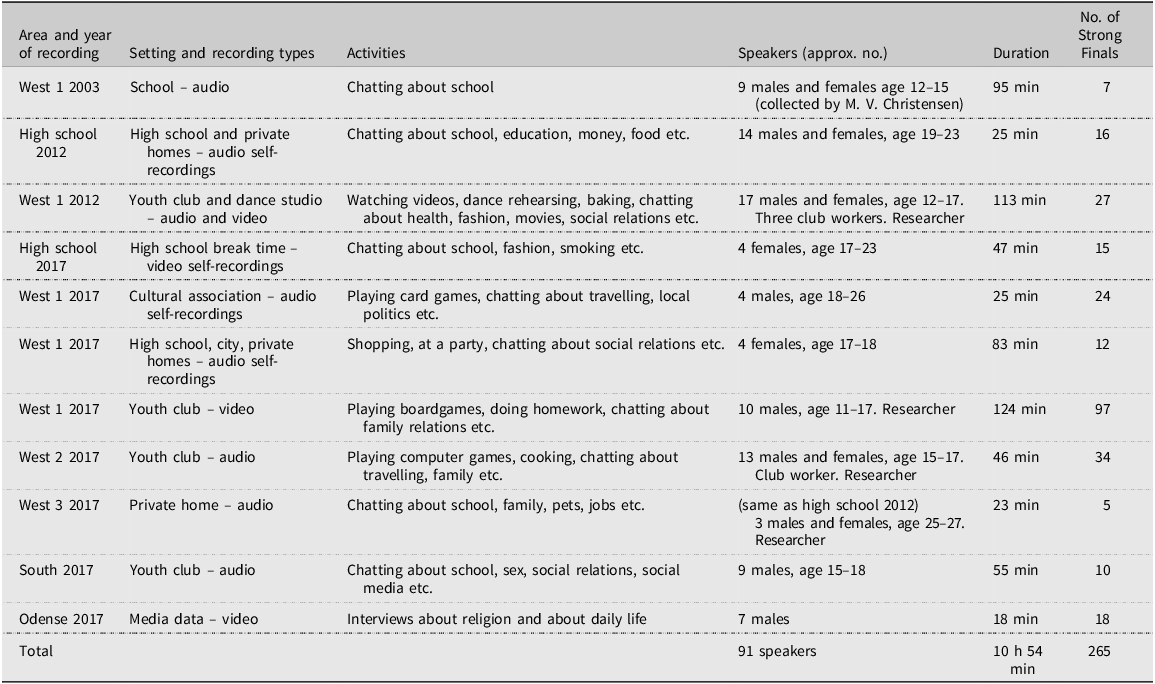
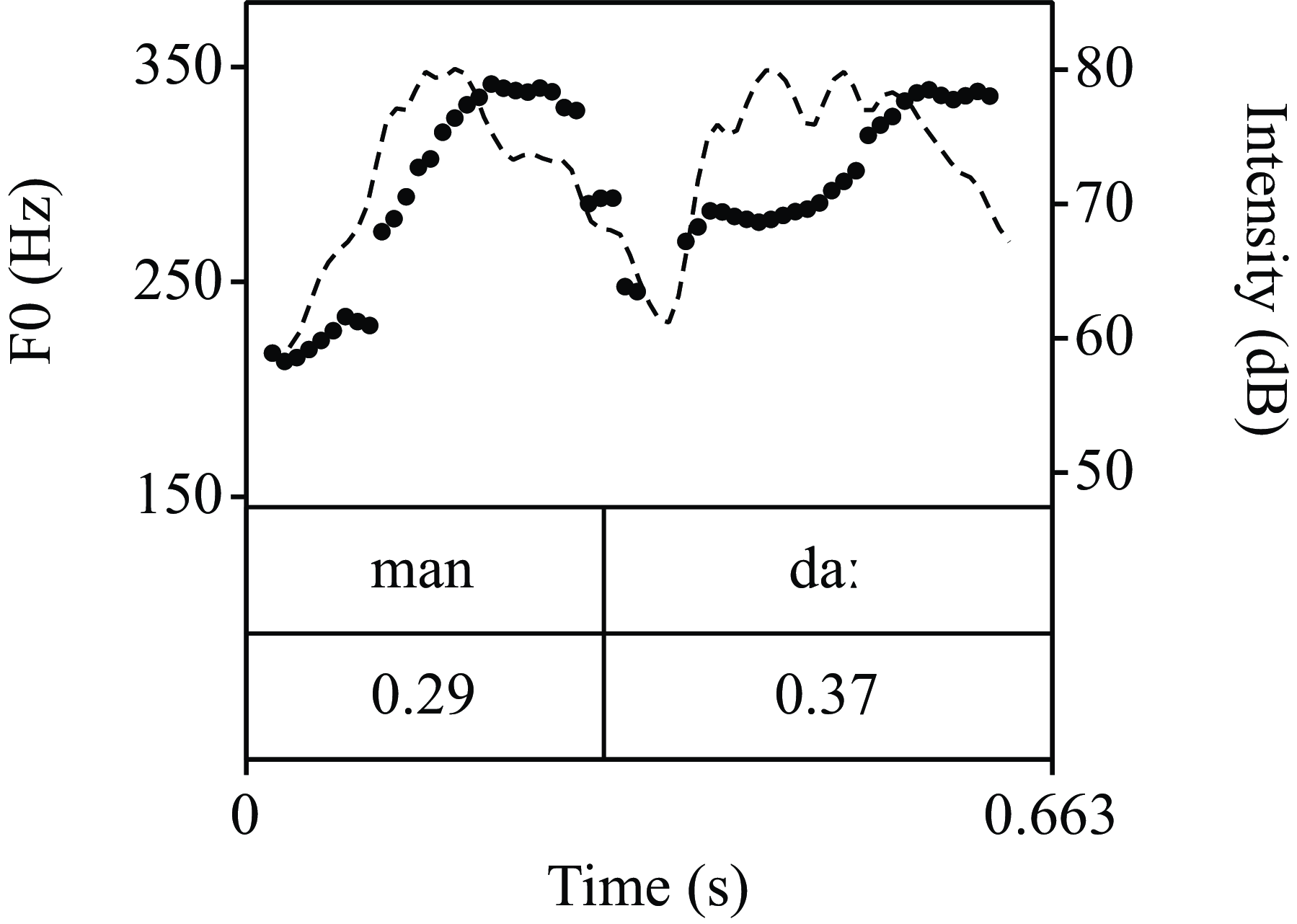
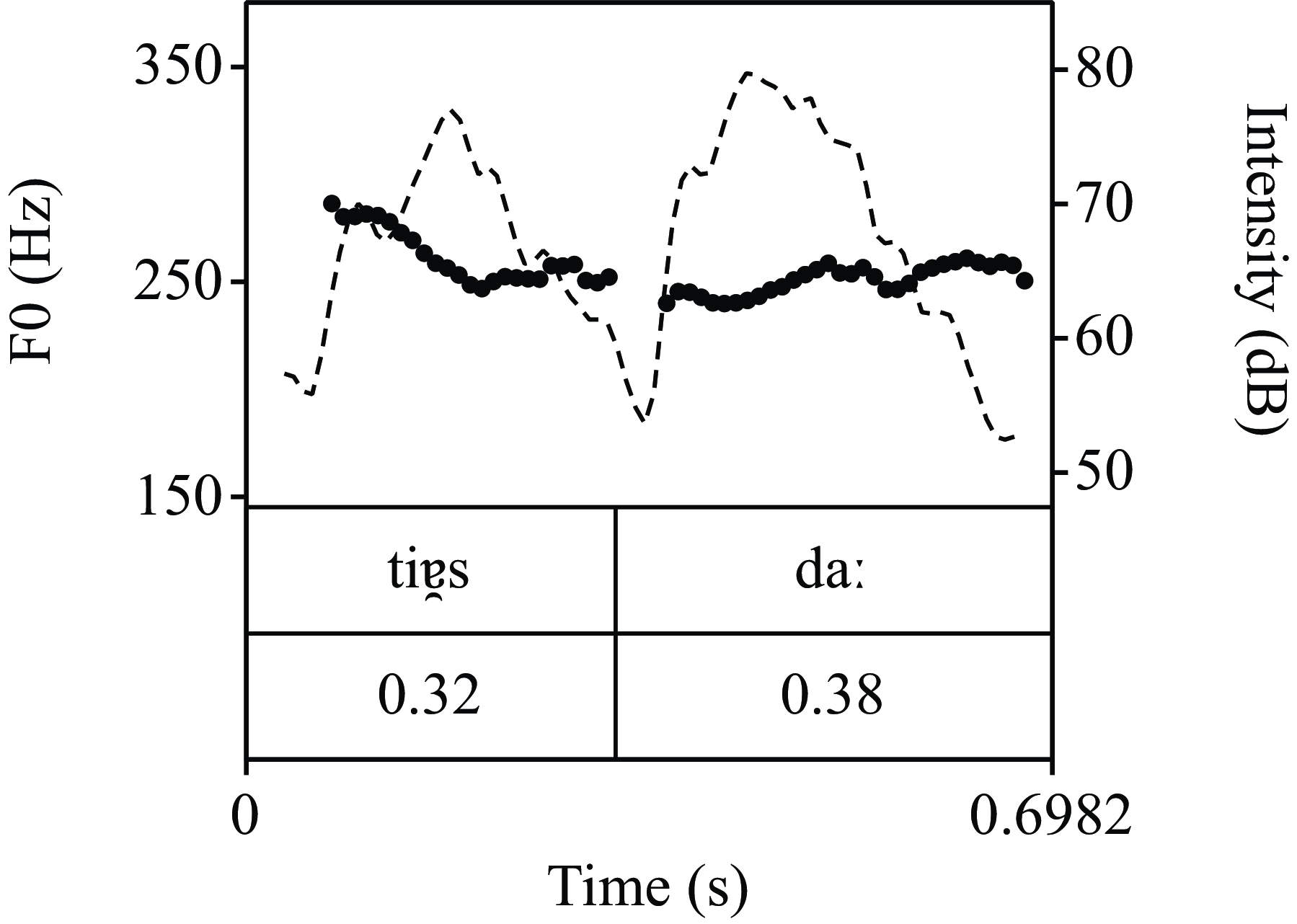
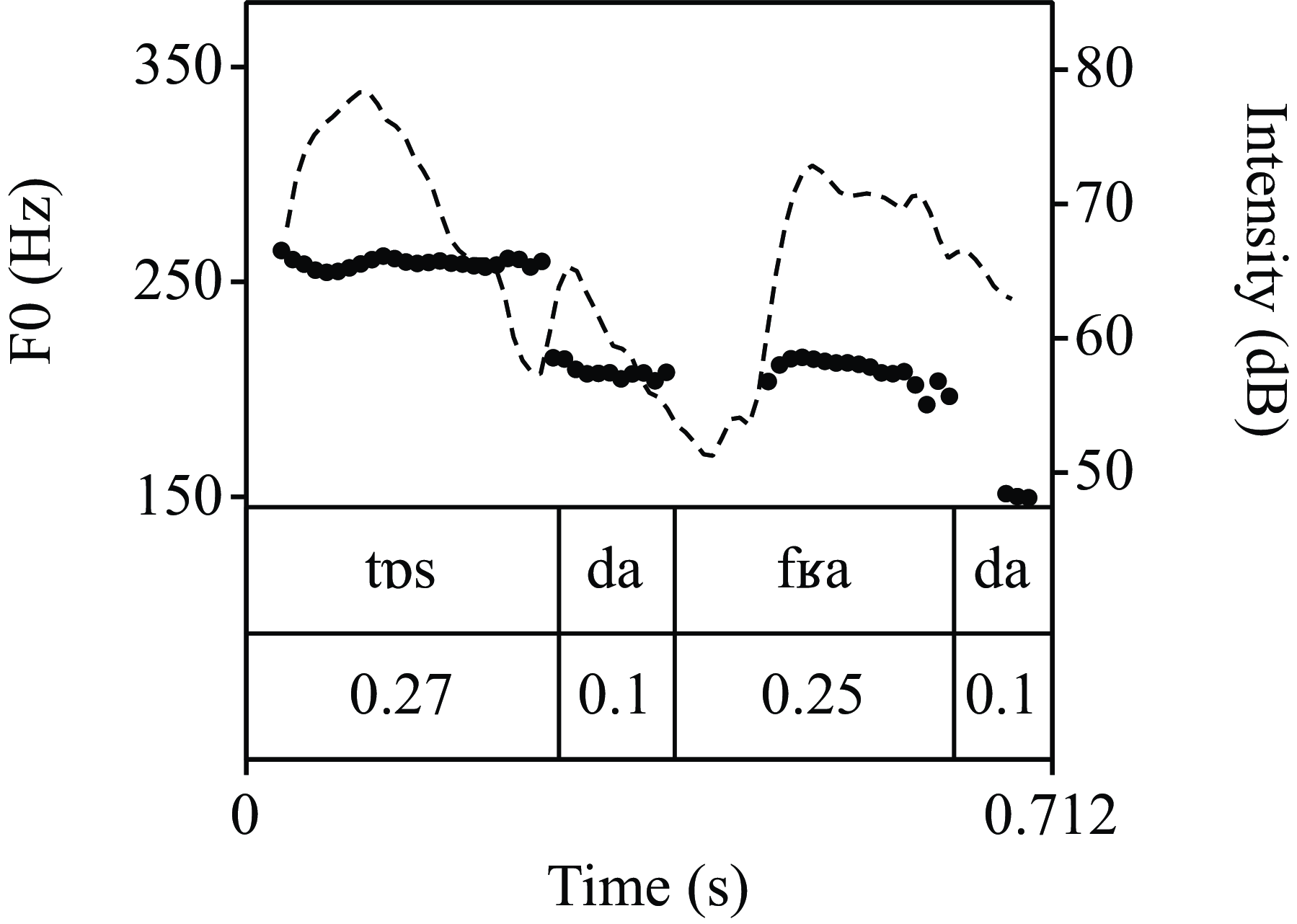
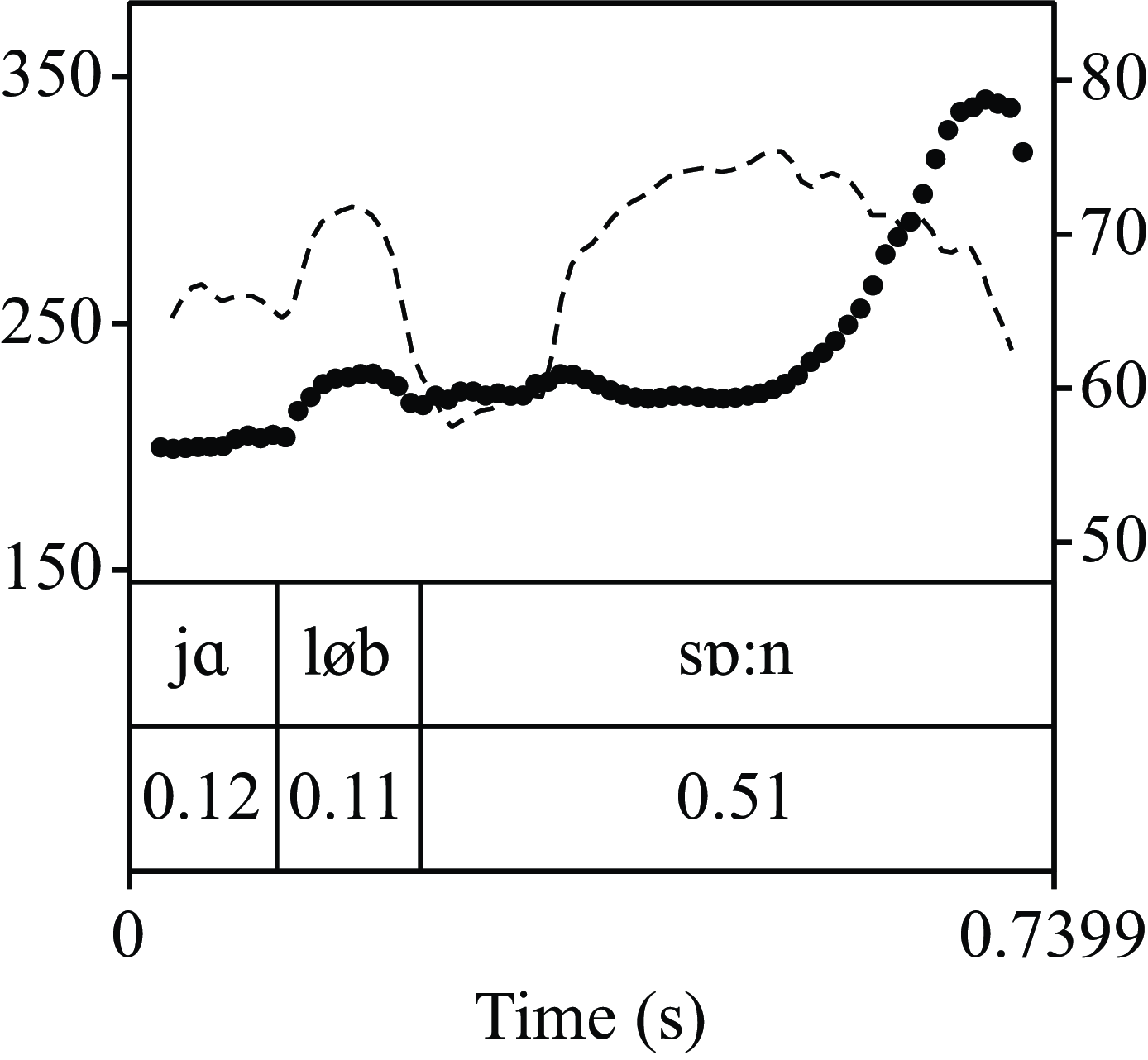
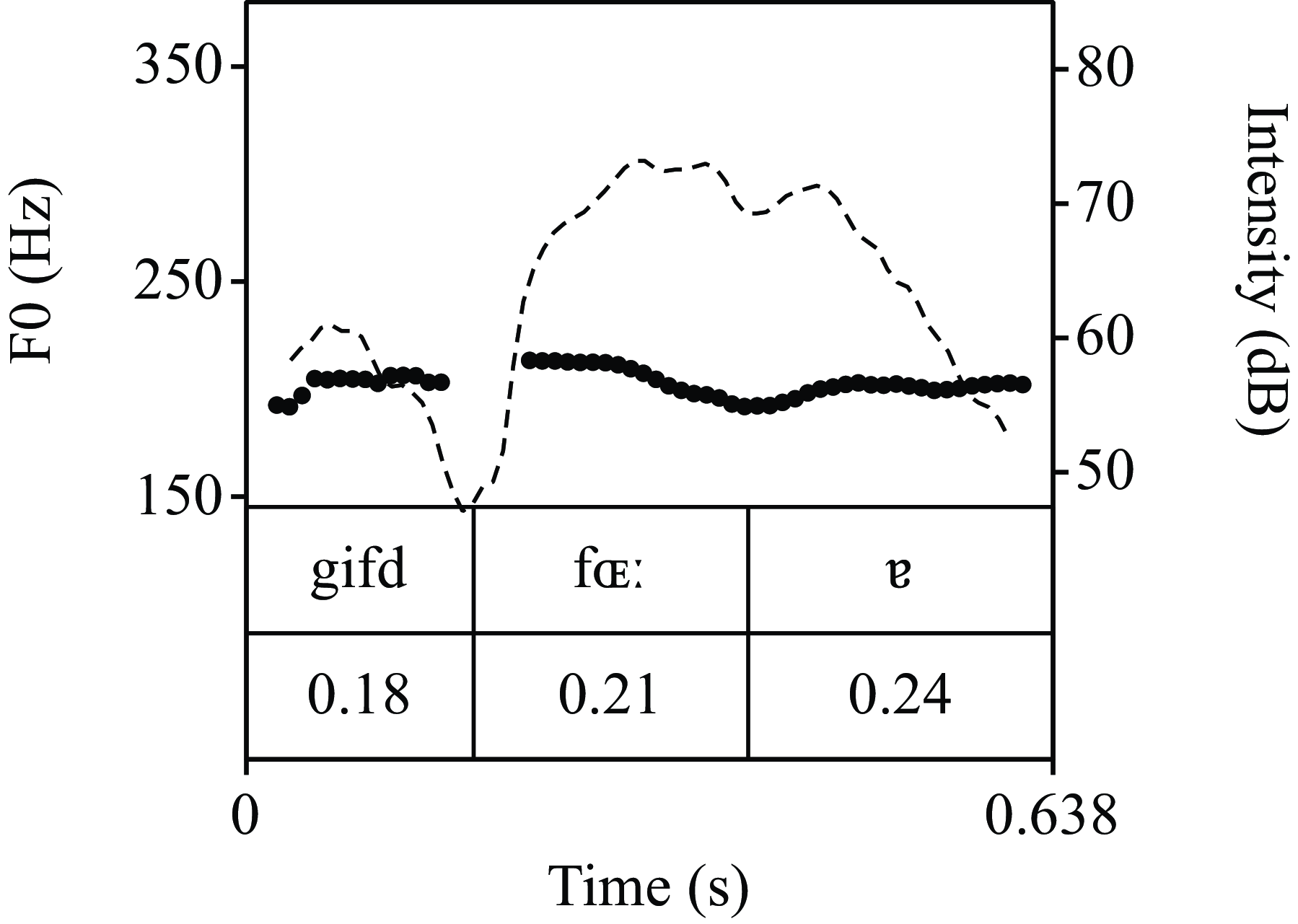
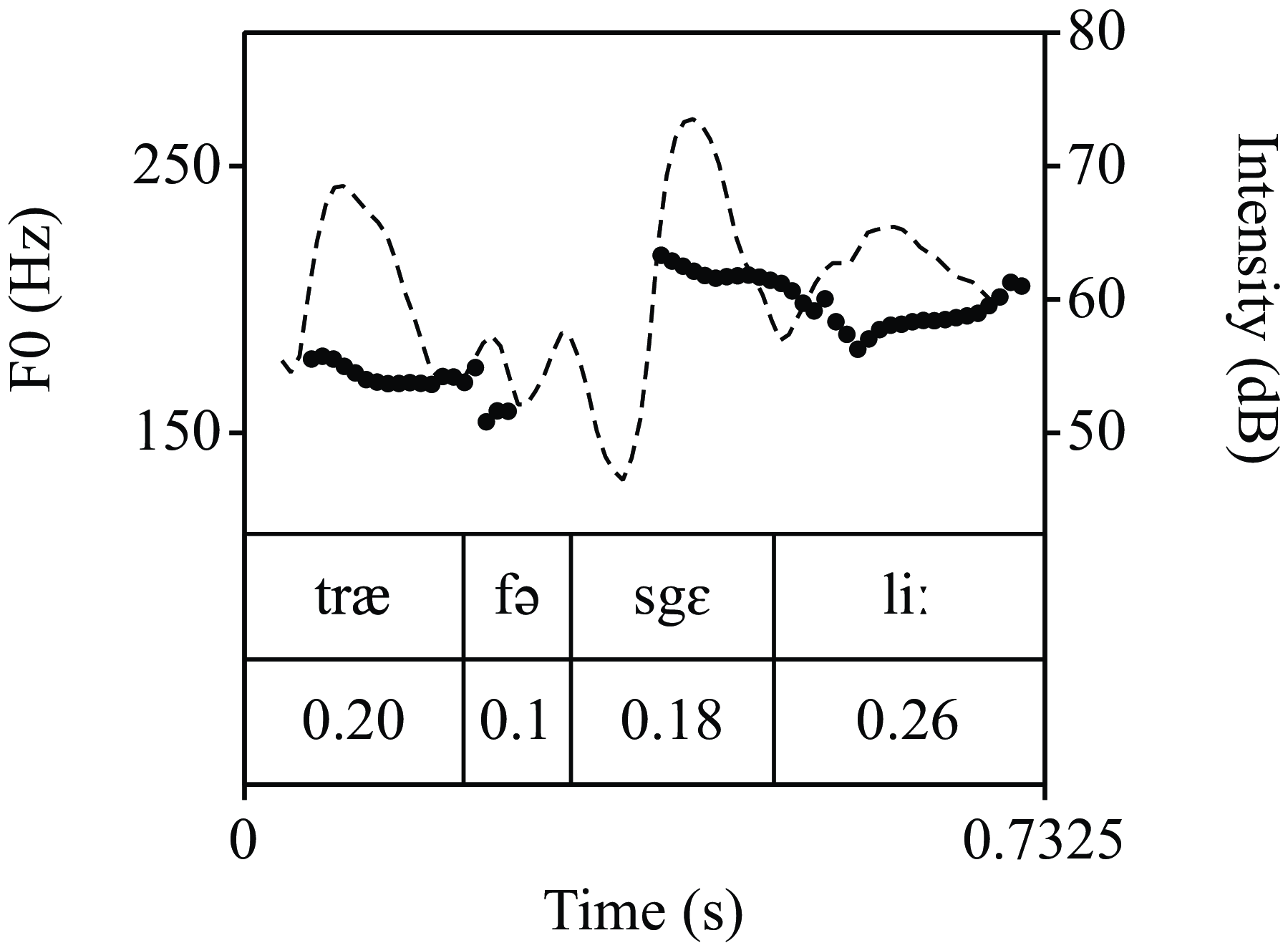
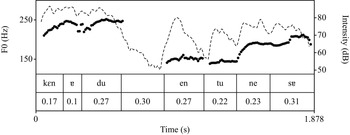
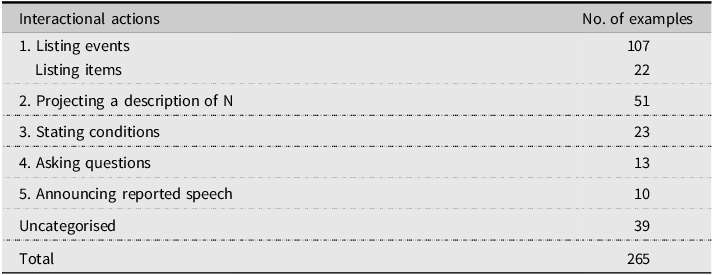
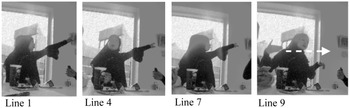


 Open access

