

The variety described here is representative of colloquial Assamese spoken in the eastern districts of Assam.Footnote 1 Assam is a North-Eastern state of India, therefore Assamese and creoles of Assamese like Nagamese are spoken in the different North-Eastern states of Nagaland, Arunachal Pradesh, Meghalaya, and also the neighbouring country of Bhutan. Approximately 15 million people speak Assamese in India (see Ethnologue, Gordon Reference Gordon2005, which lists 15,374,000 speakers including those in Bhutan and Bangladesh). In the pre-British era (until 1826), the kingdom of Assam was ruled by Ahom kings and the then capital was based in the Eastern district of Sibsagar and later in Jorhat. American missionaries established the first printing press in Sibsagar and in the year 1846 published a monthly periodical Arunodoi using the variety spoken in and around Sibsagar as the point of departure. This is the immediate reason which led to the acceptance of the formal variety spoken in eastern Assam (which roughly comprises of all the districts of Upper Assam). Having said that, the language spoken in these regions of Assam also show a certain degree of variation from the written form of the ‘standard’ language. As against the relative homogeneity of the variety spoken in eastern Assam, variation is considerable in certain other districts which would constitute the western part of Assam, comprising of the district of Kamrup up to Goalpara and Dhubri (see also Kakati Reference Kakati1962 and Grierson Reference Grierson1968). In contemporary Assam, for the purposes of mass media and communication, a certain neutral blend of eastern Assamese, without too many distinctive eastern features, like /ɹ/ deletion, which is a robust phenomenon in the eastern varieties, is still considered to be the norm. The lexis of Assamese is mainly Indo-Aryan, but it also has a sizeable amount of lexical items related to Bodo among other Tibeto-Burman languages (Kakati Reference Kakati1962), and there are a substantial number of items borrowed from Hindi, English and Bengali in recent times.
The speaker of the passage recorded for this illustration is a 27-year-old female teacher in a prestigious middle school. Apart from her teaching activities she also speaks in public gatherings and other social events. She grew up in Jorhat and has lived there all her life.
Consonants
The following twenty consonants belong to the consonant inventory of the Assamese speakers represented by the speaker of the Assamese passage:


Syllable-final plosives /p/ /t/ /k/ are unreleased. Syllable-initial and syllable-final /t/ /tʰ/ /n/, /d/, and /dʰ/ are denti-alveolar or apico-alveolar, depending on the preceding or the following vowel. For instance, in /tɔlɔt/ ‘down (Locative)’, both the initial /t/ as well as the final /t/ are alveolar. While these segments are distinctly denti-alveolar in the presence of vowels which are high and front, for instance in a word like /titi/ ‘wet (conjunctive participial)’ they are definitely apico-alveolar when either the preceding or the following vowel is a back vowel.
In the production of /b/, very often a released [β] in the initial syllable onset position is observed, as in [βɔtɑh] instead of [bɔtɑh] ‘wind’. Although aspiration is distinctive in all positions, there is considerable amount of de-aspiration in certain positions. Voiced aspirates in non-initial positions tend to lose their quality of breathiness, e.g. [bɑgʰ] > [bɑg] ‘tiger’, [lɑbʰ] > [lɑb] ‘profit’, [xɑdʰ] > [xɑd] ‘desire/wish’. Among the voiceless aspirates, a distinguishing characteristic in the phonetics of Assamese is that of spirantisation, which is not observed for /pʰ/ and /tʰ/, but /kʰ/ undergoes spirantisation to the extent that [x] and [χ] are frequently realised as allophones of /kʰ/. Depending on the individual speaker and on the degree of carefulness of speech (fast speech/slow speech or formal speech/informal speech), /kʰ/ can be pronounced anywhere from [kʰ] to [χ] or [x]. [gɑkʰiɹ]>[gɑχiɹ] > [gɑxiɹ] ‘milk’, [ɑkʰɔɹ] > [ɑχɔɹ] > [ɑxɔɹ] ‘a letter of the alphabet’.
Although the writing system of Assamese maintains a token retroflex vs. dental distinction, neither of the two place features forms a part of the consonantal system.Footnote 2 Therefore, it appears that obstruents have neutralized their dental vs. retroflex distinctions to become very distinctly alveolar (since the distinction is present in all the related languages and also preserved in the orthography, I assume that the distinction was historically present in Assamese, a contention which is, nonetheless, debatable).
All the consonant phonemes, except the velar nasal /ŋ/ and the semi-vowels /j/ and /w/, contrast initially, medially and finally. /ŋ/ in Assamese occurs independently of homorganic consonants but does not appear in word-initial positions.
Affricates are also not present as distinctive sound units. However [dz] occurs as an allophone of /z/ in some speakers, mostly in syllable-initial and therefore prominent positions. Voice Onset Time is delayed in the phonetic realisation of /z/. In non-prominent positions the delay in the onset of voicing is considerable and it can sound like an [s]. This tendency can also occasionally result in word-final devoicing. However, speakers can easily differentiate between a devoiced [z] and an [s]. [z] and [s] are both laminal.
An allophonic palatalisation when /z/ is followed by /j/ as in [xuizzʲɔ] ‘sun’ [dʰoizzʲɔ] ‘patience’ [bɑɑizzʲik] ‘superficial’ is also observed in Assamese. In the careful speech of speakers with a higher degree of formal education, lexical items may be pronounced in a way which reflect the corresponding orthographic convention, as in  [xuiɹdzjɔ] ‘sun’.
Standard Assamese has been reported to attest consonant gemination (Moral Reference Moral1996). The following examples have been taken from Moral (Reference Moral1996: 151–162):

Moral (1966: 154–155) also reports degemination in the Central Assamese dialects spoken in the contiguous districts of Morigaon, Nagaon and Sonitpur. Degemination may be a lexically determined process in the variety discussed here.
The only rhotic /ɹ/ is limited in the number of its allophones. Like English, when [ɹ] precedes a consonant, it is normally an alveolar approximant, but it can also undergo deletion in all positions except the initial position. In non-initial positions, /ɹ/ is subject to optional deletion, giving way to phonetic lengthening in the place of the deleted segment, e.g. [ɑmɑɹ] ~ [ɑmɑː] ‘our’.
Sometimes, consonants apparently not native to Assamese but used in loan words from English and Hindi also surface, like [f] and [ʃ] among others, in words such as fan and shwal. This is also optional and borrowed words may assimilate to the native system in such a way that fan and shwal may be realized as [pʰɛn] and [sɑl] respectively. [dz] and also [ʧ] are used exclusively in loan words from English and Hindi and do not belong to the ‘native’ sound system of Assamese. [rʰ] is a Sanskrit remnant and occurs only in a select few words in the careful speech of educated people; for instance,/pɔɹʰ/ ‘read’ can also be realized as [pɔh].
Vowels
Assamese has eight oral vowels.
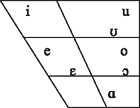

Footnote 3 The plot of the vowels in the diagram above shows that front vowels are more spread out, allowing for significant height differences among /i/, /e/ and /ɛ/. /e/ has a mid central allophone used in many contexts, especially after the occurrence of /i/, and is somewhat lower than a prototypical [e].
Among the back vowels, while /ɔ/ is the lowest, /o/ is higher than /ɔ/. /ʊ/ is only slightly lower than /u/. The quality of the [ɑ] may vary depending on the context, but is mostly pronounced in the mid position, and it assimilates to the back quality of neighbouring consonants in the environment, and it may be realized further back after the velar consonants.
The occurrences of [e] and [o] are constrained by the process of vowel harmony. They mostly appear only when /i/ and /u/ occur in the following syllable. However [e] and [o] appear in borrowed items from English, Hindi, and those which have been directly incorporated from Sanskrit. All the other vowels except [e] and [o] may occur word-initially, medially, or finally.
Though there are no phonemic length distinctions, the vowels are long in open syllables and shorter in closed syllables.
The list of Assamese vowel phonemes also includes a vowel that has been the subject of attention in phonetic studies in the recent past (Ladefoged & Maddieson Reference Ladefoged and Maddieson1990, Reference Ladefoged and Maddieson1996; Ladefoged Reference Ladefoged2001, Reference Ladefoged2003, Reference Ladefoged2007). In my analysis, this vowel is shown to be /ʊ/, but in Ladefoged's work(s) this vowel has been shown to represent / /, a low back vowel which has the tongue position of [ɑ] and the rounding of [ɔ]. Contrary to the investigation by Ladefoged, the vowel in the repertoire of the speaker of this experiment shows the qualities of height and roundedness (also noted by Ladefoged), and therefore represented as [ʊ], a vowel which alternates to /u/ under vowel harmony. Note that the occurrences of /e/ and /o/ in the examples used for Ladefoged's experiment is only due to the presence of the following high vowels /i/ and /u/, but this property is not discussed or observed in his work. Furthermore, in Ladefoged's examples, the ‘rounded low vowel’ in the verbal root /pt/ ‘to bury’ leads to the derivation of a high round vowel in [puti] ‘having buried’. Nonetheless, it is eminently possible that different regional variations have different sounds for the Assamese vowel [ʊ]. It is shown in the field report of Ladefoged's study that his consultants belonged to various parts of Assam, and it is not taken into account how this heterogeneous representation may have had an implication on the experiment. We know from previous work on Assamese (U. Goswami Reference Goswami1970) that the vowels of Western Assam vary from those of Eastern Assam.
Therefore, it will probably not be far-fetched to believe that Ladefoged's speaker of the vowel in the word [pt] does not belong to the speaking population described in this illustration. Even so, it is plausible that the reference vowel exemplified in Ladefoged's set of examples is /ʊ/, as it displays tense harmony when altering from /ʊ/ to /u/.
However, there may be a possibility of unifying the vowel posited by Ladefoged with the one postulated here. An investigation of the pharyngeal vocal tract may show that the pharyngeal component is what gives the vowel its ‘backed’ quality (John Esling, p.c.). Therefore it may be reasonable to describe the oral vowel as either reduced /ʊ/ or as open /ɔ/. Articulatory evidence in pharyngeal phonetics shows that retracted vowels are associated with complex laryngeal mechanisms which may affect the fronting and raising of those vowels (Esling Reference Esling2005). Hence, the retracted (–Advanced Tongue Root) quality of the vowel discussed here may benefit from such an investigation. The retracted feature of the vowel and the participation of this vowel in the process of vowel harmony (both of which has been pointed out in this description) may be the result of the pharyngeal property.
Vowel harmony is a distinguishing feature of the Assamese vowel system (Mahanta, Reference Mahanta2008). The tense value of the following high vowel is shared by the mid vowels in the preceding syllable. Vowel harmony in Assamese is regressive, and in the presence of the two vowels /i/ and /u/, the preceding /ɛ/, /ɔ/ and /u/ change their tense quality to result in /e/, /o/ and /u/. Harmony affects all the vowels of a word (mostly restricted to a trisyllabic or quadrisyllabic domain). However, harmony is not attested in longer syntactic domains and compounds. Assamese vowel harmony is typically word-based, excluding compounded words and larger morpho-syntactic domains. Vowel harmony in Assamese is therefore a regressive (right-to-left) process and there are no morphologically significant positions, which either trigger or target it.

Vowels that do not agree with tense values may be adjacent in the presence of two intervening consonants, and also a nasal segment. A nasal, which is in the immediately adjacent position of a triggering vowel, can block vowel harmony.

Surface diphthongs often result from the sequences /ei/, /oi/, /ai/, /ou/, /au/ (regardless of which member of the pair is assigned stress). In careful speech some speakers pronounce each vowel separately.
All the vowels discussed till now are phonemically oral. Apart from these oral vowels, there are nasal vowels like /

/ and /

/. The phonemic existence of these nasal vowels is demonstrated by the existence of /
/ and /ɑ/, and /ʊ/ and /
/ minimal pairs, as the following words show:
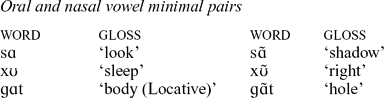
Oral vowels following a nasal consonant have a certain degree of nasalization, exhibiting clear nasal airflow in the whole segment. However, oral vowels except /ɑ/ and /ʊ/ do not have nasal counterparts.
Prominence
In marked difference to European languages, perceptual difference between stressed and unstressed syllables is reportedly not so easy to establish in the languages of South Asia, and Assamese is no exception. Owing to this difficulty, there are also differing views on stress placement rules in Assamese. Notable views on this aspect are those of Kakati (Reference Kakati1962), who accepts Grierson's (Reference Grierson1895) description, where Assamese is said to follow the pan-Indian system of accenting the heavy penultimate syllable. Goswami (Reference Goswami1966) differs from this view and opines that primary stress in Assamese is on the first or second syllable and never moves beyond the second syllable. Some acoustic correlates supporting this view, like low-rise in pitch and longer syllable duration were shown in Mahanta (Reference Mahanta2001). Mahanta (Reference Mahanta2001) argues that Assamese follows a trochaic rhythm and therefore prominence is word-initial in non-compounded words. Primary prominence is on the second syllable if it is a heavy syllable (a closed syllable) and the first is light (an open syllable), if not, primary prominence is on the first syllable. Primary prominence is never assigned to any syllable beyond the second syllable. The following examples of stress in Assamese are from Mahanta (Reference Mahanta2001).Footnote 4

In Assamese, phonetic stress is non-contrastive, and speakers are not aware of any lexical pairs that differ in meaning because of stress placement. The phonetic correlate of prominence is an initial low pitch, which progressively becomes higher towards the end of the prominent syllable. Other correlates like duration and intensity are not present.
Recorded passage
Phonetic transcription
uttɔɹɔɹ bɔtɑh ɑɹu xuizzɔɹ mɑzɔt tɔɹkɑtɔɹki lɑgi ɑsil zɛ/
t ʊlʊkɔɹ mɑzɔt kʊn besi xɔktixɑli//
tɛnɛtɛ gɔɹɔm sʊlɑ pindʰɑ zɑtɹi ɛzɔn xeikʰinit ɑhi upostʰit holhi//
tulʊkɛ tʰik koɹilɛ zɛ zɛyei zɑtɹi zɔnɔɹ gɑɹ pɔɹɑ sʊlɑ tʊ ɑtɔɹɑboloi xɔikkʰɔm hobɔ/
tukei besi xɔktixɑli buli gɔinyɔ koɹɑ hobɔ//
zetiyɑ uttɔɹɔɹ bɔtɑhɛ nizɔɹ xɔmpuɹnɔ zʊɹɛɹɛ boliboloi dʰoɹilɛ/
tetiyɑ zɑtɹi zɔnɛ ximɑn zʊɹɛɹɛ sʊlɑ tʊ meɹiyɑi dʰoɹi tʰɑkilɛ//
ɔbɔxexɔt uttɔɹɔɹ bɔtɑhɛ nizɔɹ hɑɹ mɑni lolɛ//
tɑɹpɑsɔt xuizzɔɹ ɹosmi zetiyɑ pɹɔkʰɔɹ hoboloi dʰoɹilɛ/
tetiyɑ zɑtɹizɔnɛ tɔtɑlikɛ gɔɹɔm sʊlɑtʊ kʰuli pelɑlɛ//
xeibɑbɛ uttɔɹɔɹ bɔtɑhɛ mɑni loboloi bɑidʰyɔ hol zɛ/
tulʊkɔɹ bʰitɔɹɔt xuizzɔi besi xɔktixɑli//



