To save content items to your account,
please confirm that you agree to abide by our usage policies.
If this is the first time you use this feature, you will be asked to authorise Cambridge Core to connect with your account.
Find out more about saving content to .
To save content items to your Kindle, first ensure no-reply@cambridge.org
is added to your Approved Personal Document E-mail List under your Personal Document Settings
on the Manage Your Content and Devices page of your Amazon account. Then enter the ‘name’ part
of your Kindle email address below.
Find out more about saving to your Kindle.
Note you can select to save to either the @free.kindle.com or @kindle.com variations.
‘@free.kindle.com’ emails are free but can only be saved to your device when it is connected to wi-fi.
‘@kindle.com’ emails can be delivered even when you are not connected to wi-fi, but note that service fees apply.
How did actors of the late seventeenth century supplement their earnings? And what were the relationships between their other business and their acting? This Element focuses on the diverse career of Henry Harris, a leading member of the Duke's Company between 1661 and 1682, and co-manager of the company for a decade. A skilled engraver, Harris also held appointments at the Royal Mint and as Yeoman of the Revels at court, all against the background of a fragmented private life. Drawing on recently discovered manuscript material, this is the first full-length study of a major performer of the Restoration period.
The Foundling Hospital was established in London in 1739 to save impoverished infants from destitution and abandonment by separating them from their mothers and raising them in an institutional setting. The Hospital, which also housed an art collection, concert series, and fashionable park, became a monument to the largess of the benefactors willing to support the reshaping of supposedly unwanted babies into “worthy” citizens useful to their nation. In 2024 the Coram Foundation digitized parts of its voluminous archive from the eighteenth and nineteenth centuries, making these records available to the public in unprecedented ways. Through a close examination of the material artifacts of the Hospital, this analysis of the first few decades of this institution makes visible the uneasy tension between the perspective of the benefactors and the experiences of foundlings from the moment of separation from their birth parent(s) through their years associated with the Foundling Hospital.
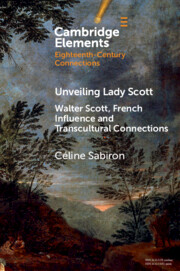
This Element sheds new light on Walter Scott's work by investigating the French influence of his wife, Charlotte Charpentier, later Lady Scott, through her transcultural upbringing and international connections. Much of the limited information about her is tainted by misconceptions from predominantly British male biographers of Scott, whose perspectives were centred on the great man and coloured by anti-French sentiment during the revolutionary period. Through new French and British public records, historical archives, annual registers, and personal materials like letters and diaries from the Scotts' family and social circles, this Element corrects false allegations and highlights her significant, yet largely unrecognised, behind-the-scenes social and literary influence on Scott's writing. By analysing these sources and conducting in-depth readings of Scott's texts, the Element emphasises Scott's collaborative literary approach and argues that Lady Scott, a knowledgeable art and literature enthusiast, greatly assisted him in his work as his secretary, amanuensis, and proofreader.
Criticism and creativity characterised literary reception in eighteenth-century Britain. The press – periodicals, newspapers, and magazines – harboured the reviewing cultures belonging to the emerging professionalisation of literary criticism. It also provided highly fertile ground for creativity, including imitative items inspired by new publications, while critical reviews often incorporated parody. The press fostered experimentation among often anonymous reader-contributors, even while it facilitated the establishment of 'classic' works by recirculating well-known authors' names. Laurence Sterne's reception was energetically shaped by the interaction between critical and creative responses: the press played a major role in forging his status as an 'inimitable' author of note.
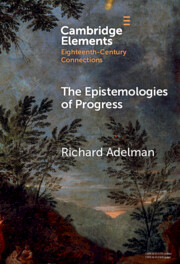
The Epistemologies of Progress brings together two recent critical trends to offer a new understanding of Scottish-Enlightenment narratives of progress. The first trend is the new consideration of the ambiguities inherent in eighteenth-century thought on this subject. The second is the fast-growing body of scholarship identifying the surprising role of scepticism in Enlightenment philosophy across Europe. The author's analysis demonstrates that stadial history is best understood through the terms of contemporary scepticism, and that doing so allows for the identification of structural reasons why such thought has been characterized by its ambiguities. Seen in this light, contemporary accounts of progress form a spectrum of epistemological rigour. At one end of this spectrum all knowledge is self-reflexively recognized to be analogy, surmise, 'speculation', and 'conjecture', untethered from lay-conceptions facticity. At the other end stand quotidian political claims, but made alongside reference to the sceptical conception of knowledge and argumentation.
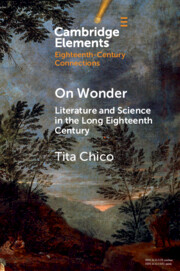
This is an Element about wonder − as an object, as a feeling, as an invitation to study, and as a way of thinking in both literary and scientific texts of the long eighteenth century. Wonder is at the heart of natural philosophical inquiry in the long eighteenth century, its inaugural provocation, its long-standing problematic. Yet wonder requires observation and imagination, operating together, if uneasily, to give shape to forms of scientific, literary, and social knowledge, shaping how thinking works − and who can do it. Studying wonder in the long eighteenth century helps us to understand our current disciplinary configurations, and also how wonder itself embodies the potential for a more capacious critical practice. Studying wonder as an epistemology, praxis, and thematic in the long eighteenth century also carries the promise of invigorating and reimagining our own critical, creative endeavors.
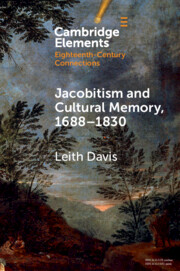
This Element has three objectives. First, it highlights the diversity of the nature of Jacobitism in the long eighteenth century by drawing attention to multi-media representations of Jacobitism and also to multi-lingual productions of the Jacobites themselves, including works in Irish Gaelic, Latin, Scots, Scots Gaelic and Welsh. Second, it puts the theoretical perspectives of cultural memory studies and book history in dialogue with each other to examine the process through which specific representations of the Jacobites came to dominate both academic and popular discourse. Finally, it contributes to literary studies by bringing the literature of the Jacobites and Jacobite Studies into the purview of more mainstream scholarship on eighteenth- and nineteenth-century literatures, providing a fuller perspective on the cultural landscape of that period and correcting a tendency to ignore or downplay the presence of Jacobitism. This title is also available as Gold Open Access on Cambridge Core.
This Element offers a multidimensional study of reading practice and sibling rivalry in late eighteenth-century Britain. The case study is the Aberdeen student and disgraced thief Charles Burney's treatment of Evelina (1778), the debut novel of his sister Frances Burney. Coulombeau uses Charles's manuscript poetry, letters, and marginalia, alongside illustrative prints and circulating library archives, to tell the story of how he attempted to control Evelina's reception in an effort to bolster his own socio-literary status. Uniting approaches drawn from literary studies, biography, bibliography, and the history of the book, the Element enriches scholarly understanding of the reception of Frances Burney's fiction, with broader implications for studies of gender, class, kinship and reading in this period. This title is also available as Open Access on Cambridge Core.
Using the lens of early modern social authorship and contemporary social media, this Element explores a new print genre popular in England at the end of the seventeenth and early eighteenth centuries, the periodical. Traditionally, literary history has focused on only one aspect, the periodical essay. This Element returns the periodical to its original, complex literary ecosystem as an ephemeral text competing for an emerging audience, growing out of a social authorship culture. It argues that the relationship between authors, publishers, and audiences in the early periodicals is a dynamic participatory culture, similar to what modern readers encounter in the early phases of the transition from print to digital, as seen in social media. Like our current evolving digital environment, the periodical also experienced a shift from its original practices stressing sociability to a more commercially driven media ecology. This title is also available as Open Access on Cambridge Core.
The making of fashionable women's dress in Georgian England necessitated an inordinate amount of manual labour. From the mantuamakers and seamstresses who wrought lengths of silk and linen into garments, to the artists and engravers who disseminated and immortalised the resulting outfits in print and on paper, Georgian garments were the products of many busy hands. This Element centres the sartorial hand as a point of connection across the trades which generated fashionable dress in the eighteenth century. Crucially, it engages with recreation methodologies to explore how the agency and skill of the stitching hand can inform understandings of craft, industry, gender, and labour in the eighteenth century. The labour of stitching, along with printmaking, drawing, and painting, composed a comprehensive culture of making and manual labour which, together, constructed eighteenth-century cultures of fashionable dress.
Theatre is the most ephemeral of art forms. It is a truism that the ephemeral performance text is divorced from the static published play text. This Element is of the eighteenth-century performance history of The Fair Penitent demonstrates the interrelation of print and performance and models how readers can recover elements of performance through close attention to text. Traces of performance adhere to the mediascape in playbills and puffs, reviews and accounts. The printed text also preserves traces of performance in notation and illustration. By analysing traces found in performance trends, casting decisions, publication histories and repertory intertexts, this Element recovers how The Fair Penitent was interpreted at different points in the century and explains how a play that bombed in its first season could become a repertory staple.
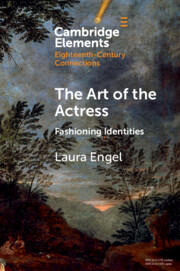
This Element looks at the art of the actress in the eighteenth century. It considers how visual materials across genres, such as prints, portraits, sculpture, costumes, and accessories, contribute to the understanding of the nuances of female celebrity, fame, notoriety, and scandal. The 'art' of the actress refers to the actress represented in visual art, as well as to the actress's labor and skill in making art ephemerally through performance and tangibly through objects. Moving away from the concept of the 'actress as muse,' a relationship that privileges the role of the male artist over the inspirational subject, the author focuses instead on the varied significance of representations, reproductions, and re-animations of actresses, female artists, and theatrical women across media. Via case studies, the Element explores how the archive charts both a familiar and at times unknown narrative about female performers of the past.
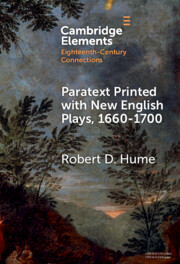
This Element Paratext printed with new English plays has a lot to tell us about what playwrights were attempting to do and how audiences responded, thereby contributing substantially to our understanding of larger patterns of generic evolution across two centuries. The presence (or absence) of twelve elements needs to be systematically surveyed. (1) Attribution of authorship; (2) generic designation; (3) performance auspices; (4) government license authorizing publication; (5) dedication; (6) prefaces of various sorts; (7a-b-c) list of characters (three types); (8) actors' names (sometimes with descriptive characterizations-very helpful for deducing intended authorial interpretation); (9) location of action; (10) prologue and epilogue for first production. Surveying these results, we can see that much of the generic evolution traceable in the later seventeenth century gets undone during the eighteenth-a reversal largely attributable to the Licensing Act of 1737. This title is also available as Open Access on Cambridge Core.
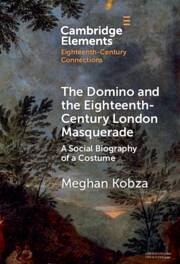
This Element presents new cultural, social, and economic perspectives on the eighteenth-century London masquerade through an in-depth analysis of the classic domino costume. Constructing the object biography of the domino through material, visual, and written sources will bring together various experiences of the masquerade and expand the existing geographical, chronological, and socio-economic scope of the entertainment beyond the masquerade event itself. This Element will examine the domino's physical and figurative movements from the masquerade warehouse, through eighteenth-century fashionable society, and into print and visual culture. It will draw upon masquerade warehouse records, newspapers, manuscripts, prints, and physical objects to establish a comprehensive understanding of the domino and how it reflected contemporary experiences of the real and imagined masquerade. Analysing the domino through interdisciplinary methodologies illustrates the impact material and visual sources can have on reshaping existing scholarship.
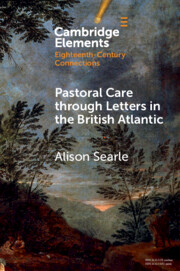
Choosing the right words is itself an act of caregiving. Centring on correspondence archives allows pastoral letters to be analysed as a distinct literary genre that contributed in complex ways to early modern practices of caregiving, negotiating political oppression, geographical isolation, and colonial experimentation. Forms of care were solicited, given, and received through the material technology of the letter as a literary artefact. The exchange of letters created new bureaucratic and pastoral structures and entanglements between Protestant believers and others across the British Atlantic and reveals the contentious balance between care and cure within early modern communities. Pastoral care involves exercising power: epistolary exchanges sustain, exploit, shape, and distort the spiritual and material wellbeing of individuals and communities in a landscape fissured by religious division, enslavement, and imperial expansion.
This Element throws new light on James Boswell's Life of Samuel Johnson by investigating its early publication history. Despite precarious psychological and financial circumstances and other limitations, Boswell was both author and publisher of the two-volume quarto edition that appeared in 1791. This study utilizes little-known documents to explore the details and implications of Boswell's risky undertaking. It argues that the success of the first edition was the result not only of Boswell's biographical genius but also of collaboration with a devoted support network, including the bookseller Charles Dilly, the printer Henry Baldwin and his employees, several newspaper and magazine editors, Boswell's 'Gang' (Edmond Malone, Sir Joshua Reynolds, and John Courtenay) and other members of The Club, and Sir William Forbes. Although the muddled second edition (1793) suffered from Boswell's increasing dysfunction in the years before his death in 1795, the resilient Boswellian network subsequently secured the book's exalted reputation.
This Element studies eighteenth- and early nineteenth-century instances of transmediation, concentrating on how the same illustrations were adapted for new media and how they generated novel media constellations and meanings for these images. Focusing on the 'content' of the illustrations and its adaptation within the framework of a new medium, case studies examine the use across different media of illustrations (comprehending both the designs for book illustrations and furniture prints) of three eighteenth-century works: Defoe's Robinson Crusoe (1719), Thomson's The Seasons (1730) and Richardson's Pamela (1740). These case studies reveal how visually enhanced material culture not only makes present the literary work, including its characters and story-world. But they also demonstrate how, through processes of transmediation, changes are introduced to the illustration that affect comprehension of that work. This title is also available as Open Access on Cambridge Core.
Science and Reading in the Eighteenth Century studies the reading habits of a group of historians and science administrators known as the Hardwicke Circle. The research is based on an analysis of the reading recorded in the 'Weekly Letter', an unpublished private correspondence written from 1741 to 1766 between Thomas Birch (1705–1766), Secretary of the Royal Society, and Philip Yorke (1720–1790), later second earl of Hardwicke. Birch and Yorke were omnivorous, voracious, and active readers. The analysis uses the Weekly Letter to quantify the texts with which they engaged, and explores the role of reading in their intellectual life. The research argues that this evidence shows that, in the early 1750s, the Hardwicke Circle pivoted from a focus on early-modern British history to a new concern with the reform and renovation of British intellectual institutions, especially the Royal Society.
Cryptology of the long eighteenth century became an explicit discipline of secrecy. Theorized in pedagogical texts that reached wide audiences, multimodal methods of secret writing during the period in England promoted algorithmic literacy, introducing reading practices like discernment, separation, recombination, and pattern recognition. In composition, secret writing manipulated materials and inspired new technologies in instrumentation, computation, word processing, and storage. Cryptology also revealed the visual habits of print and the observational consequences of increasing standardization in writing, challenging the relationship between print and script. Secret writing served not only military strategists and politicians; it gained popularity with everyday readers as a pleasurable cognitive activity for personal improvement and as an alternative way of thinking about secrecy and literacy.
This Element examines the eighteenth-century novel's contributions to empirical knowledge. Realism has been the conventional framework for treating this subject within literary studies. This Element identifies the limitations of the realism framework for addressing the question of knowledge in the eighteenth-century novel. Moving beyond the familiar focus in the study of novelistic realism on problems of perception and representation, this Element focuses instead on how the eighteenth-century novel staged problems of inductive reasoning. It argues that we should understand the novel's contributions to empirical knowledge primarily in terms of what the novel offered as training ground for methods of reasoning, rather than what it offered in terms of formal innovations for representing knowledge. We learn from such a shift that the eighteenth-century novel was not a failed experiment in realism, or in representing things as they are, but a valuable system for reasoning and thought experiment.