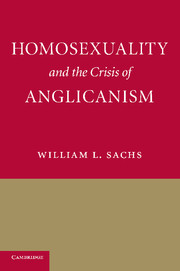
Book contents
- Frontmatter
- Contents
- Acknowledgements
- 1 A definitive moment
- 2 The shape of early Christian unity
- 3 When ideals encounter realities
- 4 Reform and the power of the periphery
- 5 Anglican tradition and local prerogative
- 6 The triumph of indigenous Anglicanism
- 7 The rise of Liberalism
- 8 In search of the pure church
- 9 Beyond warring parties?
- Index
- References
7 - The rise of Liberalism
Published online by Cambridge University Press: 05 June 2012

Book contents
- Frontmatter
- Contents
- Acknowledgements
- 1 A definitive moment
- 2 The shape of early Christian unity
- 3 When ideals encounter realities
- 4 Reform and the power of the periphery
- 5 Anglican tradition and local prerogative
- 6 The triumph of indigenous Anglicanism
- 7 The rise of Liberalism
- 8 In search of the pure church
- 9 Beyond warring parties?
- Index
- References
Summary
THE IDEAL OF THE KINGDOM
A different sort of divergence
The creation of Anglicanism in colonial contexts required adaptations of unforeseen sorts. Profound questions about the church's relation to society and the appropriate forms of governance challenged the church's leadership to balance being faithful with being effective. Although in most cases the church enjoyed the advantages of colonial authority, if not actual religious establishment, duplication of English circumstances was not possible. Even in England establishment fell short of realization. By the later decades of the eighteenth century pressure for reform could not be ignored. The political nation expanded, offering proof that comprehension on Anglican terms was not possible. But the energies of Evangelicalism injected a new emphasis on mission into the church and proved instrumental in crafting a new consensus about the role of religion in English life. Morality became a key barometer of society's state and of the church's faithfulness. Increasingly Anglicans saw their task in practical terms dictated by the need to unite society along moral lines. In time uncertainty about the church's moral ideals and their proper expression would threaten church unity.
The first glimmers of challenge surfaced as the church became indigenous in new cultural circumstances. Beyond the ability of colonial authority to control, Anglicanism developed novel patterns of life and leadership that were especially apparent in Africa. The form of the church's historic offices of ministry and worship largely retained continuity with their English origins.
Information
- Type
- Chapter
- Information
- Homosexuality and the Crisis of Anglicanism , pp. 164 - 193Publisher: Cambridge University PressPrint publication year: 2009
References
, From Coleridge to Gore: A Century of Religious Thought in Britain (Longman, 1971), p. 11.Google Scholar
, Frederick Denison Maurice: Rebellious Conformist, 1805–1872 (Ohio University Press, 1972).Google Scholar
, Fling Out The Banner: The National Church Ideal and the Foreign Mission of the Episcopal Church (Church Publishing, 2001)Google Scholar
, For the Union of Evangelical Christendom: The Irony of the Reformed Episcopalians (The Pennsylvania State University Press, 1994), pp. 79f.Google Scholar
, “UnEnglish and Unmanly: Anglo-Catholicism and Homosexuality,” Victorian Studies (Winter, 1982), pp. 181–210.Google Scholar
, William Temple: Church, State and Society in Britain, 1880–1950 (Cambridge University Press, 1992).Google Scholar
, Jr., Episcopalians and Race: From Civil War to Civil Rights (The University Press of Kentucky, 2000), pp. 175f.Google Scholar
, ed., A Keeper of the Word: Selected Writings of William Stringfellow (Eerdmans, 1994).
, ed., Where We Stand: Archbishop Clayton's Charges (Oxford University Press, 1960).
Accessibility standard: Unknown
Why this information is here
This section outlines the accessibility features of this content - including support for screen readers, full keyboard navigation and high-contrast display options. This may not be relevant for you.Accessibility Information
Accessibility compliance for the PDF of this book is currently unknown
and may be updated in the future.