

Hostname: page-component-76d6cb85b7-jhrpq Total loading time: 0 Render date: 2026-07-11T12:08:20.259Z Has data issue: false hasContentIssue false

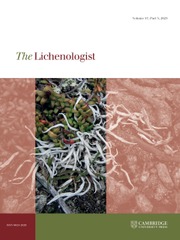
Distribution and habitat preference of protected reindeer lichen species (Cladonia arbuscula, C. mitis and C. rangiferina) in the Balaton Uplands (Hungary)

Published online by Cambridge University Press:  26 May 2021

Mónika Sinigla
Affiliation:
Bakony Museum of the Hungarian Natural History Museum, H–8420 Zirc, Rákóczi tér 3–5, Hungary
Erzsébet Szurdoki
Affiliation:
Department of Botany, Hungarian Natural History Museum, H–1431 Budapest, Pf. 137, Hungary Department of Natural Sciences, Faculty of Primary and Pre-School Education, Eötvös Loránd University, H-1126 Budapest, Kiss János altábornagy u. 40, Hungary
László Lőkös
Affiliation:
Department of Botany, Hungarian Natural History Museum, H–1431 Budapest, Pf. 137, Hungary
Dénes Bartha
Affiliation:
Institute of Botany and Nature Conservation, University of Sopron, H–9400 Sopron, Bajcsy-Zsilinszky u. 4, Hungary
István Galambos
Affiliation:
H–8420 Zirc, Alkotmány u. 33/A, Hungary
András Bidló
Affiliation:
Institute of Environmental and Earth Sciences, University of Sopron, H–9400 Sopron, Bajcsy-Zsilinszky u. 4, Hungary
Edit Farkas*
Affiliation:
Institute of Ecology and Botany, Centre for Ecological Research, H–2163 Vácrátót, Alkotmány u. 2–4, Hungary
*
Author for correspondence: Edit Farkas. E-mail: farkas.edit@ecolres.hu

Abstract

The maintenance of protected lichen species and their biodiversity in general depends on good management practices based on their distribution and habitat preferences. To date, 10 of the 17 protected lichen species of Hungary have been recorded in the Bakony Mts including the Balaton Uplands region. Habitat preferences of three protected Cladonia species (C. arbuscula, C. mitis and C. rangiferina) growing on underlying rocks of red sandstone, basalt, Pannonian sandstone and gravel were investigated by detailed sampling. We recorded aspect, underlying rock type, soil depth, pH and CaCO3 content, habitat type (as defined by the General National Habitat Classification System Á-NÉR), all species of lichen, bryophyte and vascular plants as well as percentage cover of exposed rock, total bryophytes, lichens, vascular plants and canopy, degree of disturbance and animal impacts. Sporadic populations of these species mostly exist at the top of hills and mountains in open acidofrequent oak forests, but they may occur in other habitats, such as closed acidofrequent oak forests, slope steppes on stony soils, siliceous open rocky grasslands, open sand steppes, wet and mesic pioneer scrub and dry Calluna heaths. Cladonia rangiferina was found to grow beneath higher canopy cover than either C. arbuscula or C. mitis in the Balaton Uplands. Furthermore, there were significant differences in canopy cover between occupied and unoccupied quadrats in the case of all three species. Cladonia rangiferina is a good indicator species of natural habitats in Hungary due to its restricted distribution and low ecological tolerance. These results may lead to the adoption of effective conservation methods (e.g. game exclusion, artificial dispersal) in the future.

Information

Type
Standard Papers
Copyright
Copyright © The Author(s), 2021. Published by Cambridge University Press on behalf of the British Lichen Society

Access options

Get access to the full version of this content by using one of the access options below. (Log in options will check for institutional or personal access. Content may require purchase if you do not have access.)

Article purchase

Temporarily unavailable

Supplementary material: File

Sinigla et al. supplementary material

Supplementary Material

Download Sinigla et al. supplementary material(File)
File 499.7 KB