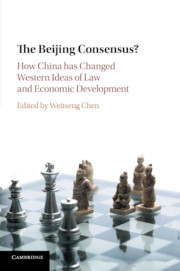
Book contents
- Frontmatter
- Contents
- Figures
- Contributors
- Acknowledgments
- Introduction: Debating the Consensuses
- PART I Deconstructing the Beijing Consensus
- 1 Dialogus de Beijing Consensus
- 2 Imagining China: Brazil, Labor, and the Limits of an Anti-model
- 3 The Beijing Consensus and Possible Lessons from the “Singapore Model”?
- PART II Examining the Beijing Consensus in Context
- PART III Revisiting the Beijing Consensus
- Bibliography
- Index
1 - Dialogus de Beijing Consensus
from PART I - Deconstructing the Beijing Consensus
Published online by Cambridge University Press: 28 April 2017
Edited by

Book contents
- Frontmatter
- Contents
- Figures
- Contributors
- Acknowledgments
- Introduction: Debating the Consensuses
- PART I Deconstructing the Beijing Consensus
- 1 Dialogus de Beijing Consensus
- 2 Imagining China: Brazil, Labor, and the Limits of an Anti-model
- 3 The Beijing Consensus and Possible Lessons from the “Singapore Model”?
- PART II Examining the Beijing Consensus in Context
- PART III Revisiting the Beijing Consensus
- Bibliography
- Index
Summary
Prologue
Beijing Consensus was a term initially coined by Joshua Cooper Ramo in 2004, as a superior, and distinctly Asian, developmental model. Ramo's claim of a “Beijing Consensus” triggered much academic interest and resistance in the West, as some questioned whether the developmental policies Ramo's model prescribed accurately described China's path to economic development. In 2007, Randall Peerenboom, in a book titled China Modernizes: Threat to the West or Model for the Rest?, advanced what he termed an “East Asian Model,” which prioritizes economic reforms over liberal political reforms and is characterized by a distinctively gradualist approach to development. A couple years later, Dani Rodrik advanced a similar model – “New Development Economics.” Similar to the East Asian Model, it emphasizes pragmatism and experimentation and considers China's post-Mao development as its principal exemplar.
In this chapter, Pessimo (Dowdle) and Optimo (Prado) debate the merits and pitfalls of each of these instantiations of the idea of a consensus. We conclude – somewhat surprisingly – that it is in the discussion they generate, rather than in their substantive prescriptions, that the real value of these models lies.
On Joshua Ramo's Original Idea of a “Beijing Consensus”
Joshua Ramo introduced the term Beijing Consensus as a particular developmental strategy that was superior to the then still popular, but increasingly discredited, “Washington Consensus.” According to Ramo, the Beijing Consensus consists of “three theorems about how to organize the place of a developing country in the world.” We examine each theorem in turn.
On Ramo's First Theorem
“The first theorem repositions the value of innovation. Rather than the ‘old-physics’ argument that developing countries must start development with trailing-edge technology (copper wires), it insists that on [sic] the necessity of bleeding-edge innovation (fiber optic) to create change that moves faster than the problems change creates. In physics terms, it is about using innovation to reduce the friction losses of reform.”
Pessimo on Development as “Bleeding-Edge” Innovation
To me, this is just a buzzword salad. What does it mean to “create change that moves faster than the problems change creates”? What problems do copper wires cause that immediate transition to fiber optics outruns?
Information
- Type
- Chapter
- Information
- The Beijing Consensus?How China Has Changed Western Ideas of Law and Economic Development, pp. 15 - 42Publisher: Cambridge University PressPrint publication year: 2017
Accessibility standard: Unknown
Why this information is here
This section outlines the accessibility features of this content - including support for screen readers, full keyboard navigation and high-contrast display options. This may not be relevant for you.Accessibility Information
Accessibility compliance for the PDF of this book is currently unknown
and may be updated in the future.
- 1
- Cited by