Book contents
Introduction
Published online by Cambridge University Press: 12 October 2009

Summary
Isn't it amazing how hard people work to raise their children? … For every grownup you see, there must have been at least one person to lug them around, and feed them … for years and years without a break. Teaching them how to fit into civilisation, and how to talk back and forth with other people, taking them to zoos and parades and educational events, telling them all those nursery rhymes and word of mouth fairytales. Isn't that surprising?
Character in The Clock Winder, by Anne Tyler, 1972, pp.258–9If you want to know what children like, you have to think like one or base it on your small brother or your cousin, you have to base it on them.
Boy, 10, inner-London primary schoolThe BBC has, I think, a special responsibility that transcends, while it cannot afford to ignore, ratings and reach. Our responsibility is to supply a distinctive public service offering information, education and entertainment, which extends young people's choices and lifts their horizons.
Sir Christopher Bland, Chair of Governors, The BBC and Children, BBC, August 1996This book has three main origins, each in some sense based on the spirit of the quotations above.To begin with the last: the practical origins of the book are an empirical study, funded by the BBC and the London Institute, with children aged between 5 and 13 years, in different parts of England and Wales, carried out during 1996 and 1997. The study's primary aim was to assess children's responses to televised storytelling, including programmes made especially for children, as well as drama programmes made for adults, which are watched by children.
Information
- Type
- Chapter
- Information
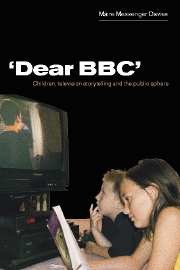
- 'Dear BBC'Children, Television Storytelling and the Public Sphere, pp. 1 - 18Publisher: Cambridge University PressPrint publication year: 2001
Accessibility standard: Unknown
Why this information is here
This section outlines the accessibility features of this content - including support for screen readers, full keyboard navigation and high-contrast display options. This may not be relevant for you.Accessibility Information
Accessibility compliance for the PDF of this book is currently unknown
and may be updated in the future.