Book contents
- Frontmatter
- Contents
- List of Figures
- Acknowledgments
- Introduction
- 1 A “good war” no more: The new World War II revisionism
- 2 From history to memory and back again: Debating the Holocaust’s uniqueness
- 3 Probing the limits of speculation: Counterfactualism and the Holocaust
- 4 Nazis that never were: new alternate histories of the Third Reich
- 5 Humanizing Hitler: the Führer in contemporary film
- 6 Between tragedy and farce: Nazism on the Internet
- Conclusion
- Notes
- Bibliography
- Index
Introduction
Published online by Cambridge University Press: 05 December 2014

Book contents
- Frontmatter
- Contents
- List of Figures
- Acknowledgments
- Introduction
- 1 A “good war” no more: The new World War II revisionism
- 2 From history to memory and back again: Debating the Holocaust’s uniqueness
- 3 Probing the limits of speculation: Counterfactualism and the Holocaust
- 4 Nazis that never were: new alternate histories of the Third Reich
- 5 Humanizing Hitler: the Führer in contemporary film
- 6 Between tragedy and farce: Nazism on the Internet
- Conclusion
- Notes
- Bibliography
- Index
Summary
Originally mocked, subsequently feared, posthumously vilified, Adolf Hitler today is becoming normalized. Throughout the Western world, the Nazi dictator has long been regarded as the epitome of evil. But since the turn of the millennium, he has been increasingly transformed into a more ambiguous figure. Nowhere is this transformation clearer than on the Internet. Anyone who conducts a simple image search of Hitler on the World Wide Web will encounter an eclectic array of representations, ranging from archival photographs documenting the dictator’s role in the Third Reich to digitally altered images that spoof him for laughs. The diversity of images is striking, but what is most notable is how the line separating them is beginning to blur. As discerning web users probably know, certain photographs of Hitler are now doing double duty, serving the purpose of both documentation and exploitation.
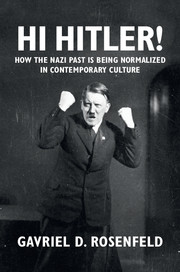
Consider Figure 1. Originally taken by Hitler’s personal photographer, Heinrich Hoffmann, in his Munich studio in 1927, it is one of a famous series of photographs that portray the then struggling Nazi party leader meticulously practicing his oratorical choreography. The photograph depicts Hitler in a pose of fanatical intensity, his fists clenched, his face contorted in an expression of fury about what we can only imagine was one of the countless grievances that fueled his political agenda. As a document of history, the photograph is significant for showing how Hitler methodically rehearsed what were widely thought to be “spontaneous” gestures, a fact that explains why the Nazi party leader, eager to protect his image as a “naturally” gifted orator, forbade the image – and the entire series of which it was part – from being shown to the German public during his lifetime.
Information
- Type
- Chapter
- Information
- Hi Hitler!How the Nazi Past is Being Normalized in Contemporary Culture, pp. 1 - 28Publisher: Cambridge University PressPrint publication year: 2014
Accessibility standard: Unknown
Why this information is here
This section outlines the accessibility features of this content - including support for screen readers, full keyboard navigation and high-contrast display options. This may not be relevant for you.Accessibility Information
Accessibility compliance for the PDF of this book is currently unknown
and may be updated in the future.