Book contents
- Frontmatter
- Contents
- Preface
- 1 Introduction
- Part I Theoretical Evolution
- Part II Emerging Themes
- 7 Non-Alignment and Beyond
- 8 India and Multilateralism: Concepts, New Trajectories and Theorizing
- 9 India and the Responsibility to Protect
- 10 India and the Indo-Pacific Discourse
- 11 India and Nuclear Deterrence
- 12 India and Its Diaspora
- Bibliography
- Contributors
- Index
7 - Non-Alignment and Beyond
from Part II - Emerging Themes
Published online by Cambridge University Press: 13 November 2018
Edited by

Book contents
- Frontmatter
- Contents
- Preface
- 1 Introduction
- Part I Theoretical Evolution
- Part II Emerging Themes
- 7 Non-Alignment and Beyond
- 8 India and Multilateralism: Concepts, New Trajectories and Theorizing
- 9 India and the Responsibility to Protect
- 10 India and the Indo-Pacific Discourse
- 11 India and Nuclear Deterrence
- 12 India and Its Diaspora
- Bibliography
- Contributors
- Index
Summary
The release of a report titled Nonalignment 2.0 in 2012 brought a seemingly antiquated debate back to the forefront of Indian policy circles. Yet as any close examination of Indian foreign policy over the past six decades will underscore, Indian policymakers’ fixation with non-alignment never truly petered out. It has remained a central component of Indian identity in global politics that is manifest in continuities: India has been in pursuit of strategic autonomy since Independence, which in practice has led to semi-alliances fashioned under the cover of non-alignment and shaped by regional dynamics. In this setting, the rise of China now raises an interesting conundrum for Indian policymakers as New Delhi seeks to balance the benefits and risks of an increasingly assertive neighbour and a network of alliances with like-minded countries.
This chapter provides an overview of what non-alignment has meant in practice for India, from the early roots of the policy, through the Cold War era, and into the modern day international system. The focus of the chapter is narrowed primarily to the role of external factors in shaping Indian policy, especially the ongoing challenges posed by Pakistan and China and the role of power politics in the global system. Though domestic factors have had a significant influence on the trajectory of Indian foreign policy, the continuities of non-alignment have prevailed through changes in leadership and domestic vicissitudes. By exploring the foundation of non-alignment and how India has operationalized the policy through time, this chapter maintains that to some extent continuity has persisted into the twenty-first century: despite the revival of non-alignment rhetoric with the 2012 policy prescription, India moved closer to the West and its allies in practice. Yet, amid China's growing influence, the success of India's modern-day pursuit of strategic autonomy may well rest on a strong foundation of strategic partnerships that move beyond the limited commitments of non-alignment. The coming to office of the NDA government led by Narendra Modi in May 2014 has signaled a move away from even the rhetoric of non-alignment with significant implications for the future of Indian foreign policy.
Origins
Many factors contributed to the development of non-alignment in India, but the origins of non-alignment can be traced to three main factors, drawn from nationalist leanings, proximity to the Soviet Union, and economic troubles on the eve of independence.
Information
- Type
- Chapter
- Information
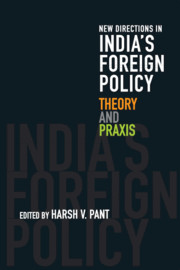
- New Directions in India's Foreign PolicyTheory and Praxis, pp. 127 - 148Publisher: Cambridge University PressPrint publication year: 2019
Accessibility standard: Unknown
Why this information is here
This section outlines the accessibility features of this content - including support for screen readers, full keyboard navigation and high-contrast display options. This may not be relevant for you.Accessibility Information
Accessibility compliance for the PDF of this book is currently unknown
and may be updated in the future.