Refine listing
Actions for selected content:
489 results in 53Cxx
COHOMOLOGY ISOMORPHISM OF SYMMETRIC POWER OF COTANGENT BUNDLE OF BALL QUOTIENT AND ITS TOROIDAL COMPACTIFICATION
- Part of
-
- Journal:
- Nagoya Mathematical Journal / Volume 261 / 2026
- Published online by Cambridge University Press:
- 11 December 2025, e1
- Print publication:
- 2026
-
- Article
-
- You have access
- Open access
- HTML
- Export citation
-
In this article, we investigate the $L^2$-Dolbeault cohomology of the symmetric power of cotangent bundles of ball quotients with finite volume, as well as their toroidal compactification. Moreover, by proving the finite dimensionality of these cohomologies, through the application of Hodge theory for complete Hermitian manifolds, we establish the existence of Hodge decomposition and Green’s operator.

On the string topology of symmetric spaces of higher rank
- Part of
-
- Journal:
- Proceedings of the Royal Society of Edinburgh. Section A: Mathematics , First View
- Published online by Cambridge University Press:
- 30 November 2025, pp. 1-43
-
- Article
-
- You have access
- Open access
- HTML
- Export citation
Pseudolimits for tangent categories with applications to equivariant algebraic and differential geometry
- Part of
-
- Journal:
- Mathematical Structures in Computer Science / Volume 35 / 2025
- Published online by Cambridge University Press:
- 27 November 2025, e33
-
- Article
-
- You have access
- Open access
- HTML
- Export citation
-
In this paper, we show that if $\mathscr{C}$ is a category and if $F\colon \mathscr{C}^{\;\textrm {op}} \to \mathfrak{Cat}$ is a pseudofunctor such that for each object $X$ of $\mathscr{C}$ the category $F(X)$ is a tangent category and for each morphism $f$ of $\mathscr{C}$ the functor $F(\,f)$ is part of a strong tangent morphism $(F(\,f),\!\,_{f}{\alpha })$ and that furthermore the natural transformations $\!\,_{f}{\alpha }$ vary pseudonaturally in $\mathscr{C}^{\;\textrm {op}}$, then there is a tangent structure on the pseudolimit $\mathbf{PC}(F)$ which is induced by the tangent structures on the categories $F(X)$ together with how they vary through the functors $F(\,f)$. We use this observation to show that the forgetful $2$-functor $\operatorname {Forget}:\mathfrak{Tan} \to \mathfrak{Cat}$ creates and preserves pseudolimits indexed by $1$-categories. As an application, this allows us to describe how equivariant descent interacts with the tangent structures on the category of smooth (real) manifolds and on various categories of (algebraic) varieties over a field.


The boundary value problem for triholomorphic maps
- Part of
-
- Journal:
- Proceedings of the Royal Society of Edinburgh. Section A: Mathematics , First View
- Published online by Cambridge University Press:
- 20 November 2025, pp. 1-29
-
- Article
- Export citation
-
We introduce a natural boundary value problem for a triholomorphic map $u$ from a compact almost hyper-Hermitian manifold $M$ with smooth boundary $\partial M$ into a closed hyperKähler manifold $N$ with free boundary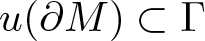 $u(\partial M)\subset \Gamma$ lying on some geometrically natural closed supporting submanifold $\Gamma\subset N$, called tri-isotropic submanifold. We establish partial regularity theory and energy quantization result in this boundary setting under some additional assumption on the $W^{2,1}$ norm of the weakly converging sequences.


Thin Gordian unlinks
- Part of
-
- Journal:
- Proceedings of the Royal Society of Edinburgh. Section A: Mathematics , First View
- Published online by Cambridge University Press:
- 19 November 2025, pp. 1-15
-
- Article
- Export citation
-
A Gordian unlink is a finite number of unknots that are not topologically linked, each with prescribed length and thickness, and that cannot be disentangled into the trivial link by an isotopy preserving length and thickness throughout. In this note, we provide the first examples of Gordian unlinks. As a consequence, we identify the existence of isotopy classes of unknots that differ from those in classical knot theory. More generally, we present a one-parameter family of Gordian unlinks with thickness ranging in $[1,2)$ and absolute curvature bounded by 1, concluding that thinner normal tubes lead to different rope geometries than those previously considered. Knots or links in the one-parameter model introduced here are called thin knots or links. When the thickness is equal to 2, we obtain the standard model for geometric knots, also called thick knots.

Generic properties of minimal surfaces
- Part of
-
- Journal:
- Proceedings of the Royal Society of Edinburgh. Section A: Mathematics , First View
- Published online by Cambridge University Press:
- 03 November 2025, pp. 1-14
-
- Article
-
- You have access
- Open access
- HTML
- Export citation
-
Let M be an open Riemann surface and $n\ge 3$ be an integer. In this paper, we establish some generic properties (in Baire category sense) in the space of all conformal minimal immersions $M\to{\mathbb{R}}^n$ endowed with the compact-open topology, pointing out that a generic such immersion is chaotic in many ways. For instance, we show that a generic conformal minimal immersion $u\colon M\to {\mathbb{R}}^n$ is non-proper, almost proper, and ${\mathfrak{g}}$-complete with respect to any given Riemannian metric ${\mathfrak{g}}$ in ${\mathbb{R}}^n$. Further, its image u(M) is dense in ${\mathbb{R}}^n$ and disjoint from ${\mathbb{Q}}^3\times {\mathbb{R}}^{n-3}$, and has infinite area, infinite total curvature, and unbounded curvature on every open set in ${\mathbb{R}}^n$. In case n = 3, we also prove that a generic conformal minimal immersion $M\to {\mathbb{R}}^3$ has infinite index of stability on every open set in ${\mathbb{R}}^3$.


Approximate control of the marked length spectrum by short geodesics
- Part of
-
- Journal:
- Ergodic Theory and Dynamical Systems , First View
- Published online by Cambridge University Press:
- 29 October 2025, pp. 1-24
-
- Article
-
- You have access
- Open access
- HTML
- Export citation
-
The marked length spectrum (MLS) of a closed negatively curved manifold $(M, g)$ is known to determine the metric g under various circumstances. We show that, in these cases, (approximate) values of the MLS on a sufficiently large finite set approximately determine the metric. Our approach is to recover the hypotheses of our main theorems in Butt [Quantative marked length spectrum rigidity. Preprint, 2022], namely, multiplicative closeness of the MLS functions on the entire set of closed geodesics of M. We use mainly dynamical tools and arguments, but take great care to show that the constants involved depend only on concrete geometric information about the given Riemannian metrics, such as the dimension, diameter and sectional curvature bounds.

Singular Kähler-Einstein metrics and RCD spaces
- Part of
-
- Journal:
- Forum of Mathematics, Pi / Volume 13 / 2025
- Published online by Cambridge University Press:
- 23 October 2025, e24
-
- Article
-
- You have access
- Open access
- HTML
- Export citation
Perturbed cone theorems for proper harmonic maps
- Part of
-
- Journal:
- Canadian Mathematical Bulletin , First View
- Published online by Cambridge University Press:
- 22 October 2025, pp. 1-18
-
- Article
-
- You have access
- Open access
- HTML
- Export citation
-
Inspired by the halfspace theorem for minimal surfaces in $\mathbb {R}^3$ of Hoffman–Meeks, the halfspace theorem of Rodriguez–Rosenberg, and the classical cone theorem of Omori in $\mathbb {R}^n$, we derive new non-existence results for proper harmonic maps into perturbed cones in $\mathbb {R}^n$, horospheres in $\mathbb {H}^n$, culminating in a generalization of Omori’s theorem in arbitrary Riemannian manifolds. The technical tool proved here extends the foliated Sampson’s maximum principle, initially developed in the first author’s Ph.D. thesis, to a non-compact setting.


Integral gradient estimates on a closed surface
- Part of
-
- Journal:
- Canadian Mathematical Bulletin , First View
- Published online by Cambridge University Press:
- 10 October 2025, pp. 1-16
-
- Article
- Export citation
-
Let $(\Sigma , g)$ be a closed Riemann surface, and let u be a weak solution to the equation where
 $$\begin{align*}- \Delta_g u = \mu, \end{align*}$$ $\mu $ is a signed Radon measure. We aim to establish $L^p$ estimates for the gradient of u that are independent of the choice of the metric g. This is particularly relevant when the complex structure approaches the boundary of the moduli space. To this end, we consider the metric $g' = e^{2u} g$ as a metric of bounded integral curvature. This metric satisfies a so-called quadratic area bound condition, which allows us to derive gradient estimates for $g'$ in local conformal coordinates. From these estimates, we obtain the desired estimates for the gradient of u.


Characterization of some convex curves on the 3-sphere
- Part of
-
- Journal:
- Proceedings of the Edinburgh Mathematical Society , First View
- Published online by Cambridge University Press:
- 06 October 2025, pp. 1-21
-
- Article
- Export citation
-
In this paper, we provide a characterization for a class of convex curves on the 3-sphere. More precisely, using a theorem that represents a locally convex curve on the 3-sphere as a pair of curves in $\mathbb S^2$, one of which is locally convexand the other is an immersion, we are able of completely characterizing a class of convex curves on the 3-sphere.

Foldable fans, cscK surfaces and local K-moduli
- Part of
-
- Article
-
- You have access
- Open access
- HTML
- Export citation
SPHERE-LIKE ISOPARAMETRIC HYPERSURFACES IN DAMEK–RICCI SPACES
- Part of
-
- Journal:
- Journal of the Institute of Mathematics of Jussieu , First View
- Published online by Cambridge University Press:
- 24 September 2025, pp. 1-33
-
- Article
-
- You have access
- Open access
- HTML
- Export citation
-
Locally harmonic manifolds are Riemannian manifolds in which small geodesic spheres are isoparametric hypersurfaces, i.e., hypersurfaces whose nearby parallel hypersurfaces are of constant mean curvature. Flat and rank one symmetric spaces are examples of harmonic manifolds. Damek–Ricci spaces are non-compact harmonic manifolds, most of which are non-symmetric. Taking the limit of an ‘inflating’ sphere through a point p in a Damek–Ricci space as the center of the sphere runs out to infinity along a geodesic half-line $\gamma $ starting from p, we get a horosphere. Similarly to spheres, horospheres are also isoparametric hypersurfaces. In this paper, we define the sphere-like hypersurfaces obtained by ‘overinflating the horospheres’ by pushing the center of the sphere beyond the point at infinity of $\gamma $ along a virtual prolongation of $\gamma $. They give a new family of isoparametric hypersurfaces in Damek–Ricci spaces connecting geodesic spheres to some of the isoparametric hypersurfaces constructed by J. C. Díaz-Ramos and M. Domínguez-Vázquez [17] in Damek–Ricci spaces. We study the geometric properties of these isoparametric hypersurfaces, in particular their homogeneity and the totally geodesic condition for their focal varieties.


On K-stability of blow-ups of weighted projective planes
- Part of
-
- Journal:
- Proceedings of the Royal Society of Edinburgh. Section A: Mathematics , First View
- Published online by Cambridge University Press:
- 29 August 2025, pp. 1-17
-
- Article
- Export citation
-
We study the K-stability of blow-ups of the weighted projective plane ${\mathbb P}(1,1,n)$, where n is a positive integer.

Alexandrov sphere theorems for $ W^{2,n} $-hypersurfaces
- Part of
-
- Journal:
- Proceedings of the Royal Society of Edinburgh. Section A: Mathematics , First View
- Published online by Cambridge University Press:
- 26 August 2025, pp. 1-49
-
- Article
-
- You have access
- Open access
- HTML
- Export citation
-
We prove that the proximal unit normal bundle of the subgraph of a $W^{2,n} $-function carries a natural structure of Legendrian cycle. This result is used to obtain an Alexandrov-type sphere theorem for hypersurfaces in $ \mathbf{R}^{n+1} $, which are locally graphs of arbitrary $W^{2,n} $-functions. We also extend the classical umbilicality theorem to $ W^{2,1} $-graphs, under the Lusin (N) condition for the graph map.


Characteristic numbers of manifold bundles over spheres and positive curvature via block bundles
- Part of
-
- Journal:
- Forum of Mathematics, Sigma / Volume 13 / 2025
- Published online by Cambridge University Press:
- 26 August 2025, e138
-
- Article
-
- You have access
- Open access
- HTML
- Export citation
-
Given a simply connected manifold M, we completely determine which rational monomial Pontryagin numbers are attained by fiber homotopy trivial M-bundles over the k-sphere, provided that k is small compared to the dimension and the connectivity of M. Furthermore, we study the vector space of rational cobordism classes represented by such bundles. We give upper and lower bounds on its dimension, and we construct manifolds for which the lower bound is attained. Our proofs are based on the classical approach to studying diffeomorphism groups via block bundles and surgery theory, and we make use of ideas developed by Krannich–Kupers–Randal-Williams.
As an application, we show the existence of elements of infinite order in the homotopy groups of the spaces of positive Ricci and positive sectional curvature, provided that M is $\operatorname {Spin}$, has a nontrivial rational Pontryagin class and admits such a metric. This is done by constructing M-bundles over spheres with nonvanishing ${\hat {\mathcal {A}}}$-genus. Furthermore, we give a vanishing theorem for generalized Morita–Miller–Mumford classes for fiber homotopy trivial bundles over spheres.
In the appendix coauthored by Jens Reinhold, we investigate which classes of the rational oriented cobordism ring contain an element that fibers over a sphere of a given dimension.


On G2-manifolds and geometry in dimensions 6 and 8
- Part of
-
- Journal:
- Glasgow Mathematical Journal , First View
- Published online by Cambridge University Press:
- 12 August 2025, pp. 1-9
-
- Article
- Export citation
-
We study the geometry induced on the local orbit spaces of Killing vector fields on (Riemannian) $G$-manifolds, with an emphasis on the cases $G=\textrm {Spin}(7)$ and $G=G_2$. Along the way, we classify the harmonic morphisms with one-dimensional fibres from $G_2$-manifolds to Einstein manifolds.


Conformally Kähler structures
- Part of
-
- Journal:
- Proceedings of the Royal Society of Edinburgh. Section A: Mathematics , First View
- Published online by Cambridge University Press:
- 11 August 2025, pp. 1-17
-
- Article
-
- You have access
- Open access
- HTML
- Export citation
-
We establish a one-to-one correspondence between Kähler metrics in a given conformal class and parallel sections of a certain vector bundle with conformally invariant connection, where the parallel sections satisfy a set of non-linear algebraic constraints that we describe. The vector bundle captures 2-form prolongations and is isomorphic to $\Lambda^3(\mathcal{T})$, where ${\mathcal{T}}$ is the tractor bundle of conformal geometry, but the resulting connection differs from the normal tractor connection by curvature terms.
Our analysis leads to a set of obstructions for a Riemannian metric to be conformal to a Kähler metric. In particular, we find an explicit algebraic condition for a Weyl tensor which must hold if there exists a conformal Killing–Yano tensor, which is a necessary condition for a metric to be conformal to Kähler. This gives an invariant characterization of algebraically special Riemannian metrics of type D in dimensions higher than four.


Maximal surfaces in the Lorentzian Heisenberg group
- Part of
-
- Journal:
- Mathematical Proceedings of the Cambridge Philosophical Society / Volume 179 / Issue 3 / November 2025
- Published online by Cambridge University Press:
- 29 July 2025, pp. 579-608
- Print publication:
- November 2025
-
- Article
- Export citation
LORENTZIAN BCV SPACES: PROPERTIES AND GEOMETRY OF THEIR SURFACES
- Part of
-
- Journal:
- Journal of the Australian Mathematical Society / Volume 119 / Issue 2 / October 2025
- Published online by Cambridge University Press:
- 25 July 2025, pp. 129-151
- Print publication:
- October 2025
-
- Article
- Export citation