

Political science and sociology are large and rapidly expanding disciplines. The number of graduate students requiring funding for degrees in political science grew by 35% from 16,445 in 2001 to 22,243 in 2005, which was more than double the rate of growth in any other discipline. By 2005, political science had the second largest number of students seeking funds in social science after psychology.Footnote 1 The number of graduate students requiring funding in sociology grew by 8% from 6,725 in 2001 to 7,234 in 2005, making sociology graduate students the fourth largest group seeking funds in social science.Footnote 2
Among political scientists and sociologists, a significant number have long conducted comparative and area studies research. Therefore, it is surprising that in recent years, despite the rapid growth in and size of their graduate programs, political science and sociology students have received a small and declining share of funding for dissertation field research. Specifically, political science and sociology students appear to be losing out to applicants from humanities-oriented fields such as anthropology, history, religion, and ethnomusicology.
Such trends are worrisome, because they undermine the influence that political science and sociology will have on future comparative and area studies research. Moreover, these trends challenge the original impetus of area studies as an interdisciplinary endeavor that spans and integrates multiple methodological approaches and theoretical premises. What explains these trends and how can we facilitate greater success in gaining funding among political science and sociology graduate students? This article draws on data from three major funders—the Department of Education's Fulbright-Hays program, the Social Science Research Council (SSRC), and the National Science Foundation (NSF)—to address these questions.
After detailing recent funding trends across disciplines, we advance two explanations for the declining share of awards won by students in political science and sociology. First, we suggest that shifts in methodological training in these two disciplines have failed to support both traditional, qualitative research designs and the increasingly popular mixed-method approaches to fieldwork. As political science and sociology departments have placed greater emphasis on training in quantitative methods, they have deemphasized training in contextual work that would include courses in language, history, culture, and area studies. This directional shift has made political science and sociology students less competitive, because their applications often fail to provide convincing evidence of their capacity and need to conduct fieldwork.
Second, we suggest that the structure of funding programs and the nature of the selection process privilege area studies and language training above methodological skills (quantitative and, in some cases, qualitative), in which political scientists and sociologists are increasingly trained. In other words, although the training in departments of political science and sociology has changed, the selection criteria for major dissertation awards have not.
As a result of these simultaneous forces, political science and sociology students who attempt to obtain funding for field research are asked to do double duty. They must satisfy their departments by investing heavily in quantitative (and sometimes qualitative) methods training, and they must satisfy funders' review committees by achieving a full mastery of area studies and language studies. Completing all of this training in two or three years of coursework stretches most students too thin.
Still, despite the present bleak reality, history has shown that students of political science and sociology have much to offer to the field of comparative international research. In particular, political scientists and sociologists have a competitive advantage in methodological training that can be used to conduct qualitative and mixed-methods research. Although mixed-methods approaches have encountered some stumbling blocks in the funding process, they offer tremendous promise for social scientific inquiry if they can integrate the rigor of contemporary social science methods with the depth of traditional area studies training.
We conclude this article by offering three recommendations to improve the quality of funding proposals, increase the share of funding awarded to political science and sociology graduate students, and ultimately reincorporate these students into international comparative research. First, departments and advisors should be more mindful of the realities of the funding process, and should provide students with the necessary area training to compete more successfully for major awards. Such training demands a deeper integration with area studies centers on campus, as well as curriculums that encourage political science and sociology students to take more courses on culture, history, and language. Second, graduate students should devote more thought to the types of research proposals that are likely to receive funding—namely, proposals that feature field research as a central element of the methodological approach and are substantially grounded in knowledge of area-specific literature and data. Finally, major funders should be more sensitive to how their selection criteria and the structure of their selection committees affect the cross-disciplinary distribution of awards.
TRENDS IN FUNDING FOR DISSERTATION FIELD RESEARCH
Drawing from data on disciplinary funding patterns for three major dissertation awards—the Fulbright-Hays Doctoral Dissertation Research Abroad (DDRA) Fellowship, the SSRC's International Dissertation Research Fellowship (IDRF), and the NSF's Doctoral Dissertation Improvement Grant (DDIG)—we identify the following trends: (1) graduate students in political science and sociology have received a small and declining share of the major awards in recent years, (2) political science and sociology students have been gradually edged out of funding by students in small humanities disciplines, and (3) the largest share of funding for dissertation field research has consistently been awarded to students in anthropology and history.
Disciplinary Shares of Funding
Figures 1a through 1c display the distributions of the three dissertation awards by discipline. Figures 1a and 1b show the percentage of Fulbright-Hays DDRA and SSRC IDRF fellowships awarded to students from various disciplines in recent years. Figure 1c displays the percentage of NSF DDIG funding awarded to students in different disciplines.Footnote 3 Although the data we present for SSRC IDRFs and Fulbright-Hays DDRAs (percentage of fellowships awarded) are not directly comparable to the data for NSF DDIGs (percentage of total funding), we suspect that the average monetary amount of SSRC IDRFs and Fulbright-Hays DDRAs tends to vary less across disciplines than the amount of NSF DDIGs. This difference may be due to the fact that a single interdisciplinary committee awards all SSRC IDRFs and Fulbright-Hays DDRAs, whereas NSF DDIGs are awarded by NSF's independent disciplinary programs, each of which employs separate standards to allocate awards.Footnote 4
Distribution of Fulbright-Hays DDRA Awards by Discipline, 2001–2006
Note: DDRA: Doctoral Dissertation Research Abroad
Source: U.S. Department of Education 2009.

Distribution of SSRC IDRF Awards by Discipline, 1997–2007
Note: SSRC: Social Science Research Council. IDRF: International Dissertation Research Fellowship.
Source: Data provided to authors by SSRC.

Distribution of NSF Funding by Discipline, 1997–2007
Note: NSF: National Science Foundation.
Source: National Science Foundation 2008. For full details regarding the procedures used to compile these data, see footnote 1.

The data presented in figures 1a through 1c present a stark picture regarding the disciplinary imbalance of dissertation field research funding. As shown in figure 1a, students in political science and sociology combined won just 8% of the 932 Fulbright-Hays DDRA fellowships awarded between 2001 and 2006, with students in political science winning 5% of the awards and students in sociology winning 3%. The annual number of Fulbright-Hays DDRAs awarded during this period ranged from 129 to 163. The annual number of awards given to political scientists during this period ranged from seven to ten, and from one to six for sociologists. Over the entire period, Fulbright-Hays funded 50 political science dissertations and 28 sociology dissertations. In contrast, Fulbright-Hays awarded a solid majority (61%) of DDRAs to students in anthropology (277 awards) and history (284 awards).
Figure 1b displays a similar pattern in the awarding of SSRC IDRFs. Between 1997 and 2007, the SSRC awarded the majority of IDRFs (53%) to students in anthropology and history, and just 20 percent to students in political science and sociology. During this period, the SSRC awarded a total of 586 IDRFs, with 166 (28%) going to anthropologists, 146 (25%) to historians, 68 (12%) to political scientists, and 45 (8%) to sociologists.
Figure 1c, on NSF DDIGs, presents further evidence of disciplinary imbalances in dissertation funding. From 1997 to 2007, the NSF awarded a little over $23.7 million to graduate students for their dissertation research. Nearly half of this funding was awarded to students in archaeology (19%), cultural anthropology (15%), and geography (15%). Students from sociology and political science were awarded roughly the same percentage of NSF dissertation funding (20%) as was awarded through SSRC IDRFs. But the relative positions of the two disciplines were reversed, with sociology winning 12% and political science 8% of funding.
Although sociology students won a higher percentage of NSF DDIGs than SSRC IDRFs, the average award size was smaller than for other disciplines. Figure 2 presents the average size of NSF DDIGs by discipline from 1988 to 2007. During this period, the average award size across all disciplines was $9,319, while the average award size for sociology was $6,484. This difference in award size reflects a decision by the sociology program to administer a large number of small awards. The NSF sociology program places an upper limit of $7,500 on its DDIGs. After the sociology program, the political science program awarded the second smallest number of NSF DDIGs, with an average award size of $8,705.Footnote 5 The NSF political science program places an upper limit of $12,000 on its DDIGs.
Average Size of NSF Grants, by Discipline, 1988–2007
Source: National Science Foundation 2008. For full details regarding the procedures used to compile these data, see footnote 1.

As a result of these upper limits, the DDIGs in these disciplines constitute an important source of dissertation funding, but they are rarely enough to fund an entire year of international field research. The same is not true of standard SSRC IDRFs and Fulbright-Hays DDRAs. The average size of an SSRC IDRF is $18,500.Footnote 6 Fulbright-Hays DDRAs are typically even more generous than the SSRC IDRFs; in 2007, the average size of a Fulbright-Hays DDRA was $32,612.Footnote 7
Trends in Disciplinary Shares
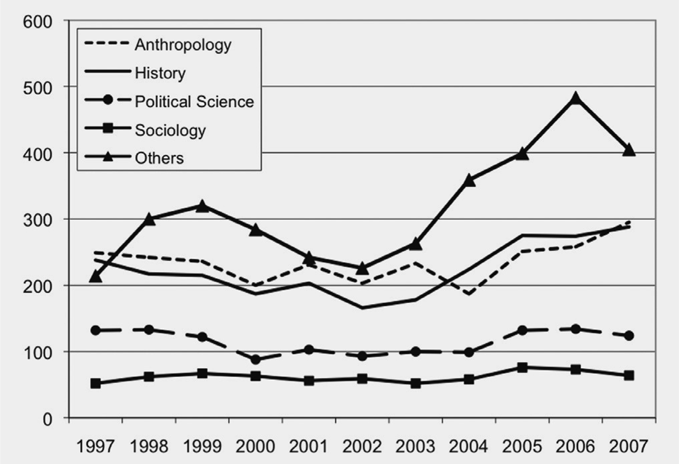
Trend data suggest that funding troubles for political science and sociology have gotten progressively worse over the last decade. We were able to obtain data on the share of funding that has accrued to various disciplines over time for the SSRC IDRF and the NSF DDIG.Footnote 8 Figures 3a and 3b present trends in SSRC IDRF applications and awards from 1997 to 2007. These figures demonstrate that although the number of political science and sociology applicants for SSRC IDRFs has remained steady since the 1990s, the number of awards granted to these students has declined. From a high of 15 awards granted in 1997, political science awards sunk to a low of just two in 2003 and three in 2007. Similarly, since 2000, no more than five SSRC IDRFs have been awarded to sociologists in any given year, and in 2006, the SSRC awarded just one IDRF to a sociologist.Footnote 9
Number of SSRC IDRF Applications in Four Disciplines, 1997–2007
Note: SSRC: Social Science Research Council, IDRF: International Dissertation Research Fellowship. Data provided to authors by SSRC.
Percentage of SSRC IDRFs Won by Four Disciplines, 1997–2007
Note: SSRC: Social Science Research Council, IDRF: International Dissertation Research Fellowship. Data provided to authors by SSRC.

Relative to the SSRC IDRFs, data on the NSF DDIGs present a slightly more optimistic outlook for political science and sociology students in terms of how the interdisciplinary share of awards is trending. Figure 4 displays the percentage of total NSF DDIG funding awarded between 1988 and 2007 to major disciplines, which we define as those winning $1 million or more in funding during this period. During the 1990s, political science and sociology increased their share of NSF DDIG funding. However, this trend leveled off in the late 1990s, and during the current decade, sociology's share of funding has resumed its decline.
Percentage of NSF Funding Awarded to Major Disciplines, 1988–2007
Note: NSF: National Science Foundation.
Source: National Science Foundation 2008. For details, see footnote 1.

It is important to note that political science and sociology students started from a low base of support and have been chronically underfunded (both numerically and financially) relative to students in other disciplines. As figure 4 illustrates, the share of NSF DDIG funding allotted to several other major disciplines—namely, archaeology and physical anthropology—has declined since 1990. Nevertheless, these and other major disciplines continue to enjoy a larger share of NSF DDIG funding than do political science and sociology. In 2007, the NSF awarded 20% of DDIG funding to cultural anthropology, 17% to archaeology, and 15% to geography. In comparison, in the same year, only 11% of DDIG funding was awarded to political science, and only 9% to sociology.
Figure 5 displays trends in the average number of NSF DDIGs awarded to major disciplines from 1988 to 2007. During this period, political science students received slightly less than the average number of awards. Sociology students received more than the average number, but, as noted previously, sociology awards tend to be smaller than the average NSF DDIGs in other disciplines. In addition to their large share of NSF DDIG funding (see figure 4), the cultural anthropology, archaeology, and geography programs consistently awarded more than the average number of DDIGs during this period.
Number of NSF Grants Awarded to Major Disciplines, 1988–2007
Note: NSF: National Science Foundation.
Source: National Science Foundation 2008. For details, see footnote 1.

New Sources of Disciplinary Competition
Figures 3a, 3b, 4, and 5 highlight a recent trend in interdisciplinary competition for dissertation funding—namely, the increasing number of applications from and support for smaller disciplines, including musicology, religion, linguistics, geography, and environmental science (disciplines represented by the “other” category in these figures). The data on SSRC IDRF and NSF DDIG awards show that the rise in applications from and awards to these smaller disciplines correlates with the declining share of funding for political science and sociology. At the same time, other disciplines do not appear to have suffered as a result of this new competition. For example, history and anthropology have maintained a consistent share of IDRFs, and economics and law have increased their shares of NSF DDIG funding in recent years.
Disciplinary Success Rates
The most useful measure for the examination of disciplinary shares of funding is the disciplinary success rate, defined as the number of awards granted by a discipline divided by the number of applications received by that discipline. Using data on success rates for SSRC IDRFs and for comparative politics awards as a subset of NSF DDIG awards,Footnote 10 we found that sociology and political science graduate students, and comparativists in particular, have a much better chance of success in applying for NSF DDIGs rather than SSRC IDRFs.
Figure 6 displays IDRF success rates between 1997 and 2007 for anthropology, history, sociology, political science, and “other” disciplines in relation to the average success rates for all disciplines. Although history and anthropology have maintained success rates above the average for all disciplines in recent years, political science and sociology have fallen below the average. During the 2000s, success rates for history and sociology varied between 4% and 8%, and rates for political science varied between 2% and 4%. Although sociology maintained a relatively high success rate until 2003, it declined thereafter, falling below 2% in 2006 and returning to the average of 4% in 2007.
IDRF Success Rates across Disciplines, 1997–2007
Note: IDRF: International Dissertation Research Fellowship. Data provided to authors by the Social Sciences Research Council.

Table 1 presents success rates for NSF DDIG applications in comparative politics. The average success rate for comparativist applications for NSF DDIGs (29%) is much higher than the success rate for all political science applications for SSRC IDRFs (5%). Comparing figure 3 with table 1, we see that the number of comparativist applications for NSF DDIGs is between one third and one half of the number of political science applications for IDRFs. Yet, the annual number of NSF DDIGs awarded to students proposing research in the field of comparative politics (between 7 and 20) is much higher than the annual number of political science SSRC IDRFs awarded during the same period.Footnote 11
NSF Comparative Politics Doctoral Dissertation Improvement Grant Applications, Awards, and Success Rates, 2002–2007

Note: NSF: National Science Foundation.
Source: National Science Foundation 2008.
EXPLAINING THE TRENDS
What explains these unfavorable trends in dissertation field research funding for political science and sociology? Are not enough qualified political scientists and sociologists applying for these awards? Or are these trends evidence of a structural bias against political science and sociology? In the following discussion, we suggest that both these dynamics may be at work.
Training in Political Science and Sociology
One of the most important reasons for lower success rates in dissertation funding among political science and sociology students is that methodological shifts in both disciplines have complicated efforts to train the next generation of comparative and area scholars. Increased training in quantitative (and sometimes qualitative) research methodology has virtually replaced training in area studies and language, which in turn has hurt the quality of funding applications from these disciplines.
Much has been written and said about the recent retreat from qualitative and interpretive fieldwork and the rising prevalence of quantitative analysis in political science and sociology. On one hand, our data confirm that, relative to other disciplines, a smaller percentage of political scientists and sociologists apply for dissertation fieldwork funding. This finding may be attributable to the disproportionate focus on quantitative research and the subsequent smaller demand for qualitative research that requires fieldwork in both disciplines. On the other hand, figure 3a and table 2 show that a stable number of SSRC IDRF and NSF DDIG applications have come from political science and sociology students since the late 1990s. The constant demand for fieldwork funding suggests that the growing focus on quantitative research cannot fully explain the decline in awards to political scientists and sociologists.
Composition of IDRF Selection Committee

Note: IDRF: International Dissertation Research Fellowship. Data from Social Sciences Research Council 2008.
Despite the rising dominance of quantitative research in sociology and political science, interest in international, qualitative, contextual work remains extant in both disciplines. Although sociology has historically been weak in the area of internationally-oriented research, contextual analyses and qualitative methods still occupy an important space on the discipline's research stage. Even quantitative studies in sociology are increasingly incorporating national or regional contexts into their analyses. Moreover, in line with the field's increasing emphasis on economic and cultural globalization, sociologists are displaying an increasing interest in non-U.S. locations. Among political scientists, an international focus has long constituted the bedrock of respected works in comparative politics and international relations. In recent years, scholars of comparative politics have launched vigorous debates over the place of qualitative methods in the subfield. Evidence of these debates can be found in the “perestroika” movement against the increasing dominance of quantitative methods in political science, and in the proliferation of qualitative methods workshops and training seminars.
The simultaneous trends of an increased focus on quantitative analyses and a continuing interest in qualitative, contextual, international work has not only provided a window of opportunity for the growth of traditional qualitative research, but has also given rise to a new, popular hybrid—the mixed-methods approach to fieldwork in both disciplines. In the spirit of this new methodological pluralism, the next generation of scholars in political science and sociology is being encouraged to combine their interest in international research with the scientific rigor associated with rational choice approaches and enhanced qualitative and quantitative methods training. Why have these popular mixed-methods approaches, along with the improved rigor of qualitative research, not translated into greater success for political scientists and sociologists in interdisciplinary competitions for fieldwork funding?
One possibility is that applicants employing either qualitative or mixed-methods approaches fail to pay adequate attention to the contextual component of their research design, which requires area studies and language training.Footnote 12 Specifically, our discussions with grant reviewers and administrators from all three funders revealed that students of political science and sociology often fail to provide enough evidence of their need and capacity to conduct fieldwork. For example, students often fail to detail and justify the type of fieldwork they intend to pursue, thereby indicating a lack of training in conducting fieldwork and understanding its inherent constraints and challenges. Additionally, students tend to submit proposals in which fieldwork is secondary to the analysis of an existing dataset or the construction of a large-N dataset that does not require fieldwork. In other words, the concern is that fieldwork is used merely to add some local flavor to a regression analysis, and such proposals are unlikely to succeed in competition with proposals that incorporate fieldwork as the core element of the research strategy.
The failure to justify the need for fieldwork and convince reviewers of applicants' capacity to conduct it may largely be due to graduate training in political science and sociology. In recent years, departments have added rigorous quantitative methods requirements to their graduate programs. Our review of 20 high-ranking graduate programs both in political science and in sociology found that all 40 programs currently have robust quantitative methods requirements.Footnote 13 Some programs have also begun adding options for qualitative methods courses. These requirements have taken scarce student time and resources away from training in language and area studies, as well as international field visits.
At the same time, graduate programs in sociology and political science have been reducing their requirements for area and language training. Out of the 20 graduate programs in sociology we investigated, we found that only two had a language requirement.Footnote 14 Of the top 20 graduate programs in political science, only three require all students to demonstrate proficiency in a foreign language.Footnote 15 Four programs require graduate students to learn a language if it is essential for their research,Footnote 16 or if a student's major field is comparative politics.Footnote 17 The majority of programs in both disciplines allow students to choose between a methods or a language requirement, permit methods courses to be substituted for a language requirement, or have no language requirement at all. In contrast, the top 20 programs in anthropology and history all have demanding language requirements.
This tradeoff between quantitative (and sometimes qualitative) methods courses versus language and area training in political science and sociology helps explain the paucity of applications for dissertation field research funding and their low success rates. Relative to other disciplines, few students in political science and sociology apply for fieldwork funding, because area studies and language training are not encouraged or supported by their departments. The applications of the few students who do apply often suffer from an inability to justify the need for fieldwork, detail the type of fieldwork they intend to pursue, or defend their capacity to conduct fieldwork.
Increased training in area-specific history, culture, and language is essential for reversing these deficiencies. It is no surprise, therefore, that the programs in political science whose students have the greatest success in fellowship competitions are those programs that have the closest integration with area studies programs. For example, the University of California, Berkeley, which has obtained 14 SSRC IDRFs since 1997 (more than double the number of any other school), offers a separate area studies subfield dedicated to providing political science graduate students with area studies training. Similarly, Cornell University's government department (seven SSRC IDRFs) and Northwestern University's political science department (six SSRC IDRFs) have strong links to area studies centers and encourage students to take courses with area studies content.
The Review Process
The second reason for low success rates in dissertation funding among political science and sociology students is that the structure of the review process can emphasize the weaknesses of political science and sociology graduate students. To a large extent, the success rates of political science and sociology graduate students are inversely proportional to the emphasis that funders' selection criteria place on the area studies and language training that political science and sociology programs have begun to deemphasize. The NSF, through which political science and sociology graduate students have had the most success, demands little in terms of formal area studies training for its applicants. The SSRC, through which political scientists and sociologists have had moderate success, places a heavier emphasis on the evaluation of the applicant's preparedness for field research and requires the applicant to submit a language evaluation if a foreign language is required to carry out the research. Finally, the Fulbright-Hays DDRA program, from which political science and sociology graduate students win only a handful of awards each year, places the largest weight on the applicant's area studies and language background. In fact, 65 out of 105 potential points on the Fulbright-Hays reviewer's scoring sheet are awarded on the basis of area studies and language training.Footnote 18
In some cases, the formal emphasis on area studies and language training is a function of program structure. For example, the Mellon Foundation, which funds the SSRC IDRF, explicitly asks SSRC to increase participation from humanities disciplines, which privilege area studies and language training. In addition, a formal emphasis on area studies and language training may be amplified by the structure and composition of selection committees, particularly the interdisciplinary selection committees of the SSRC IDRF and Fulbright-Hays DDRAs. These committees tend to be dominated by disciplines that favor a traditional area studies approach over social scientific inquiry. In the case of SSRC, balancing selection committees by discipline is not a primary consideration; rather, selection committees are composed to reflect regional, as well as disciplinary, expertise.
Table 2 details the composition of IDRF final selection committees, which the SSRC makes public.Footnote 19 In a given year, final SSRC IDRF committees consist of 14 to 16 faculty members from various disciplines. In most years, political science and sociology have been represented by just one or two members, and, together, these disciplines have never formed a majority on the committee. Moreover, representation by political scientists and sociologists has declined over time. By contrast, historians and anthropologists routinely have three or more representatives each on the committee. Six historians sat on a 14-person and a 16-person committee in 2000 and 2001, respectively. Together, historians, anthropologists, and area studies faculty regularly constitute a majority of members on the committee.
To some extent, the overrepresentation of the anthropology and history disciplines on final SSRC IDRF selection committees may be justified by the higher number of applications received from these disciplines. At the same time, such overrepresentation may lead the committees to privilege research methodologies and approaches favored in anthropology and history, even when committee members from anthropology and history are evaluating proposals from other disciplines. This tendency might explain the higher success rate of small, humanities-oriented disciplines, which train students to conduct research in ways that are similar to approaches used in anthropology and history, and the simultaneous decline in funding for political science and sociology, which emphasize methods training over area studies and language training.
The structure of SSRC and Fulbright-Hays selection committees contrasts with that of the NSF DDIG, which separates committees by discipline. A potential downside to discipline-specific committees is that minority voices within each discipline (e.g., ethnographers in political science) may receive poor representation on the committees. In our discussions with funding reviewers and administrators, reviewers of both NSF DDIGs and SSRC IDRFs noted that they had experienced this problem.Footnote 20 In the case of SSRC IDRFs, although final selection committees are interdisciplinary, first-tier committees are discipline-specific. SSRC IDRF reviewers from political science argued that first-tier reviewers from political science often provided low scores for their own applicants, because the reviewers themselves did not understand or privilege ethnographic fieldwork.
At the same time, an important benefit to the stand-alone committee system is that it protects the diversity of discipline-specific approaches to social scientific inquiry. By allowing for greater variation in the selection criteria employed by various disciplines, NSF's stand-alone structure ensures that the best applicants—as judged by the standards of each discipline—are selected for NSF DDIG awards. Additionally, employing separate programs and committees ensures that each discipline can respond effectively to the demand from its graduate students for dissertation field research funding. These benefits are evidenced by the high success rates, noted in the previous section, of political and sociology graduate students who apply for the NSF DDIG.
HOW CAN POLITICAL SCIENCE AND SOCIOLOGY STUDENTS INCREASE THEIR SHARE OF FUNDING?
The trends in dissertation funding outlined in this paper are troubling, and it is important for social science and area studies to address them. Robust funding for political science and sociology graduate students is critical if these two disciplines are to build on their legacy of important contributions to comparative and international research. If the decline in funding for political science and sociology continues, both area studies and social science will lose out on the benefits of interdisciplinary debate across theoretical premises, approaches, and methodologies. It was these benefits, after all, that formed the original justification for area studies programs and interdisciplinary programs like the SSRC IDRF and the Fulbright-Hays DDRA.
Reversing these trends will require action on all sides—by faculty and graduate students in political science and sociology, as well as by funders. With regard to the demand for funding and the quality of applications, faculty and students of political science and sociology must rebalance their disciplines through better area, history, and language training. Ideally, this would involve better integration of these disciplines with area studies centers on campus. In cases in which area studies centers do not exist, individual departments must place greater emphasis on improved training in contextual work. Before applying for dissertation field research funding, students must attain strong language training and conduct preliminary fieldwork in their country of interest. Once in graduate school, students should apply for predissertation fellowships that can enable them to visit their country of interest, make local contacts, and explore local contexts—all of which should be detailed in their fellowship applications. To do this and manage the existing pressures of required graduate coursework, students should use the summer before entering graduate school to undertake more extensive area studies training. Students interested in comparative research might also consider working in their country of interest or completing a master's degree in history or area studies prior to starting a Ph.D. program in political science or sociology. Graduate programs should consider weighing, more heavily than they currently do, area studies training as an admissions qualification for students wanting to write dissertations that feature comparative and international research. Such efforts will enable political science and sociology students to write funding applications that display evidence of their awareness of how to conduct fieldwork and their capacity to do it.
Second, faculty and students of political science and sociology must provide clearer justifications for the need for fieldwork in their applications. This is especially true for research proposals using mixed-methods approaches, for which the simple recipe of “add fieldwork and stir” has proven unsuccessful. By placing field research at the core of their research designs, students employing mixed-methods approaches can better use their comparative advantage in methodological training (both qualitative and quantitative) to make important contributions to area studies. For example, rather than proposing a handful of exploratory interviews or short narratives to frame a quantitative analysis that is primarily based on existing data, a student might propose original data collection through a new survey that requires field presence, participant observation, or in-depth interviews to extend or falsify existing theory. In other words, the problem with the current mixed-methods approach is not that it embraces a data-intensive approach to social scientific inquiry, but that it embraces a data-intensive approach that is divorced from the field and fails to make an original contribution to area-specific research.
With regard to the supply of funds, funders should examine the impact and structure of their selection committees to avoid disadvantaging particular approaches or disciplines. Fulbright-Hays and the SSRC have displayed a strong and impressive commitment to a diversity of disciplines and approaches, but this commitment has been challenged by the tendency of interdisciplinary selection committees to privilege traditional area studies approaches to social scientific inquiry. As well, greater transparency regarding funders' success rates by discipline would help members of the scientific community measure and hopefully improve the relative success of their own disciplines.
These recommendations offer a first step toward reversing the worrisome imbalances that currently mark dissertation funding trends. Political scientists and sociologists must work harder to meet funders' high area studies standards. At the same time, funders must reestablish a balance in supporting research approaches from both ends of the methodological spectrum. It is only with such increased attention and effort that political scientists and sociologists can remain key contributors to the important study of areas outside of the United States.



